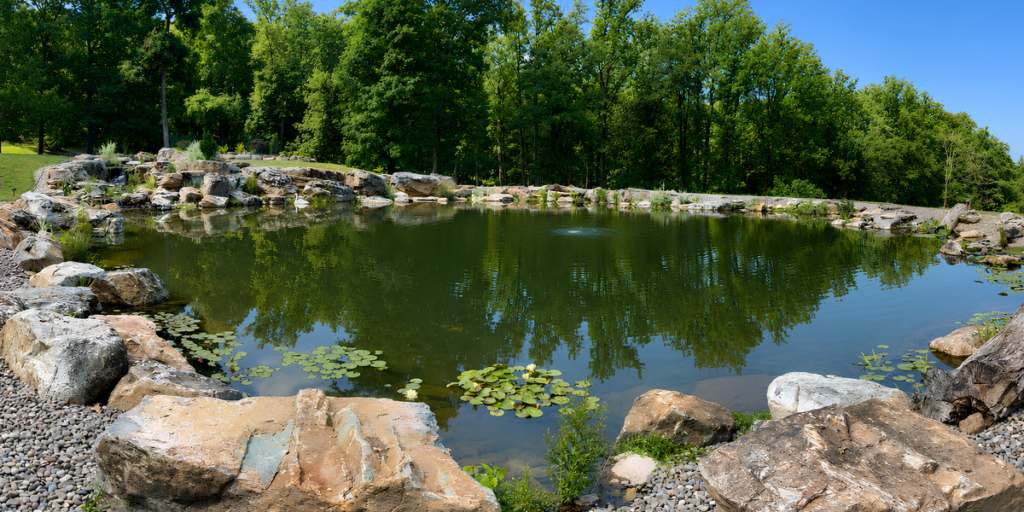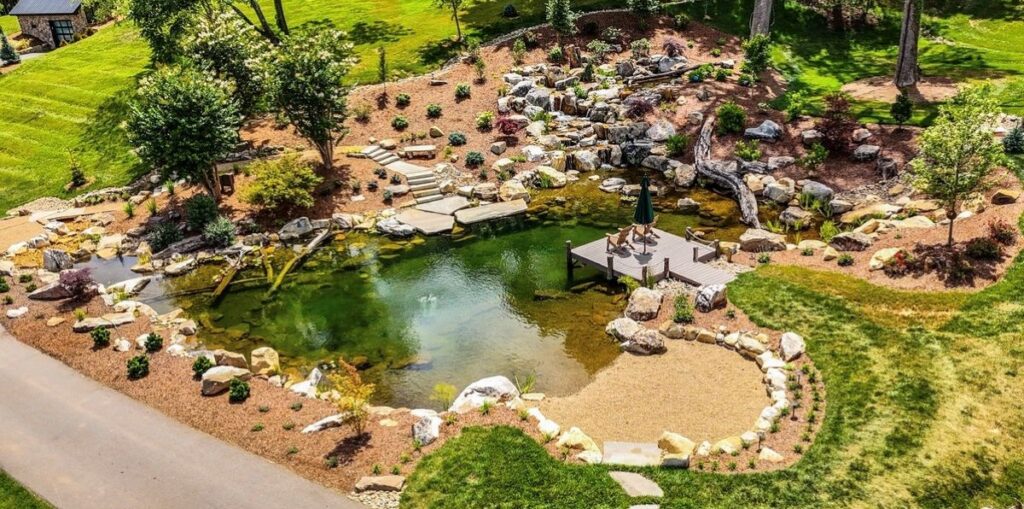
One year after an ambitious quarter-million-gallon pond build, mature plantings, clear water and a new generation of koi reveal the project’s true character.
When the last boulder was set and the water first began to move through Sasha Vaynerchuk’s newly transformed backyard pond, the scale of the project was impossible to miss. A collaboration among some of the pond industry’s most accomplished contractors had turned a chronically muddy body of water into a quarter-million-gallon recreation pond anchored by massive stone, a sweeping waterfall and a carefully engineered wetland filtration system.

But a pond of this kind is never truly finished on the day construction ends. Stone establishes the framework; water begins the process. Plants must root, fish must settle in and the surrounding landscape must gradually soften the edges. Nearly a year after the original build, the pond has entered that next chapter, and in many ways, it is now showing what the project was always intended to become.
The once-new feature has grown into its setting. Greenery now spills between boulders, flowering plants punctuate the shoreline and koi move through water clear enough to reveal fish far below the surface. Even more telling, the pond has supported a successful spawn. Roughly 100 baby koi have been observed darting among the larger fish, finding refuge within rockwork, fish caves, planted margins and the pond’s varied shoreline.
What began as an extraordinary construction project has become a living ecosystem.
Planting for Beauty and for the Real World
The planting plan began at Fitz’s Fish Ponds’ Saddle River location, where Emily Lane and Tom Swinarsky met with Sasha in the Hardy Greenhouse. Surrounded by hundreds of marginal pond plants, they worked through dozens of possibilities, considering far more than color alone. Growth habits, mature size and cold hardiness all mattered. Sasha wanted varieties capable of surviving New Jersey winters and returning stronger each summer, allowing the landscape to become fuller and more established with every season.
There was also a less glamorous, but essential, consideration: wildlife. Deer are drawn to the sound and availability of the water, and once they arrive for a drink, lilies and other tender plants can quickly become part of the menu. Geese, koi and other visitors create their own pressures. The planting team therefore had to balance beauty with durability, choosing less appealing varieties where possible and positioning more vulnerable plants where animals would have difficulty reaching them.
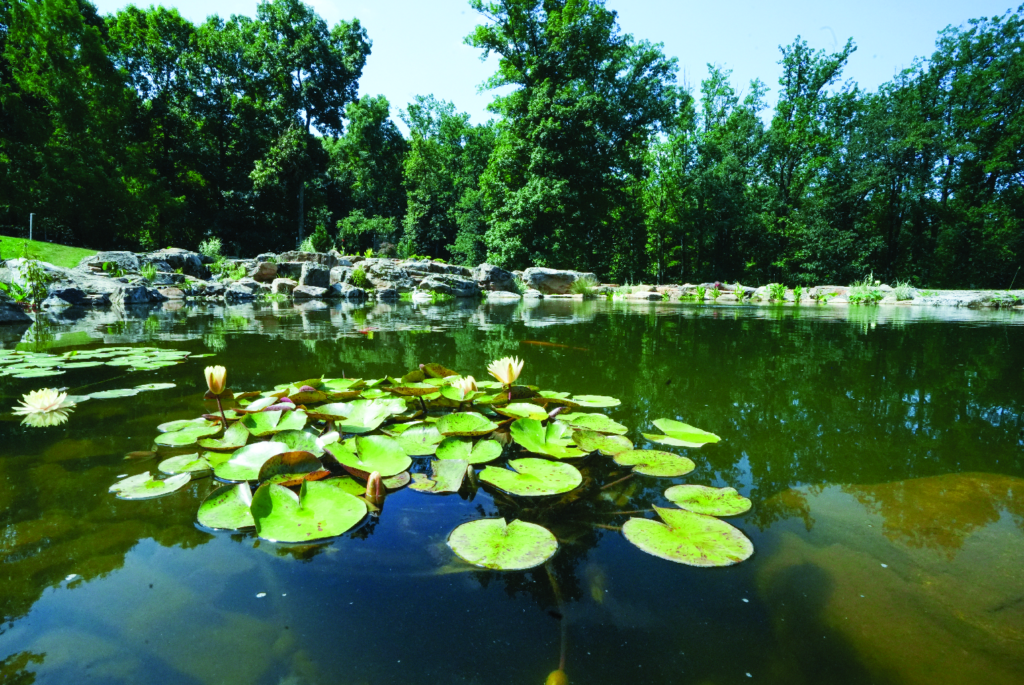
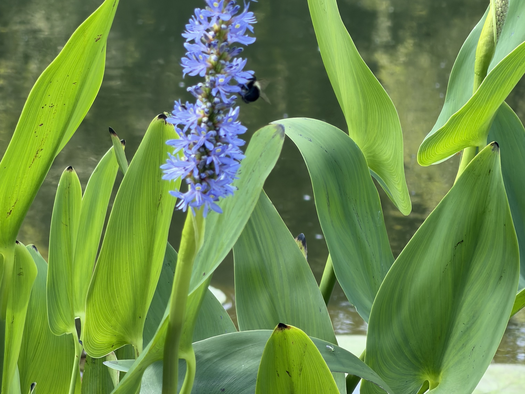
The final palette is broad and intentionally layered. Several varieties of water lilies and lotus bring flowers to the open water, while tall marginals give height and structure. Lower-growing plants creep around the edges, helping blur the transition between pond and landscape. The mix includes noninvasive yellow iris, monkeyflower, moneywort, forget-me-nots, hardy water canna, scarlet rose mallow, several rush varieties, four-leaf clover, golden creeping Jenny and reeds. Forget-me-nots appear both in the pond and in the surrounding beds, visually tying the aquatic and terrestrial landscapes together.
Tropical Plants Require a Different Maintenance Plan
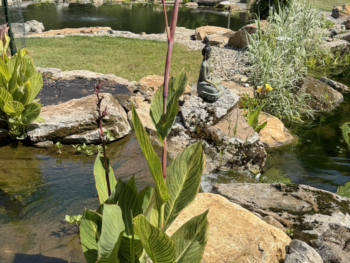
Tropical plants were added selectively to extend the bloom season. These plants provide late-season color but require a different maintenance plan: before winter, they will be lifted and returned to the greenhouses. Hardy varieties will remain in place, where their root systems can continue to establish and return with greater vigor the following year.
The result is more than ornamental. The plants attract pollinators, contribute to natural filtration, help stabilize the pond’s margins and, in certain cases, add oxygen to the water. Together they demonstrate the central idea behind the follow-up phase of the project: beauty and function do not have to compete.
How the Pond Looks and Performs
One of the original project’s defining challenges remains central to how the pond looks and performs. Its water level is not fixed. The pond is supplied by rainfall and runoff from a nearby stream, so its elevation can change dramatically between wet and dry periods—at times by several feet.
Designing for a Pond That Rises and Falls
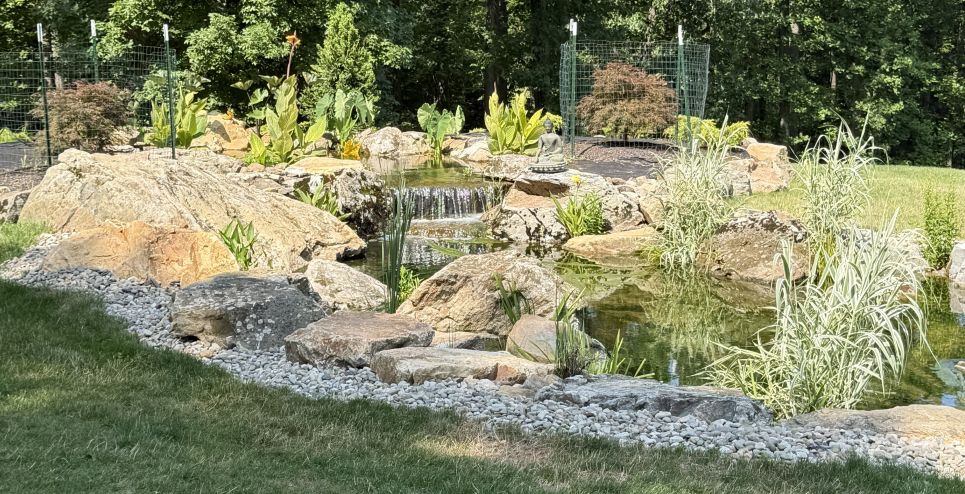
That fluctuation shaped the coping from the beginning. Instead of building an edge that appears finished at only one precise waterline, the team used large stones, gravel, logs and driftwood to create a broad, natural transition. When the water recedes, the exposed shoreline still feels intentional. When it rises, additional stones become submerged and the pond takes on a fuller character without losing the integrity of its edge treatment.
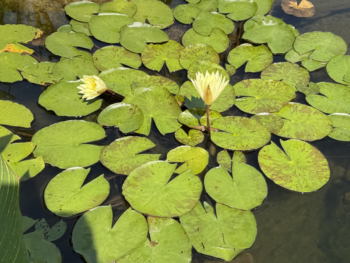
The new plantings reinforce that adaptability. Patches of pickerel rush and water lilies soften the coping, while lotus, canna and horsetail rush occupy different elevations around the pond. As the hardy plants establish themselves in the soil, they will be better equipped to tolerate changing moisture conditions. The landscape can respond to a rainy season or a drought without appearing unfinished in either one.
The skimming system required the same kind of flexibility. Because the pond may sit roughly a foot higher or lower than its typical level, the skimmer was installed lower in the feature than it would be in a conventional pond. Its placement and disguise demanded creative engineering, including faux-rock covers that allow the mechanical components to disappear into the natural setting. Atlantic-Oase supplied the products used throughout the build, with team members Demi, Jeff and Tyler contributing hands-on support to help solve these unusual conditions.
Small Changes That Make the Vaynerchuk’s Pond More Livable
A year of use has also revealed opportunities to refine how people move through and experience the space. Stepping stones are being added through the lower bog so Sasha can cross the water more comfortably and reach the opposite side. The original stones were spaced too far apart for an easy walk; the added pieces will make the wetland area both more accessible and more interactive.
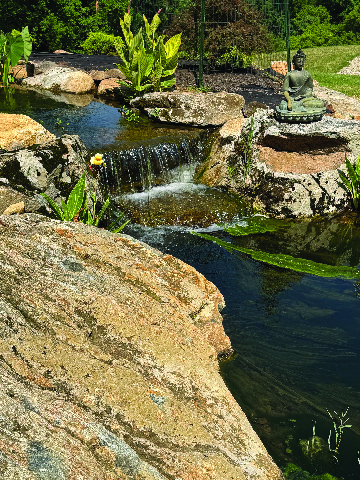
The bog itself has developed into one of the pond’s most engaging zones. Two planted groupings sit near the upper portion and two more anchor the lower area, preserving a clean sightline from the home’s front door down through the bog. Water, bits of plant material and small natural food sources—including mosquito larvae—travel over the falls and collect near the base. The koi have learned to gather there, waiting for whatever the current delivers.
That behavior is a small but satisfying sign that the feature is no longer simply a designed landscape. The fish are reading it as habitat.
From Property Stones to a Sense of Place
The maturing plants have also brought renewed attention to the project’s most distinctive materials. Nearly every major stone used in the pond was harvested from the woods on the property. During construction, a crew extracted and moved boulders while Sasha—who has lived there for nearly three decades and knows the woods intimately—identified individual stones he wanted incorporated into the design.
Some are the size of small cars. They form the waterfall, retain changes in elevation and give the shoreline a scale appropriate to the pond. Others were used more quietly, creating ledges, hiding areas and natural transitions. Driftwood and logs collected from the property add another layer of authenticity. Nothing feels imported into the setting; the pond appears to have emerged from the land around it.
A newly placed boulder near the lower bog continues that approach. It is another example of the project evolving after the main construction phase—not through a wholesale redesign, but through careful additions that strengthen the original vision.
A Clear Measure of Success
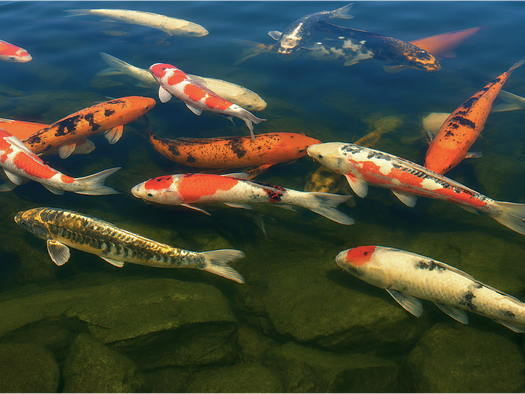
Before the renovation, the existing pond had been an eyesore for years: a muddy, opaque basin described as looking like chocolate milk. Today, the water is clear enough to see 10 to 15 feet down when the sunlight and viewing angle cooperate. Large koi glide across the open areas, while their offspring gather among the rockwork and planted edges.
The baby koi may be the most convincing measure of the pond’s progress. The varied shoreline gives spawning fish multiple types of cover, while fish caves and spaces between rocks provide protection for fry. The bog and plantings contribute to water quality and create a web of small food sources.
In a lighthearted sense, Sasha has become a koi farmer—but the successful spawn also indicates that the pond is doing what a well-designed ecosystem should do: supporting life at multiple stages.
Recreation Pond Draws the Family Outside
The pond continues to serve its other purpose as well. Built as a recreation pond, it invites people into the water in a way a conventional ornamental pond may not. More importantly, it has drawn the family outdoors. Sasha, Gary and their relatives have gathered beside it, watched the fish and enjoyed a part of the property that had previously been a persistent problem.
That may be the most meaningful transformation of all. The waterfall is still the first feature visitors see when they enter the driveway, and the immense boulders still provide an undeniable sense of drama. Yet the pond’s success is now found just as much in quieter details: flowers returning for another season, koi waiting below a waterfall, young fish sheltering between stones and a family spending time at the water’s edge.
One year later, the project is no longer defined only by how it was built. It is defined by how it lives—and it is just getting started.