The pond hobby’s gateway drug or valid small-space alternative?
The backyard pond, with its beauty and tranquility, is on the wish list of many a homeowner. But the required space, excavation, upkeep and expense drives many away from this dream. And what of those in apartments with just a window, or a condo/townhome with just a deck? Most pond supply retailers may not consider these as potential customers to visit a pond store. But they are untapped potential and can enjoy a pond on a very small scale.
“Nano” has been a trend across consumer products for the past decade. Even in the related aquarium hobby, “nano” tanks and smaller fish and shrimp are all the rage now.
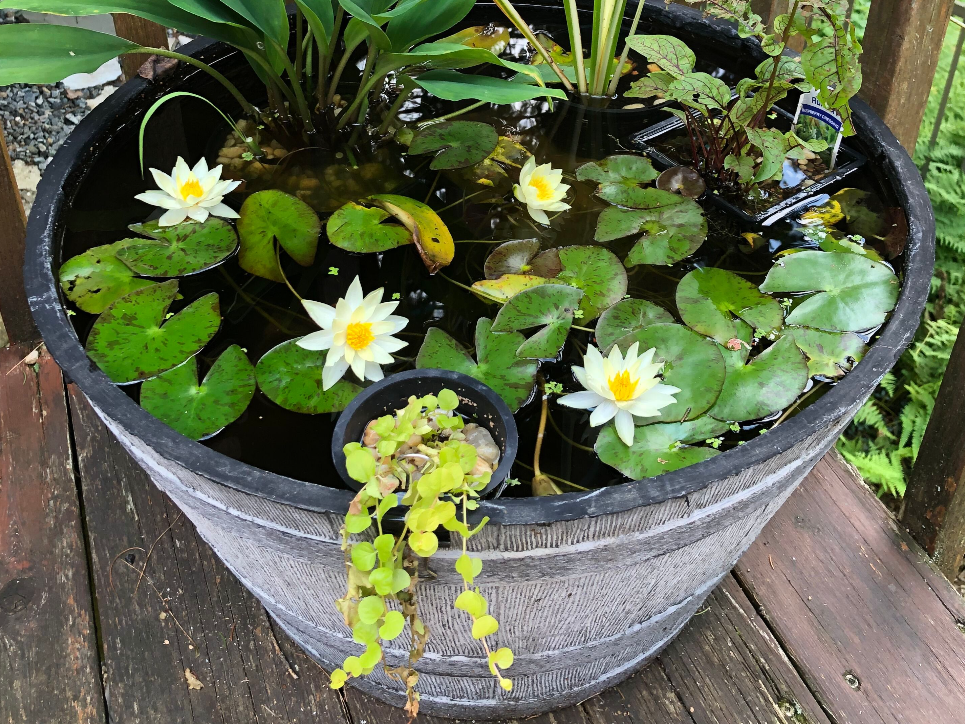
In the pond hobby there is an easy alternative to the traditional pond: the free-standing container water garden or “tub pond.” Many retailers have set up displays of indoor setups with LEDs, from misting floor models to tiny tabletop designs by Aquascapes. There are also outdoor formal tubs that have been popular with aquarists since this author began “evangelizing” the practice of “taking your fish outside” in print and club programs decades ago. Practical DIY free-standing inserts from Beckett and MacCourt were available off the shelf at Lowe’s and Home Depot up until a couple of years ago, now by special order on their websites. At the premium end of the price spectrum, more stylized “patio ponds” with water features are offered from various vendors and on Amazon. Agricultural stock tanks from farm supply dealers have been turned into free-standing ponds ranging from 25 to 600 gallons.
Benefits of Tub Ponds
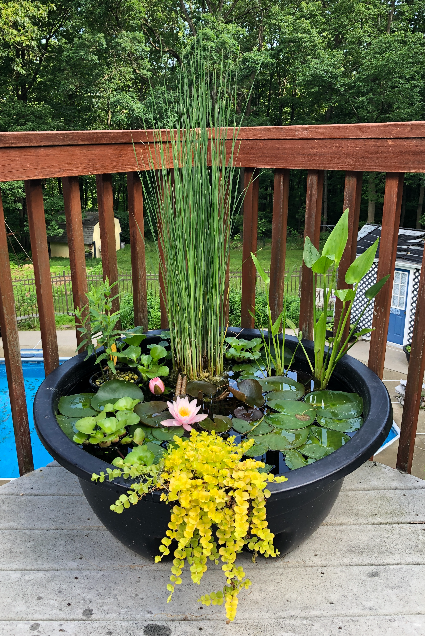
A free-standing tub pond, or patio pond, is not just an alternative to a larger in-ground. They have benefits over traditional ponds:
Ability to smell the flowers and taste the nectars of plants like waterlilies.
Observe insects and aquatic life up close.
Bring a slice of the aquatic world to more places in your living space: from your kitchen counter to by a chair on your deck.
Marketing tub and patio ponds to the consumer who has not considered these as a possibility for their living space requires new messaging. In my water gardening programs and lectures, I always mention the late great Greg Speichert’s quote: “Water gardening is for the gardening impaired: you cannot fail!” You cannot over or under water a marginal aquatic or bog plant — they self-regulate. You can even grow them in plain pea gravel and perforated baskets, using the new PondTabb Jr. fertilizer (1/5 the concentration of the standard tablets). “Black-thumb gardening” and “no-soil approach” can be marketing messages to a new demographic who want to garden but either lack the confidence nor want to get their hands too dirty.
Then there are fishes. A trepidation for some consumers, but one that should be encouraged due to the activity and interest they provide. It should be mentioned that fishes are not required for container or patio ponds. But they do devour insect larvae and help fertilize the plants. And by not including the classic goldfish or koi, maintenance is very easy. Little to no feeding is required for small tropical and temperate fishes available in pet stores, as insect larvae, microorganisms and algae are in abundance for such small bellies (although I find feeding a little flake food every day does wonders for the plants). Indeed, if the customer goes this route — no mechanical filtration nor aeration is required! None of my 30-plus free-standing tub ponds have mechanical aeration or water features, except for one shaded tub with fancy goldfish and sponge filter.
Probably the biggest concern I hear from interested water gardeners and “non-ponders” is “won’t this attract mosquitoes.” Yes it will. And that’s a good thing, because your tub pond will help control mosquitoes on your property. A female mosquito has a set number of eggs to deposit in standing water each evening. Most likely this will be in the gutters on houses in your neighborhood, where they will eventually hatch and start biting. But if they deposit their clutch in a patio pond, their progeny will not see the light of day. In the 30-plus tub ponds I maintain, there is ZERO mosquito larvae. The egg rafts are eaten the next day by my fishes. As an unnecessary redundancy, 1/4 to 1/2 of a mosquito dunk (depending on tub size) once month can be added.
Location, Location, Location
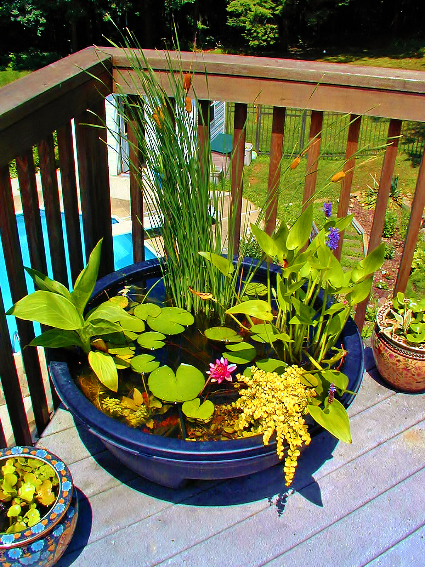
The variety only requires a few hours of sunlight to flower.
How should you get started with container ponding? Success boils down to two key considerations: expected temperature and light. The primary way to manage these is deciding where to situate your tub. The most successful, low-maintenance tub pond is one located in that “sweet spot” that grows and flowers your plants, filters your water and warms your fishes — but not so much that it overheats or propagates excessive algae. Note I am referring to free-standing containers here. Sunken tubs are my least favorite. Getting on my stomach to smell the flowers, search for fry and observe is not enjoyable. Leave inground ponds for koi and goldfish viewing.
Temperature impacts oxygen levels (cooler water holds more). You manage this by (1) sticking with small fishes, (2) choosing a location and surface covering plants so water temperatures do not exceed 90 F for most of the daylight hours and (3) selecting a tub with at least 15-inch depth.
Light via solar radiation is the engine that powers your tub’s natural filtration system. Plants and bacteria take up nitrogenous wastes and other dissolved organic compounds (DOC) as fuel, creating food sources for a variety of tub life. At least six hours full sun will support the widest selection of plants and create adequate vegetative filtration, while ensuring your tub warms sufficiently during the day. More light is better to maximize flowering and improve filtration. Midday sun is the hottest and brightest, but a photoperiod of morning and late afternoon can suffice and prevent overheating in warm climates. Do not despair if you cannot provide this much full sun. I maintain several container ponds in shadier locations using appropriate plants such as Lizard Tail, Royal Fern, Iris pseudocorus, Peletandria virginica, Creeping Jenny, Golden Carex and Pickeral.
Selecting Tub Ponds
Ranging in size from tabletop to hot tub, container ponds utilize a variety of materials from the intentional to the repurposed. If it holds water, someone, somewhere, has made a pond out of it. Dedicated container pond kits are available, some with water features. Farm stores sell a variety of stock tanks. These will require milk crates and potentially clay bricks to support marginal plants at their preferred depths. My most versatile tub for small fishes and plants is the affordable 34-gallon, 40-inch diameter, three-shelved patio pond available at home improvement stores.
Contrary to conventional wisdom, it is tub shape, rather than volume, that is most important in your selection. My preferred tub is one where surface diameter (top length) exceeds depth. This provides adequate gas exchange that allays two concerns: oxygen depletion and water stagnation. This shape also provides better evaporative cooling, which helps during summer heat.
Lastly, when choosing a container ensure the material is either a dedicated pond, a safe No. 5 plastic or has a food-grade designation. Other plastics, such as in garden planters, can poison or set back all kinds of important life in the aquatic food chain. Containers can be made safe by coating them with liquid rubber designated safe for ponds. Do not use cinder or cement block in a tub pond as they harden the water excessively.
Planting: Thrillers, Fillers and Spillers
Plants are the most important component of your tub pond. They offer up not only beauty, but also filtration that removes organic wastes (not just ammonia and nitrate). As a result, mechanical filters and water changes are generally unnecessary in tubs with small fishes for the 3-5 months they stand.
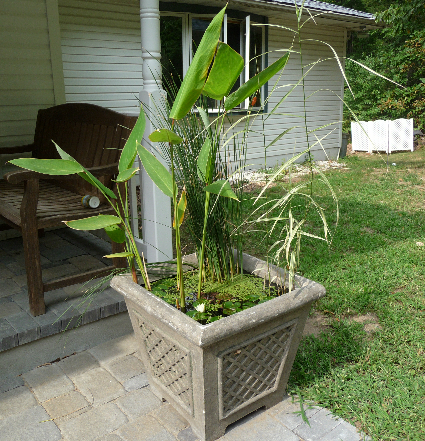
Try to incorporate thrillers, spillers and fillers when planting a container pond.
Thrillers would be considered the tall background deep water marginals. These also tend to be primary vegetative filters. What is the mark of a good vegetative filter? Fast growth and a spreading root system. Aquatic Iris, Pickeral Rush, Cattail (I prefer Typha laxamannii), Monkey Flower (M. repens), and Carex aquatilis species are good examples. To be effective as filters, plants must be bedded in perforated pond baskets. My preferred medium is rinsed pea gravel in the 5-inch to 9-inch perforated pond pots. Soil in small free-standing containers can produce an odor. Fertilize using 1 PondTabbs Jr. tablet every 1-2 weeks, staggering the plants that receive them to not overload the nutrients all at one time.
Fillers are smaller marginals for the shelves, floating plants and of course the waterlilies. No tub pond is complete without one, if there is no water feature to disrupt them (and why I do not use them). I recommend the pygmy Nymphaea ‘Helvola,’ the compact N. ‘Chromatella,’ and the small N. ‘Joanne Pring,’ as reliably flowering favorites. Tub ponds >40 inches in diameter (stock tanks, for example) can feature ‘Attraction,’ ‘Colorado,’ or ‘Sioux’ for ease of flowering. Tub-housed waterlilies are best planted in smaller 1–2 gallon solid pots with clay soil covered with sand then gravel. Their floating pads help with evaporation and cooling of the tub — key since the water is more shallow (and why small aquarium fishes are a better option if not using a aerator).
Make fertilizing easy to maximize your flowering: at the first of the month use 1-2 waterlily tablets per gallon of pot, placed deep along the sides so as not to burn the crown. Another easy schedule is 1 tablet per pot every Sunday,
Spillers extend their foliage over the side of your container and every tub pond needs them. Golden Creeping Jenny is my go-to spiller, followed by Bacopa moinieeri, Parrot’s feather (especially the red-stem variety), and the aquatic mints. I hook mini pond pots to the side on my tubs for this purpose, planting in pea gravel or soil. Shower curtain S-hooks are handy here. Fertilize as you do the Thrillers above.
Starting a Tub Pond
Tub ponding fish and plants is like flying an airplane. You get nervous at takeoff and landing. The actual flying part is mostly autopilot. I like to set up a new tub a month or two before adding fish and tropical plants. Get your hardy plants settled in earlier, too, so they are ready to function as filters when the fish arrive. If a home aquarium is free of disease, add a bucket of aquarium water from the water column to help kick-start your tub’s nitrogen cycle.
Squeezing out a sponge filter into the tub can seed valuable bacteria and infusoria, too. Add some crumbled dry leaves to feed them. A dose of nitrogen-consuming beneficial bacteria can also be employed — just choose an established brand and check the expiration date. Smaller bottles are available from reliable brands like SeaChem, API and Microbe-Life. All this prep ensures biological balance, including important biofilms and phototrophic bacteria, prior to introducing fish.
So, when do we put out our aquarium fishes? My rule of thumb is to add fish when tub water temperatures are the same or warmer than their aquarium or retail store purchased. A digital aquarium thermometer comes in handy here (floating pond and pool thermometers are notoriously inconsistent). Water chemistries should be similar, too. I do a 90% water change in my tubs a few days to a week prior to fish introduction (for me in Zone 6 New Jersey that’s Memorial Day Weekend for true tropicals, May for cool water tropicals listed in this article).
Move live or plastic plants around the tub edges to prevent jumping. After their introduction, nearly all fish adjust to daily fluctuations in temperature and water chemistry as the season progresses (like in nature) — even more so than their aquarium counterparts! Breeding is common once they are settled and a sight to behold up close.
Maintenance? Meh.
One of the attractions of tub ponding vs. aquarium is their lower maintenance. For example, after that water change prior to fish introduction, I am done for the season with that activity. Water changes should never be discouraged, of course, but I do not bother as I set up my tubs properly a month or two earlier. I top off with either rain barrel water or dechlorinated tap water.
Light daily feedings of a quality flake will benefit both fish and plants. But if you get busy or go on vacation, no worries or need to find a sitter, as nature provides a bounty. Spent flowers and dead leaves on all plants can be pruned to encourage new growth. See previous section on easy fertilizing regimens.
Tub ponds have higher evaporation and need to be “topped off” from time to time. Rainfall helps. Your tub water will get harder and more alkaline with evaporation. I check KH in my tubs midseason and after a very heavy rain, and top off with tap water if the reading drops below 3. Otherwise, I use soft neutral water from my rain barrels, or tap water if the KH is not above 8.
Teardown Time
Now to land the plane. When do we take in our small tropical fishes? When water temperatures are expected to drop below the minimum for the species going forward in time. For me in Zone 6 that is mid-September through October for true tropicals, November for the cold-tolerant fish listed here. If a cold snap comes in late summer, you can add a heater and wait it out. But get an accurate mid- or late-day water (not air) temperature reading before you panic.
When you do bring your charges back inside, be cognizant their tub water will be VERY different than your aquarium. I fill a small acclimation tank, or their permanent tank, with 100% tub water. Over the course of five days I slowly acclimate them back to treated tap water. This is particularly important for juvenile fishes. Alternatively, you can donate your fishes back to your pet store, another hobbyist or a local aquarium society for winter.
“The Tub Pond Handbook” describes several techniques for overwintering plants. For hardy plants, I wait until a hard frost kills off the foliage. This, combined with the cessation of fertilizers at least one month prior, triggers them to go through a proper dormancy cycle, resulting in a stronger plant for spring. Most of my stock then gets my CMS method (cold moist storage). For basket plants, this entails letting them drain for five minutes and then shaving off their roots with a razor knife. Cut back any foliage to near the gravel line.
For solid pots, tip them to drain, then remove all but the tiny indicator leaves near their crown. Then place the pots in a Styrofoam or plastic box. You can sprinkle a little peat moss on top to deter fungus. An old plastic shopping bag can be tucked around the pot(s) and fluffed up to make room for new shoots. The boxes then go into an unheated garage, or if Styrofoam, a solid outdoor shed.
What about the tubs? For winter here in my Zone 6, I drain my tubs and store them upside down. Thin or cheaper plastics get stored inside my shed.
Water gardening and tub ponds are more popular than ever. Maybe it is the movement of fish, discovery of fry, or smell of a waterlily, all at arm’s length? My tub ponds are still an immensely satisfying activity, and one I look forward to every spring.
I hope you discover the same.
*Monitor children around any pond. Tubs are hard to get out of. Injury or drowning can occur in even small volumes of water.

Those tub ponds look like a unique twist for backyard weddings. Do they require a lot of maintenance?