In an increasingly urbanised and technology-driven world, opportunities for children to connect meaningfully with nature are becoming increasingly limited. In Australia, school environments are often constrained by safety, structure, and space, leaving fewer opportunities for unstructured exploration and discovery. Yet it is often these experiences of interacting with water, observing wildlife, and learning through curiosity that leave the most lasting impressions.
Aquatic ecosystems offer a powerful solution. Thoughtfully designed, ponds and streams become dynamic, living classrooms where students can engage directly with ecological processes in real time. This philosophy underpinned the Kallangur State School Ecosystem Pond Project in Queensland, Australia, completed in November 2025.
Uniquely, the project did not begin as a construction brief or capital works proposal. It began as a Grade 5 persuasive writing assignment, where students formally requested a water feature for their school grounds. Their case was compelling. They wanted a place to connect with nature, to learn about ecosystems, and to experience something beyond the conventional playground. That request was championed by Andrew Swailes, Principal of Kallangur State School, who recognised both the educational value and broader wellbeing benefits such a space could provide.
Project Scope and Design

The project involved the construction of a fully functioning ecosystem pond and stream system designed to support aquatic life while remaining accessible, engaging, and compliant within a school environment.
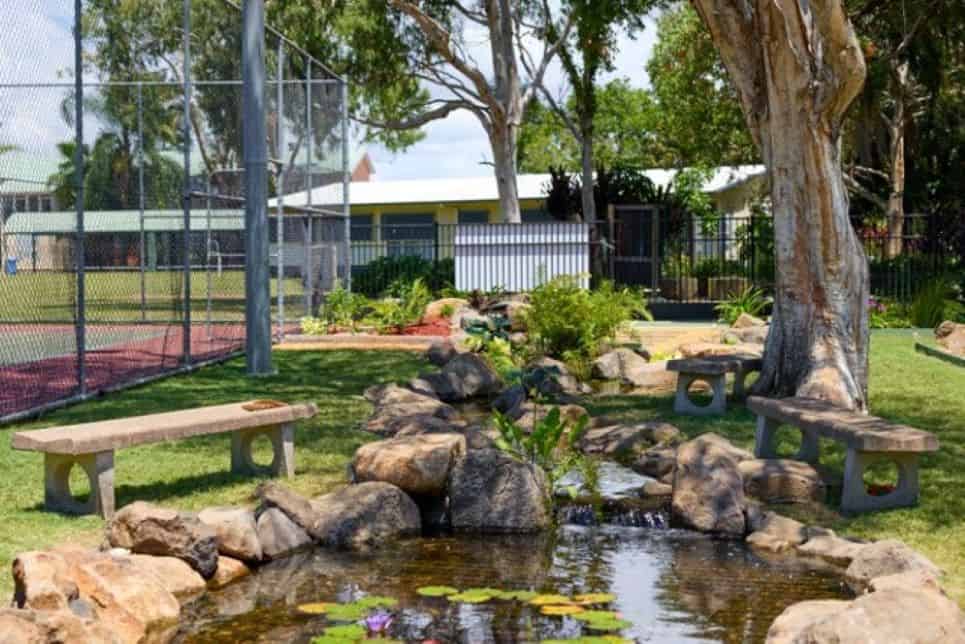
The stream system consists of two sections: one approximately 12 metres in length and an adjacent 9-metre section, both meandering toward a central pond measuring approximately 5 metres by 4 metres. A second stream commences on the opposite side of the wetland, completing the circulation and creating a layered, naturalistic layout.
A hardwood sleeper bridge was constructed to replace an existing concrete footpath, providing a safe crossing point while enhancing the visual flow of the space. Flat stepping stones and a stone-set beach entry were incorporated to encourage safe interaction with the water.
The beach entry has proven particularly successful, offering tactile engagement while maintaining strict safety compliance.
Safety and Compliance in a School Environment

Safety was the defining consideration throughout the design and construction process. Australian Education Department requirements stipulate that no body of water within a school environment may exceed 200mm in depth, and that any rocks smaller than a baseball must be fixed in place to prevent them from being picked up or thrown.
To meet these requirements without compromising the ecological integrity of the system, a stainless steel safety grid was installed within the pond at 200mm below the water surface. This solution allows students to safely observe a thriving aquatic ecosystem beneath the surface including fish and a couple of resident turtles while ensuring physical safety at all times.
Rock selection was undertaken with equal care. Stones were sourced for their rounded forms and smooth edges to minimise risk, and smaller rocks and gravel above the waterline were securely fixed in place. These measures ensured both long-term durability and a natural aesthetic appropriate to an educational setting.
Site Challenges and Construction Solutions

The project site presented several construction challenges. Most notably, the area had no natural elevation, making water movement and stream flow more difficult to achieve, something we are not used to here in Brisbane. Stream beds were carefully graded, and rock placement was used strategically to guide water movement and create the appearance of natural meanders without relying on gravity-fed elevation.
Wet weather during construction further complicated the build, requiring flexibility in scheduling and installation techniques to ensure materials remained secure and site safety was maintained. Despite these challenges, the project was completed within a three-week construction period through careful planning and effective on-site problem solving.
Accessibility was a key design objective. The school requested multiple access points to ensure inclusivity for students of all abilities. The bridge crossing, stepping stones, and beach entry provide varied ways to interact with the system, creating a space that is welcoming, engaging, and functional for all users.
Materials and Environmental Considerations
Material selection was guided by safety, longevity, and ecological performance. Larger rocks were used to define structure and create subtle scurries, while fixed smaller stones provide texture and habitat without presenting risk. Some native Australian aquatic plants were selected to support water quality, oxygenation, and biodiversity, while avoiding invasive species or high-maintenance requirements.
The ecosystem was stocked carefully, introducing fish and a couple of turtles were also added to establish a balanced and observable aquatic environment. The system relies on low-maintenance filtration and natural biological processes, reducing ongoing operational demands while supporting long-term sustainability.
Collaboration and Delivery of the Living Classroom
The project was delivered by Pond Works, with construction led by Mark Jones and his right hand man, Sean Callinan. Close collaboration with school administration and early engagement with compliance requirements were critical to the project’s success.
By addressing regulatory constraints from the outset, solutions such as the sub-surface safety grid and fixed rockwork could be integrated seamlessly into the design rather than retrofitted later. This proactive approach ensured the project progressed efficiently from concept through to completion.
Educational and Social Impact of the Living Classroom

While the technical and compliance aspects were significant, the most rewarding outcomes have been observed after completion. Students actively seek out the pond and stream area, often preferring it over other parts of the school grounds. They watch fish, search for the turtles, float handmade boats down the stream, and engage with the water in ways that are both joyful and educational.
Watching children interact with the system evokes memories of childhood spent down local creeks, damming water with rocks, racing leaves downstream, and learning about nature through play. For many children growing up in today’s built-up Australian suburbs, these experiences are becoming increasingly rare. This ecosystem provides a safe, structured way to reintroduce that connection.
Student feedback has consistently highlighted the pond as a preferred space within the school. Importantly, it offers an alternative for children who do not gravitate toward organised sport on the oval, giving them a place to observe, reflect, and engage at their own pace.
Teachers have embraced the space as well, often enjoying their playground duties more when supervising this area. The pond has become a shared environment that supports learning, wellbeing, and connection for both students and staff.
Lessons for Contractors
Several key takeaways from this project may benefit contractors considering similar school-based installations:
- Student-led ideas can translate into successful projects when supported by strong leadership
- Safety compliance and ecological outcomes can coexist when addressed creatively
- Flat sites require careful planning to achieve natural flow and visual interest
- Multiple access points enhance inclusivity and engagement
- Well-designed water features provide value beyond aesthetics, supporting learning and wellbeing
Conclusion
The Kallangur State School Ecosystem Pond Project demonstrates what is possible when education, safety, and ecology are integrated from the outset. What began as a Grade 5 persuasive writing exercise has become a living classroom and a space that supports curiosity, connection, and joy.
For contractors, this project highlights the growing opportunity to contribute meaningfully to educational environments. With thoughtful design, regulatory awareness, and collaborative delivery, ecosystem ponds can thrive even within highly regulated settings offering children something increasingly rare: a genuine connection with water and the natural world.
About the Author
Andrea Jones is co‑director of Pond Works in Brisbane, Australia, where she leads administration and client coordination alongside her husband, Mark Jones. Mark, a Master Certified Aquascape Contractor, was recognised as Business Person of the Year for the Australia region in 2025 which is an achievement that saw both Andrea and Mark travel to Utah for industry engagement and professional development at Utahmonium.
Pond Works specialises in ecosystem‑based pond construction and delivers a robust maintenance service, supporting owners from new installations through long‑term care.