In koi keeping, discussions about food often begin with brand, protein percentage or whether a feed is meant for growth, color or all-season use. But that is not really where nutrition begins. Nutrition begins with metabolism, and metabolism begins with water temperature.
Koi will often rise to the surface with energy, appearing eager for food. This conditions hobbyists to think in terms of appetite rather than koi physiology. However, because koi are ectothermic animals, their body temperature, metabolic rate, digestive efficiency, immune performance and oxygen demand are all controlled by the water they live in. A koi does not process food according to the label on the bag, but instead according to the temperature and oxygen conditions in the pond.
A Unique Digestive System
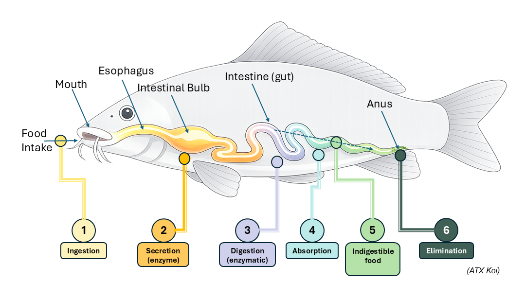
Unlike other fish with more distinct stomachs, a koi doesn’t have a true stomach. Food passes from the esophagus into a long, coiled intestinal tract where digestion proceeds through enzymatic action as it moves along. This anatomy adapts koi well to grazing.
If food is not efficiently broken down by the enzymes in the koi’s intestinal tract, more nutrients pass through as waste. This directly impacts pond filtration, creating cloudier water, increased ammonia levels and elevated organic load.
Impact of Water Temperature on Metabolism
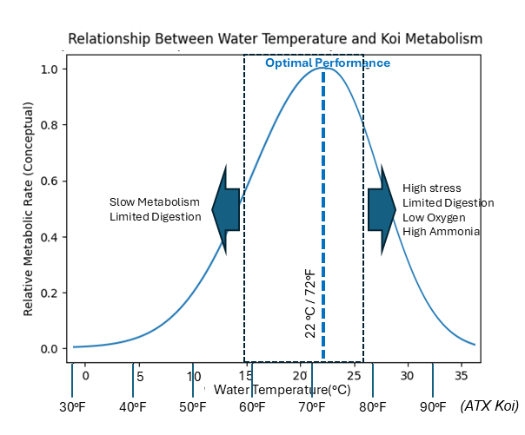
As water warms from winter lows into spring and early summer, koi metabolism increases. Enzyme activity improves, gut motility becomes more effective, feeding response strengthens and the fish use nutrients more efficiently for growth, tissue maintenance and activity. However, this increase in performance occurs only within an optimal temperature range.
Figure 2 shows the conceptual temperature-to-metabolism curve. The graph helps illustrate that koi performance does not rise in a straight line with warmer water or colder water. Instead, it follows an inverted bell curve.
At the cold end of the range, digestion slows so dramatically that feeding becomes inefficient and potentially harmful. Around 50°F (10°C) and below, koi may enter a semi-dormant, low-energy state commonly described as torpor. Gut motility drops, enzyme activity reduces and food processing diminishes. Under these conditions, feeding is more likely to create internal digestive stress or water-quality problems than to deliver real nutritional benefit.
As the temperature rises into the favorable range, metabolism improves and koi perform at their best. But once the temperature climbs too high, performance declines again. This is not because the fish have suddenly become inactive. Heat stress and reduced dissolved oxygen begin to impose physiological limits.
At the warm end of the curve, the danger changes form. Above the upper optimal range, especially once pond temperatures move into the mid-80s°F, dissolved oxygen becomes a limiting factor. Warm water cannot hold as much oxygen as cool water. At the same time, the koi’s physiological demand rises, their breathing effort increases and the pond’s biological processes accelerate. Organic waste breaks down, uneaten food decomposes faster and the risk of ammonia rises faster. Even a mature filtration system stresses if high temperatures, feeding and organic load begin to increase at the same time.
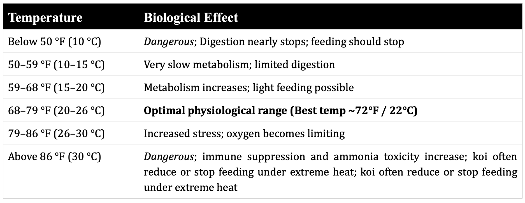
Feeding strategy must align with water temperature. Table 1 summarizes the correlation of temperature to metabolism of koi.
Food Labels and Composition
Now that we better understand koi metabolism and the impact of water temperature, let’s turn to food labels and nutrition.
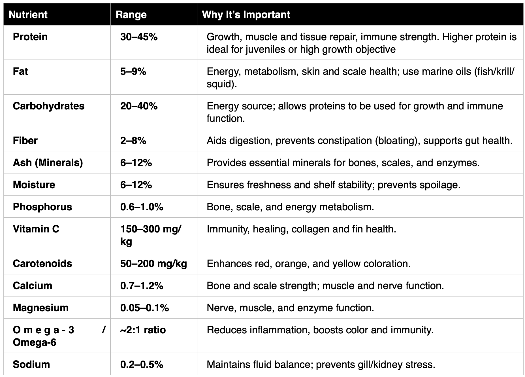
(2011) – Nutrient Requirements of Fish and Shrimp & Dr Jessie Sanders- How to Kill your Koi
Protein is the cornerstone of koi nutrition, especially for growth, tissue repair and muscle development. Protein content typically should be about 30-40%, however some growth diets have higher percentages. The source of protein matters more than percentage, as it directly impacts digestibility. Fish meal, krill meal, shrimp meal, wheat germ protein and spirulina are generally more useful ingredients than vague by-products or low-value bulk protein sources.
Wheat-germ-based diets are recommended when the pond temperatures are between the 50-65°F range. The reason for this guidance is straightforward. Protein-based wheat germ (typically 26-35%) provides essential amino acids, fatty acids and vitamin E needed for the health of the koi. This makes it easier to digest than richer growth formulas.
Fat is a type of lipid and provides energy, supports cell membranes and contributes to skin quality and sheen. In better koi foods, fats are often derived from fish oil or krill oil, which offer useful fatty acid profiles. Heavy, poorly defined animal fats are less desirable. The preferred fat content is within the 5-10% range, depending on formula. The goal is not maximum richness but usable energy that does not overburden digestion or contribute to unnecessary waste.
Carbohydrates play a useful role although not as essential as protein or fat. Well-digested carbohydrates provide energy, allowing protein to stimulate growth and tissue repair rather than burn as fuel. Ingredient quality is key. Wheat germ, rice bran and vegetable components can fit appropriately within a balanced koi food. Because carbohydrates are not always listed as a percentage on nutrition labels, look at the ingredient list. Some foods contain cheap fillers that pollute water and have minimal nutritional value.
Fiber is another key to maintaining healthy koi digestion. In their natural environment, koi constantly ingest small amounts of plant matter, detritus and algae, which keeps their intestinal tract functioning smoothly. A well-formulated koi diet includes an appropriate amount of fiber from sources such as spirulina, alfalfa, wheat germ or vegetable components to help regulate digestion and promote consistent nutrient absorption.
Vitamins such as A, C, E, K and the B-complex group are important in the koi diet. These constitute water-soluble and fat-soluble vitamins. Water-soluble vitamins (C and B-complex) need replenishment more frequently than the others. Because vitamins also degrade over time, food stability and storage are important to consider. Even high-end nutrition can be compromised if bags are left open too long in heat, humidity or direct light.
Minerals, usually represented on the nutrition label as “ash,” are widely misunderstood. “Ash” indicates the percentage of mineral content. Minerals support skeletal development, scale quality and metabolic processes. However, more is not automatically better, and excessively high ash content may point to lower-value formulation or excessive indigestible mineral load, rather than premium nutrition.
Clarifying Color
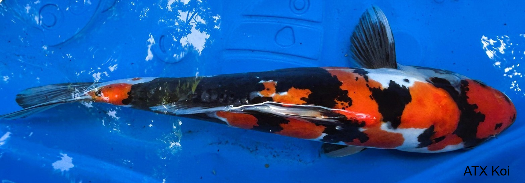
While color enhancement may be the most heavily advertised feature in koi food, it is here, too, when a metabolic lens is useful. Natural carotenoids in food, such as astaxanthin, canthaxanthin, beta-carotene, zeaxanthin and spirulina-associated pigments, can help intensify red, orange and yellow tones. However, these pigments are often over-advertised and oversold. To clarify a common misunderstanding, these ingredients do not improve black (sumi), white (shiroji) or improve skin quality. These also do not create or generate new pigment cells (chromatophores) where one doesn’t exist as part of natural koi genetics. Instead, these additives just enhance what is already there, even if it is suppressed or not visible.
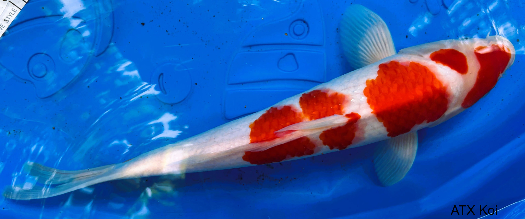
Most well-balanced koi food typically comes with some color enhancers in well-balanced proportions to help avoid these unintended consequences for the koi hobbyist. Color food should be used selectively and in moderation alongside a balanced staple diet—as part of a broader nutrition strategy, not as a miracle product. Using color food
consistently can result in unintended consequences, such as the sudden appearance of red on the white body of Tancho Kohaku.
Physical Aspects of Pellets
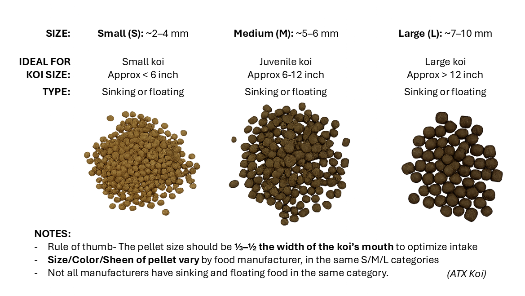
In real-world koi pond keeping, the feeding method matters. Floating foods are useful because they let keepers monitor the feeding response, estimate consumption and visually inspect koi at the surface. Sinking foods also have their place in special situations, but they make it harder to track leftovers and prevent fouling. Pellet size can also influence feeding success. Feeding 3 mm pellets to 2-6 inch koi, especially in mixed populations, ensures the smaller koi have access to food.
Montmorillonite Clay
This is a special type of koi food, and not really a “clay” per se. It’s a pond additive that creates a “mud-pond” effect in synthetic environments (such as liner or concrete ponds) by re-mineralizing the water, detoxifying the environment and acting as a natural flocculent to polish water. Montmorillonite clay (or Koi Clay) is mineral-rich, calcium-based food that improves koi health, digestion and skin quality when added directly to ponds or mixed with food. This binds toxins and heavy metals, thereby helping detoxify the gut, increasing mineral intake and enhancing white and black skin luster.
This clay should only be given when the water temperature is above 60°F. These pellets are usually large. To feed smaller koi, the pellets could be crushed or moistened prior to feeding. It is also available in powder form. Although some koi foods already have this clay pre-mixed, if feeding separately then mix approximately ¼ cup of clay with 4 cups of koi food. This clay mix can be fed a few times a week for best results.
A Treatise on Treats
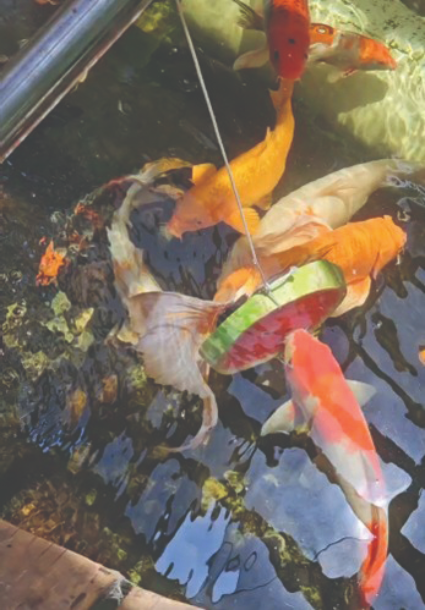
from Austin, Texas)
While human food can make great supplemental food for koi for enrichment and variety, they are no substitute for balanced koi nutrition. Feed human treats sparingly and remove any uneaten portions promptly. Only offer human treats when water temperatures and water quality are appropriate for digestion.
Good treats: Good koi treats are fresh, simple foods offered only in small amounts as occasional supplements, not as dietary staples. Safer options include soft fruits and vegetables such as:
- Peeled orange segments
- Watermelon, cantaloupe and honeydew
- Romaine lettuce
- Blanched, shredded and softened spinach, broccoli, cauliflower, cabbage and kale
- Strawberries, blueberries
- Zucchini
- Cucumber
- Shelled peas
- Small amounts of cooked pumpkin, sweet potato, carrots
- Small amounts of garlic and leeks
- Koi may also enjoy natural protein-rich treats such as:
- Plain unsalted shrimp and prawns
- Unsalted and cleaned sardines, crayfish, clams
- Washed earthworms
- Daphnia, bloodworms, mosquito larvae
- Silkworm pupae, mealworms
- Nori or seaweed sheets for grazing
- Hardboiled egg pieces (especially yolk)
- Frog tadpoles
Not good treats: These constitute foods that are salty, sugary, oily, starchy, processed, difficult to digest or likely to foul the water, such as:
- Starchy/processed foods: white bread, crackers, chips, cookies, candy, pasta, rice, cereal
- Processed meats: beef, pork, lunch meats, chicken
- Pet food
- Fried foods
- Buttery foods
- Sauces
- Seasoned leftovers
- Flavored nuts
- Salty snack foods
- Toad tadpoles (usually toxic)
Never feed: Raw beans and uncooked legumes should also be avoided. Large amounts of corn or other hard, starchy foods also pass poorly through the koi digestive tract. Even though koi will eagerly eat these items, they can contribute to bloating, excess waste, oily surface films, poor water quality and unnecessary stress on the fish and biofilter.
A Greater Understanding
The key to good feeding is understanding that even the best koi food only works well when the koi are metabolically able to digest it and the pond is ecologically able to handle it. It’s not based on percentage of protein, brand prestige or whether a feed is marketed for color or growth.
About the Author
A pond owner since 2004, Rjat Agarwal developed a deep understanding of what makes koi special, their varieties, building ponds, Japanese landscaping and pond keeping. Since 2022, he has made presentations on koi classification and varieties, koi ponds and building Japanese koi gardens for local pond societies in Austin, San Antonio, and Houston (as well as the Austin Oita Sisters Japanese Cultural Event). He has been featured on the Central Texas Gardner, KXAN 512 Studio and RJ Designs on KLBJ radio. In May 2025, he opened ATX Koi Corp, a supplier of prime Japanese and domestic koi in the Greater Austin area.