
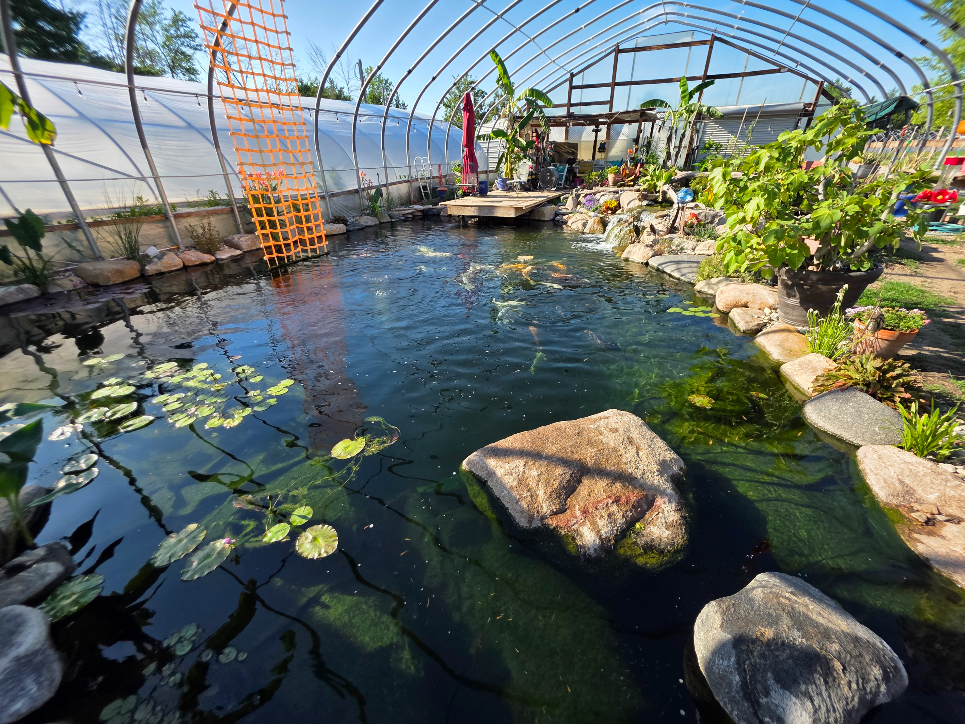
Thirteen years ago, I started what I thought was a simple aquaponics project. I had no idea it would grow into something so much bigger—a passion, a sanctuary and, eventually, a full-fledged business. The pond that started it all has gone through three major transformations. Here’s the story of how a body of water meant to grow lettuce became the center of a pondhouse evolution that transformed my life.

The Original Build – Spring 2013

The first pond was never meant to be more than a reservoir to supply nutrients to our aquaponics systems in two adjacent greenhouses. Initially, functionality was the focus and aesthetics were secondary.
When it came time to choose fish for the pond, we chose carp instead of tilapia, after research showed they were excellent nutrient producers for our bell siphon-based grow beds. For about a year, the pond served it’s role well.
Summer 2013 – Falling in Love With the Pond
By that summer, our koi were thriving—and noticeably so. While people were quick to let me know the pond wasn’t exactly “easy on the eyes,” I didn’t disagree. At that stage, the pond and fish were simply a cog in the machine. The produce was the real product.

But something unexpected happened: our family started spending more and more time by the pond. Evening koi feedings turned into casual hangouts with a drink in hand. The pond, messy as it was, began to charm us.
We began to make small changes such as planting around the edges, removing old car batteries (yes, really), and lining the perimeter with rock. That summer, our koi grew a lot, and it suddenly hit us: if we lost these fish, it would be both emotionally devastating and logistically disastrous. They were now the heart of our system.
We looked into insuring them. Unfortunately, because koi aren’t a “crop” fish like tilapia, we couldn’t get coverage. We weren’t raising them for food; we were relying on them as heavy bio-producers. Since insurance wasn’t an option, we chose the next best thing: protection through infrastructure.
Fall 2014 – Building the Greenhouse
In October 2014, we began constructing a greenhouse over the pond to shield the fish—especially from harsh winter conditions. By late November, the structure was partially up. The ends were left open, and we secured plastic sheeting over them to enclose the space. The entrance was through a small corner opening that resembled a makeshift “hobbit hole.”
Even though the greenhouse was only 40 feet long, just enough to cover the pond with no room to spare, we found ourselves going in there often. As winter settled in, it felt surreal to be inside this warm, protected bubble. It became more than shelter—it became an experience.
Spring and Summer 2015 – The Pondhouse Is Born
By spring, we realized just how much our family and friends enjoyed the space. It no longer felt like a utility, it felt like a retreat. Around this time, our focus shifted away from aquaponics and toward developing what we started calling “The Pondhouse.”
We couldn’t expand the structure’s width, but we could extend its length. So we added another 22 feet. That summer, we poured a patio in the back and built a floating wooden deck complete with a roof, TV and mini-fridge. It became our go-to hangout spot. We watched movies, hosted gatherings and made memories.
My dad had an idea: “Let’s add a dock.” So we did. And suddenly, everything felt complete.
Fall 2015 – Finishing the Structure
We learned a lot from our first winter. Draped plastic ends acted like giant parachutes in the wind—not ideal. Now, with the greenhouse fully extended and the layout locked in, we took the time to frame in the ends properly and install real doors.
Almost exactly a year after starting construction, the Pondhouse had evolved from an experiment into a fully enclosed, four-season structure. It felt like a hidden oasis—and it finally had a name.
2015–2024 – From Backyard Project to Business – A Pondhouse Evolution
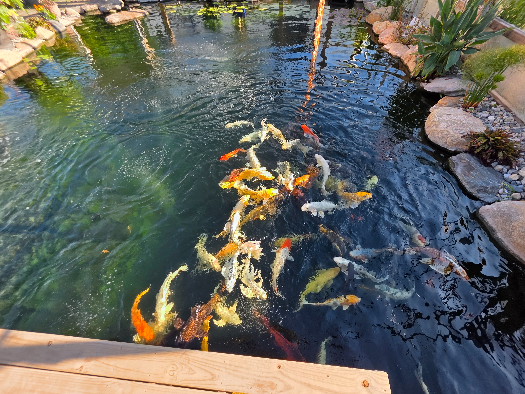
From 2015 onward, we enjoyed the Pondhouse to the absolute max. It became more than a passion project; it sparked an entire business. That little aquaponics setup eventually led to a full-service pond store and construction company.
Now, 13 years after starting that first system and 10 years into operating the business, the original Pondhouse—my first full pond build—was beginning to show its age. It had held up remarkably well, but it was time to address wear and tear and bring the space up to the standards I always envisioned.
The Rebuild – 2021 to 2024
The decision to rebuild came after a series of weather events:
2021: A derecho swept through, causing minor damage to the greenhouse.
2022: A massive hailstorm shredded the plastic panels, requiring full replacement.
Winter 2022: Another derecho blew in the south wall by 2–3 feet, bending the frame and several perlins.
With structural issues mounting—and the pond developing leaks and liner strain—it was time to fully rebuild. When we first built the wall, we concreted each post into the ground. Rebuilding required those posts to come completely out. With the wall gone, I had the rare opportunity to bring in heavy equipment. If we were going to fix it, we were going to do it right.
What Changed

Depth: The original pond was only 3.5 feet deep with a 4-foot center. The new pond is a full 10 feet deep, allowing for safe diving and play.
Rebuildable Wall: I designed the new wall to be modular, with posts set on individual concrete pads. If a storm ever damages it again—or if I want to make major changes—I can rebuild it section by section.
Trench Removal: A 42-foot trench (2 feet wide by 4 feet deep) once connected the pond to another greenhouse. It was collapsing and stretching the liner, so we removed it entirely.
Filtration: We kept the undergravel grid, bead filter and UV, but upgraded the bog to a wetlands system and added an ozone generator.
Purpose: While it’s still a pond—not a recreational “swimming pond”—we do swim in it often. The new depth and filtration make that easier and more enjoyable.
The Build Process

Although our target timeline was to build from August to October, actual completion expanded into February—just in time for the fish (barely!)
Space was tight compared to the original build. We moved the koi to a temporary 5,000-gallon tank with full filtration. Excavation required me to operate the mini-excavator from inside the hole, working backward. The pond ended up slightly wider but the same footprint—just much deeper.
We dug an extra 4–5 feet in one corner for a sump pit to manage groundwater. The liner was a 50-by-68-foot monster. I called in a small army of friends just to stretch it into place.
We rented a 50-foot Lull lift for coping stone placement. After that, we installed the undergravel grid and five bottom returns connected to the ozone system.
For the new wall, we used concrete pads instead of embedding posts. This allows individual replacements, making it easier to manage future wood rot or storm damage. Good thing we did—another summer storm ripped off all the plastic sheeting and hit both walls hard. The north wall will need rebuilding, but the new modular design makes the repairs much simpler.
The New Wetlands and Filtration System
Originally intended as a low-profile setup, we raised the wetlands slightly to add another layer of sound and visual interest to the waterfall. Measuring about 12 by 20 feet, it’s built with eco blocks and a 4-inch backwash valve for easy maintenance. It’s fed by a 5HP PerformancePro pump drawing from the undergravel grid.

Filtration Components:
• Undergravel grid
• Wetlands
• Skimmer
• Bead filter
• 400W Aqua Ultraviolet Viper UV

• 476W Desert Eagle ozone generator
Pumps:
• One 1HP Wlim pump (skimmer)
• One 5HP PerformancePro (grid)
We don’t use chemicals or conventional treatments. Instead, the ozone system plays a crucial role in maintaining clarity and water quality. Regular backwashes and beneficial bacteria additions keep it clean and low maintenance. Weekly tasks include skimmer basket cleaning, bead filter flushing and removing string algae from the wetlands.
Conclusion

It’s hard to imagine a day without this pond. It’s been instrumental in my growth—not just as a person, but as a pond builder. I used to think the original build was bulletproof. But here I am, already thinking ahead to what the next decade could bring.
Next on the list? Expanding the greenhouse. We’ve spent countless days—and just as many peaceful evenings—watching our kids swim and enjoy the space. It’s truly become our family’s retreat. While it shines in summer, it’s those warm, humid moments in the dead of winter that make it magical.
This isn’t just a pond. It’s our escape, our reset button and our refuge from the cold.
About the Author: Eric Twigg has been building, servicing and maintaining ponds now full-time for four years. Building ponds was a passion discovered on accident, but he has now built them all over the country and doesn’t plan on stopping. Follow him on Instagram.

Great article Eric! Love how you can escape the Iowa wintry weather (which is kinda similar to our Ottawa Capital region here in 🇨🇦) in your tropical koi paradise!