

As professional pond and waterfall designers and builders, we usually find ourselves working with a theme, such as a koi pond, backyard water garden, grotto waterfall, estate pond, etc. These types of features encourage tranquility, allow for the enjoyment of aquatic plants, or attract wildlife. So, what kind of questions will quickly pop into your mind if a prospect calls and requests an Adventure Pond?
There are so many questions to ask, and many are not typical. I think my first few questions were something along the lines of “What do you consider adventurous?”, “Who are you expecting to use this Adventure Pond?”, “How large of an Adventure Pond are you considering?”, and “What is the timeframe for the start and completion?” Certainly, the money or budget questions will follow shortly.
As I’m asking these questions, my mind is racing forward, trying to visualize what this prospect is really talking about. I certainly don’t have any Adventure Ponds in my portfolio to use as a reference. While many of our projects were an adventure to build, the end result was always intended to be peaceful and natural-looking.
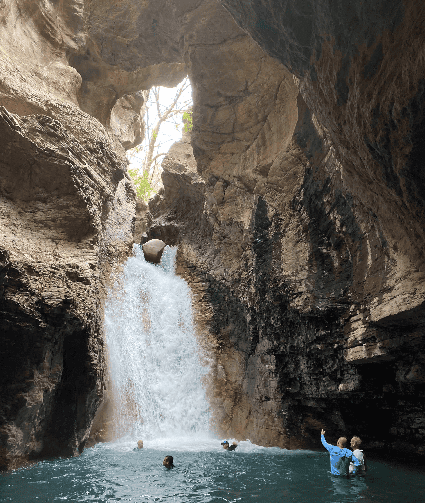
After that initial call and several video conferences later, we planned a a site meeting. Here is where the adventure really began. Determined to make his goal and vision clear, on day two of the meeting the client arranged an immersion trip into a remote part of the country for the heads of the design and construction team.
Immersion Trip
So, very early the next morning we drove for several hours before trekking off into the dense mountain forest. We swam in deep blue pools, crawled over rocks and climbed into grottos. We waded up streams, through narrow canyons, jumped off waterfalls, and explored underwater rock formations.
Quite an eye-opening experience.
So, after a full day of exploring and team building, we were quite exhausted. However, we were also full of ideas and excited about the possibilities We were very motivated to start developing the Adventure Pond.
Setting Priorities for an Adventure Pond
At the design meeting the next day, we identified several priorities early:

- A tall, wide, sheer waterfall designed for jumping, with a minimum height of 15 to 20 feet and a width of at least 8 feet.
- A deep pool at the base of the waterfall, immediately named the Blue Hole.
- Rugged access from the Blue Hole to the top of the waterfall.
- Heavy water flow over the main waterfall, with reduced flow on secondary cascading waterfalls alongside it.
- An expansive, semi-hidden grotto behind the waterfall designed for rock climbing, with ledges for sitting or diving.
- Underwater rock formations for exploration and swimming.
- Several semi-submerged rock formations and islands in the Blue Hole large enough to accommodate multiple people for sitting or sunbathing.
- A tall rope swing.
With the client being so involved early on, it was easy and quick to qualify ideas, discard others and get approval. Sometimes we were asked to come up with better ideas or solutions. With the plans moving forward rapidly, we moved into scheduling. This is always a dance between goals, fantasy, reality and execution.
The timeframe from the moment this meeting ended to full operation of the Adventure Pond was absurdly short. We had eight months between breaking ground and jumping off the tall waterfall. The overriding factor that made this all possible was the assembled team of can-do people. Everyone had extensive planning and construction experience, excellent resources of crew, equipment and materials, management and communication skills. To top it off, we had a motivated client.
Designing the Blue Hole and Upper Pond

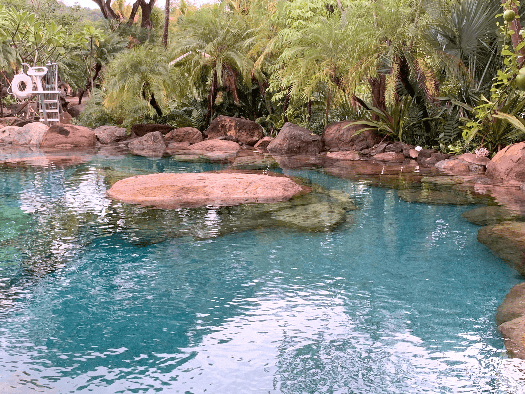
As the project was designed and then laid out on site, we ensured it would nest properly onto the steep hillside. It became clear that this would need to be a concrete structure. The lower basin, or the Blue Hole measured 135 feet wide by 115 feet long and 16 feet deep. The vertical waterfall/grotto structure and the rock terrace walls would rise steeply, almost a sheer 20 feet above the Blue Hole.
The peaceful upper pond with killerviews, was an elongated shape so it could wrap into the hillside. However it was straight enough to allow for a 25-meter swimming lane. The waterfall weir ended up sitting about 18 feet above the water in the Blue Hole with a finished wet weir of approximately 9 feet. The maximum flow we planned for the waterfall was to be an immense 4,000 gpm for that WOW factor. Normal flow for jumping and diving was expected to be approximately half or two-thirds of that, or 2,000–3,000 gpm.
Massive Pumps, Safety Considerations and Innovative Engineering

With the project being built of concrete, it allowed for large storage and equipment rooms adjacent to the Blue Hole. This provided for some easy suction and return pipe runs to and from the pumps. For this project, we used four 25 hp variable-speed pumps for the main waterfall. Smaller pumps providing circulation and filtration.
With this amount of waterflow potential, we discussed drowning and entrapment safety early on. Besides the human safety factor, we needed to address clogging of the inlets from leaves and other debris. The inlet system would have to diffuse the water velocity to safe levels but maintain maximum flow volume.
Ultimately, we decided to split, or tee, all of the four pumps’ suction pipes and spread them out in a row on a single wall. Next, we built a concrete balancing chamber around them. The top of the chamber was approximately 4 feet tall, and the front wall was located 4 feet away from the pond sidewall. In the front wall of the balancing chamber, we built eight 3-by-3-foot openings. Those e planned to cover with removable composite grates.
This common chamber, or balancing chamber technique, allowed us to greatly reduce water velocity at any one point. Even if one or two grates became partially clogged, there would still be sufficient open area in the other grates to make this area of the pond safe for swimmers.
Rocks that Look Like Trees in a Forest
To enhance the safety factor and hide the concrete chamber structure, we trimmed the ends off of a dozen long rocks. The rocks would measure 4 feet long and could be stand upright on the cut end. We placed these pedestal rocks in random locations, 2 to 4 feet in front of the inlet grates. These tall sturdy vertical rocks looked like trees in a forest when placed. Now that we had sturdy supports in front of the inlet chamber, we began setting large rock slabs. We laid them horizontally across the top of the inlet chamber and onto the rock pedestals. This further limited access by swimmers.
Bringing in a Tower Crane and Organizing the Rockwork

Since the project was immense, set on a steep hillside, and construction time was a factor, a traditional or all-terrain crane was not an option. What we needed was an industrial tower crane that could provide substantial lift capacity at 135 feet of reach. The tower crane provided great access to our rock staging areaon one side, and our full work area on the other side.
It was quite remarkable to see all the segments of crane structure and its concrete counterweights arriving on several semi-trucks. It required another large crane to offload the trucks and assemble the tower crane.
With all the planning and preparations underway, and the crane operational, it was finally time to organize the rock inventory. One of the issues with the larger projects, especially those on hillsides, is that when the materials, such as rocks, start flooding in, they are unloaded and often packed together so tight it is almost impossible to see the shapes and character of individual rocks. It took a full week of crane time to organize and stage the rock in various areas of the project.
Building the Waterfall, Grotto and Rope Swing Experience

Due to a nearly 20-foot height difference between the upper and lower pond, a significant amount of rock, concrete and drainage material was needed to build the tall terrace walls. Knowing that the landscaping would be lush, allowed us to hide the non-descript and ugly rocks we knew would materialize from our stockpile.
To access the jumping or diving ledge at the top of the waterfall, visitors begin at the Blue Hole. Here, a rugged, irregular rock staircase rises to the left of the falls. Along the ascent, they must navigate multiple cascading waterfalls and maneuver past a large cantilevered tree trunk. The trunk has a rope attached, allowing daring guests to swing far out over the Blue Hole before letting go.
As they continue upward, visitors pass several rock outcroppings that allow for diving, jumping or simply watching the activity below. Behind the falling water, the grotto reveals another adventure area. This one features small ledges for rock climbing and larger ledges that provide a dramatic perch for observers.
Underwater Adventures: Caverns, Tunnels and Semi-Submerged Rocks

The Blue Hole is quite large and deep — 16 feet deep, in fact — allowing for more adventures. To encourage family and friends to explore underwater, we installed many large rock slabs as veneers on the underwater sidewalls. We also constructed large rock formations similar to what we encountered on our immersion trip.
Some of these rock formations formed irregular caverns or tunnel-like sections at different depths that a person could swim through.
On the shallower swim-throughs, the semi-submerged slabs that made the cavern ceilings were of considerable size. These allow a half dozen swimmers to climb out of the water and onto them for a break. These oversized semi-submerged rocks are now a popular location to watch the jumpers and divers perform their aerial feats.
As the days, weeks and months flew by, it felt like progress was moving at a snail’s pace. The artistic and creative edge was waning, and nothing ever seemed to change, much like in the movie “Groundhog Day.”
To control the negative effects of this, we rotated ACS and its team of subcontractorsotated on and off the project on a regular basis. We found this helped to ensure a safe working environment and maintain the high level of artistic workmanship demanded.
As we scheduled crew rotations, there was at least one ACS crew who remained onsite to take charge and make sure the work consistently moved forward.
Near the Finish Line: Pressure, Excitement and Last-Minute Changes
As we hit milestones on the project and were getting to the halfway and then three-quarters of the way through the project, we started noticing the client was returning more often and getting visibly excited as well. As is to be expected, there are always going to be certain questions asked, like “How are things going?” or “Do you like the progress?” “What do you think about changing this, or adding that?”, and the big one, “Do you think we are going to get it done on time?”
The First Flow of Water: A Once-in-a-Lifetime Moment

Finally, the eventful day arrives, when we run the pumps for the first time. As exciting as this moment is, inside you know of a half dozen catastrophic events that could take place if someone was forgetful or careless. Fortunately, by using variable-speed pumps we could ramp up the flow and manage the startup process.
While most of the ACS team was spread out around the project, focused on flow and leak testing details, a crowd of 50 to 60 workers, who had never been involved in the construction of a water feature before this project, started to assemble in small clusters around the Blue Hole taking pictures. As always, it was a breathtaking moment to see the first water pouring over the weir and watch it steadily grow in volume.
The workers, who were now spectators, got to experience the roar of the falling water and felt the wind in their faces as they stood taking it all in.
As I looked around, I was really proud not only of the group of men I brought to the project. But also, of all the other individuals who probably had not understood or envisioned what they were actually building, but who worked steadily and effortlessly together to make it all happen.
Why the First Drop Never Gets Old
I realized early on in my career that there is only one first time for water to flow over a new waterfall, so you have to stop and embrace that moment, that event. It still sends chills up my spine and always makes me smile, at least inside. I know there are many of you out there who are passionate about waterfalls and can appreciate the moment when you flip a switch and bring another form of life into the world.
That moment when you see the first flow of water run around and across the tops of the rocks, fill up what were earlier dry basins, and ultimately the first drop off the weir — it’s priceless.
To all of you who are passionate and enjoy the art of waterfall and stream constructing, congratulations on finding a rewarding career.

About the Author:
Dave Duensing is the founder of Aquatic Construction Services (ACS) which specializes in the construction aspect of natural rock formations
and living water features.

This is a spectacular water feature, congratulations on a job well imagined and completed!
Thank you Julie. I appreciate that.
It was a long, challenging, and exciting project. What made it work was the team and a motivated client.
If you reference back to the Jan/Feb 2025 Pond Trade, to the Cutting Edge article, it is the same project, just a different portion of it.
Dave