Each year, the International Waterlily & Water Gardening Society (IWGS) brings together a global community of growers, researchers, hobbyists and plant enthusiasts who share a passion for aquatic plants and the ponds they call home. The 2026 IWGS Symposiumbe was an exciting event for all who are involved with water gardening and aquatic plants.

In August, the annual symposium came to St. Louis. It’s a fitting location for a water gardening gathering. For more than a century, St. Louis has been a center of aquatic plant research. It is home to the hybridizers and horticulturists who shaped the water lilies grown in ponds and gardens around the world today.
St. Louis also has a long-standing connection to the IWGS. The second annual symposium was held here in 1986, during IWGS’ early years. This is when the water gardening community was first beginning to take shape.
Forty years of education, research and conservation later, returning to St. Louis offered an opportunity to celebrate how far the community has come, and to reconnect with the friendships, memories and shared history that define it.
Behind the Scenes at Missouri Botanical Garden
Missouri Botanical Garden, recently highlighted by The New York Times as one of America’s great urban botanical gardens, was the backdrop for the symposium’s first full day.
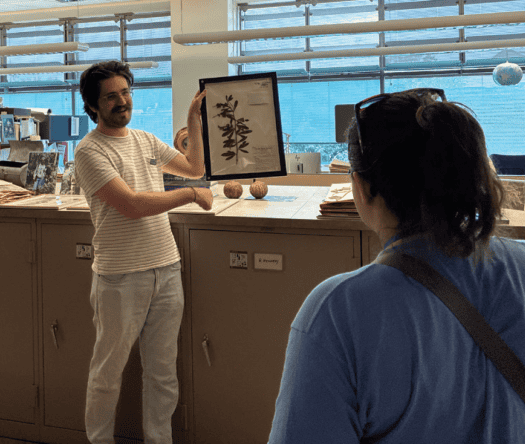
Our visit did not begin at the 79-acre garden, but down the street, at the Peter H. Raven Library, home to 280,000 items, including books, botanical artwork, field books, photographs, maps and more. The library supports the work of Missouri Botanical Garden’s scientists, students and researchers from all over the world. It is vital to the garden’s mission “to discover and share knowledge about plants and their environment, in order to preserve and enrich life.”
We were welcomed by Dr. Lúcia G. Lohmann, an internationally recognized botanist who serves as the garden’s eighth president and director. IWGS President Suzanne Boom, a senior horticulturist at Longwood Gardens, where she oversees the aquatics collection, then officially opened the symposium.
Then, eager to explore, we moved through the library, viewing rare books, the latest scanning technology, paper restoration and a look at the practical uses of aquatic plants, from lotus seed snacks to taro tubers to hats woven from cattail plants.
We got a peek at specimens collected in the field, including a fern collected by Charles Darwin and another collected by Jane Goodall. The room filled with oohs and ahhs.
And just like that, the week was underway.
From the Library to the Lily Pools
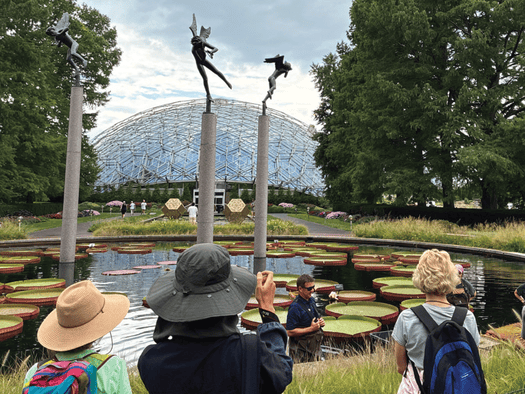
Presentations from Bob Stolzberg and Derek Lyle traced the history of water lily cultivation in St. Louis from James Gurney’s first Victoria flowering at the garden in 1894 through the hybridization work of George H. Pring, including his varieties growing in the reflecting pools today. With 130 years of water lily history in our heads, we were ready to see the plants.
We made the short trip to the garden itself, where we walked past pools of water lilies in bloom on our way to our next stop. Luckily lunch was waiting, or we might have lost a few water gardeners!
The afternoon’s education sessions featured a presentation by Zijun Li, who has spent 15 years collecting and hybridizing water lilies, on the genetic patterns of Nymphaea mexicana. Domonick Gravine of Redleaf Exotics shared the origins, culture and hybridization of Nepenthes and tropical pitcher plants. He passed around specimens for the group to examine up close.
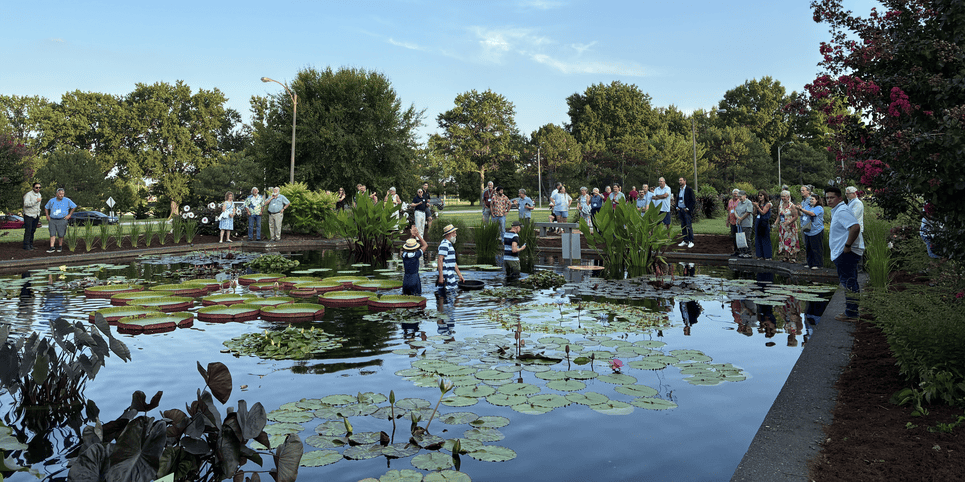
Then we moved outside, where Greta Berg, Claire Krofft and Derek Lyle waded into the giant Victoria water lily pond to present on the garden’s aquatic displays and their participation in the Waterlily Weigh-Off. The competition, which was accepting entries that same week as the symposium, invites growers around the world to see how much their giant Victoria leaves hold.
After a cloudy morning, the sun came out just as the group spread out to explore. Some made their way to the production greenhouses, not open to the public. This is where the garden’s collection of Nymphaea species and hybrids is propagated and maintained. Others wandered the expansive public gardens in peak summer bloom.
A City of Water Gardens
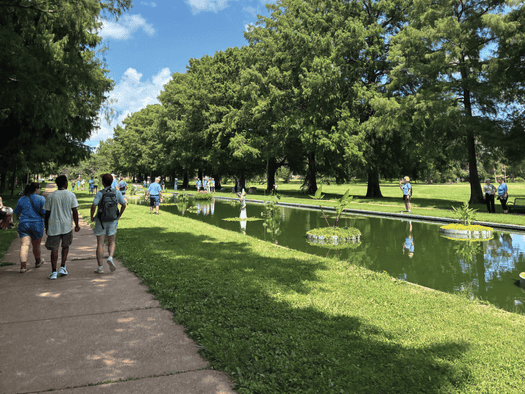
If our first day was all about water gardening as an institution, the second showcased water gardening in the community.
The morning began at the Piper Palm House in Tower Grove Park. Built in 1878, it is the oldest greenhouse west of the Mississippi River. It was originally constructed to overwinter the park’s collection of tropical plants. The conservatory sits on an open-air plaza overlooking a set of historic lily ponds. It offered a natural contrast to the manicured reflecting pools at Missouri Botanical Garden, seen the day before.
Inside the greenhouse, Danny Cox of Lewis Ginter Botanical Garden offered pond construction and design advice from a public horticulture perspective. Neil Eisenberger presented his work on the Tower Grove Park East Stream Restoration Project. This stream daylighting intervention transformed buried drainage infrastructure into a functioning ecological corridor.
Dr. John J. Cho, professor emeritus of plant pathology at the University of Hawaii, closed the morning with a presentation on Colocasia esculenta. Dr, Cho traced its origins as a food crop through his ornamental breeding program. The program has produced more than 17 patented cultivars under the Royal Hawaiian Colocasia label.
Several of his varieties were growing in the ponds right outside. We made our way across the city through the afternoon, stopping at Francis Park. This community-maintained lily pond offers another reminder that water gardening runs deep in this city. We then headed to the St. Louis Aquarium at Union Station for a behind-the-scenes tour.
The Aquarium Tour
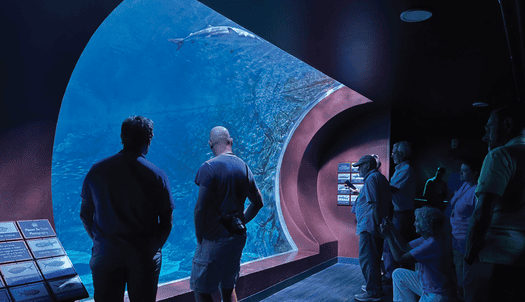
For a group that spends its days managing aquatic plant environments, the aquarium offered an unexpected parallel.
The pump room alone, a massive system keeping thousands of gallons of freshwater and marine habitats healthy, was a reminder that water, in any context, demands respect.
An Evening by the Pond
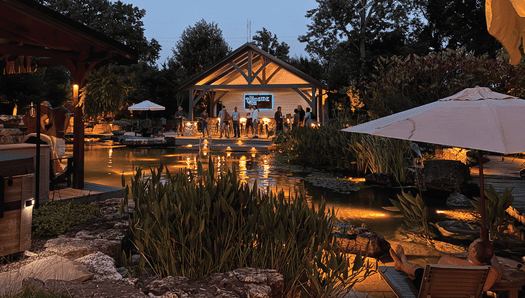
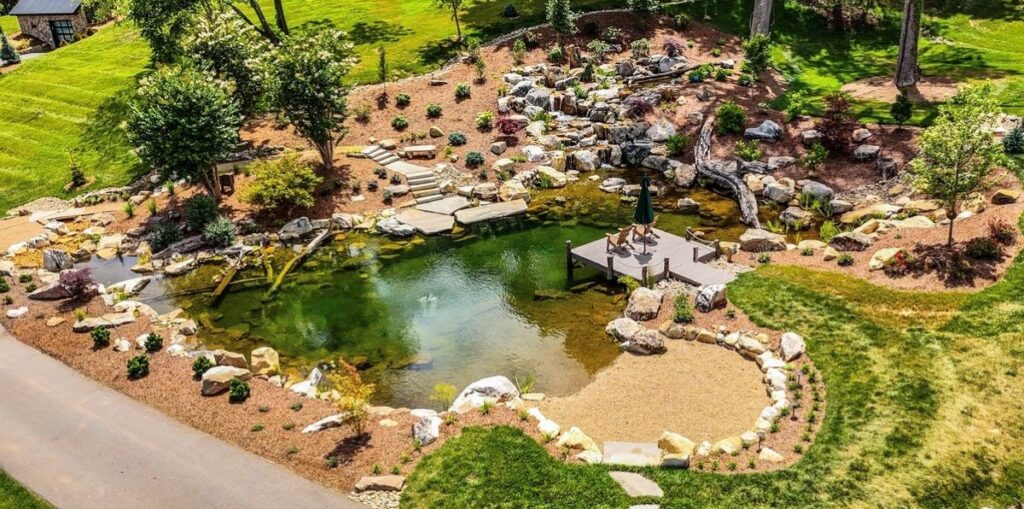
After a day full of talks, tours and fish tanks, we kicked back at the home of Chris and Tara Siewing. Chris is the Aquascape-certified contractor behind Nature’s Re-Creations, which specializes in naturalistic water feature design. His family’s home pond, Fox Mountain Falls, is something to behold. It measures 120 by 60 feet, and is more than 8 feet deep. Built from more than 385 tons of weathered limestone boulders, it features a custom stone bluff and shallow sundeck. A Pondside Pub is centered around a 40-foot petrified wood bar.
As the sun went down and the pond lights came on, water gardeners from around the world mingled at the water’s edge. Three of them felt inspired to jump right in alongside the koi.
Tara summed up the evening best when we thanked her for hosting: “People from all over the world gathering in my backyard?” she said.
“That’s why you build a pond.”
From the Garden to the Lab
We spent two days among plants. This one was about where they begin.
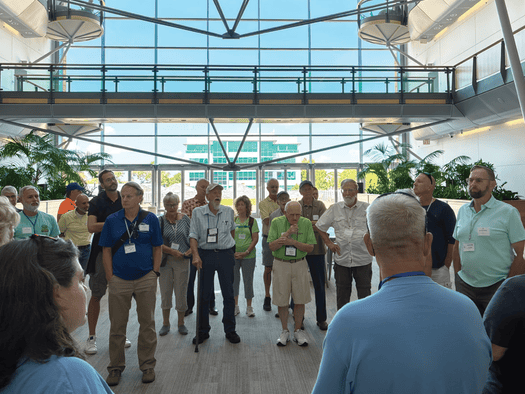
The morning began with Harry Hensley, environmental solutions manager at Eco Constructors. He made the case that plants have always belonged here — native landscapes and plant-based solutions rooted in what the land already knows.
From that conversation, the group set out to see plant science at a very different scale.
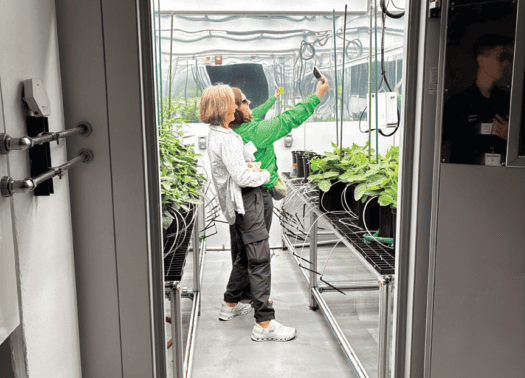
Our first stop was Bayer Crop Science, a global life sciences company with a significant St. Louis presence. They focus on crop science research, seed development and sustainability.
The afternoon brought a visit to the Donald Danforth Plant Science Center. This world-renowned independent nonprof is dedicated to plant biology, crop improvement and global food security.
Both facilities offered a rare look behind the curtain: the growth chambers, the specialized technology and the scale of research that happens long before a plant reaches a grower.
The Jewel Box
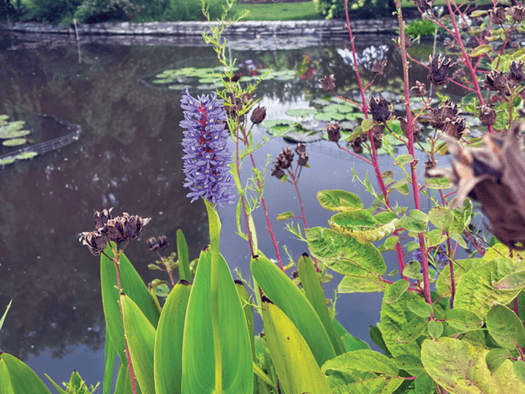
The symposium closed with a banquet at the Jewel Box, a 1936 Art Deco conservatory with 50-foot glass walls. They catch light in a way that makes it one of the most distinctive structures in Forest Park. For comparison, the park covers 1,293 acres (500 more than New York City’s Central Park).
Outside the Jewel Box, the St. Louis Water Garden Society maintains and funds three separate ponds which hold 39 varieties of aquatic plants. Among them are erennial water lilies, annual day- and night-bloomers and, of course, a Victoria ‘Longwood Hybrid’ at the center.
On this evening, they were spectacular.
We gathered to watch the St. Louis Water Garden Society film its entry for the annual Waterlily Weigh-Off. Its giant Victoria leaf held 49 pounds. It was a fitting bookend to a week that had buzzed with the excitement of the competition.
Inside, the evening unfolded slowly and warmly. After sundown, a bowl was passed around the tables carrying freshly cut Victoria blooms from the ponds. A first-day bloom, white and fragrant with its signature scent of butterscotch was set alongside a second-day bloom, turned pink.
The People Behind the Plants
Then came the speeches, the awards, the Hall of Fame inductions and yes, some tears.
Three members were inducted into the IWGS Hall of Fame. Deb Spencer, co-owner of Water’s Edge in Lawrence, Kansas, was honored for her contributions to trade and technology. She created pump performance charts and shared practical knowledge with contractors and the public for decades.
Susan Davis, a former IWGS president, was inducted for her contributions to the society and to the trade. In particular, for her gift of helping customers find their own vision of water in the garden. She and Spencer co-owned Water’s Edge together from 1989 to 2020.
The third induction was posthumous. Kit Knotts, who died in 2023, was honored for her contributions to horticulture and knowledge. Her Victoria hybridizing research and the websites she created, Victoria-Adventure.org and WaterGardenersInternational.org, became what Rich Sacher called “a worldwide treasury of aquatic plant information.”
In his tribute to Kit, Sacher also offered perhaps the best reminder of what this community is and does, and why we were gathered in the first place.
“This IWGS to which we belong is really a giant catalytic converter. We bring people together from all over the world; we cross-pollinate each other with our enthusiasm, ideas and plants’ we produce some wonderful hybrids — and the very best ones are the lifelong friendships which we create.”
To Be Continued …
The evening ended outside, around the ponds again. The day bloomers had closed. The night bloomers were open.
And I have a feeling a few water gardeners were already thinking about the 2027 symposium. That’s when the community will gather again in the Netherlands and Belgium.
For more information about the IWGS and future symposiums, visit iwgs.org.