
A single crystalline drop, shimmering in the sun, swells until gravity pulls it to the mossy pool below with a satisfying plunk.

Waterscapes.
Water runs downhill.
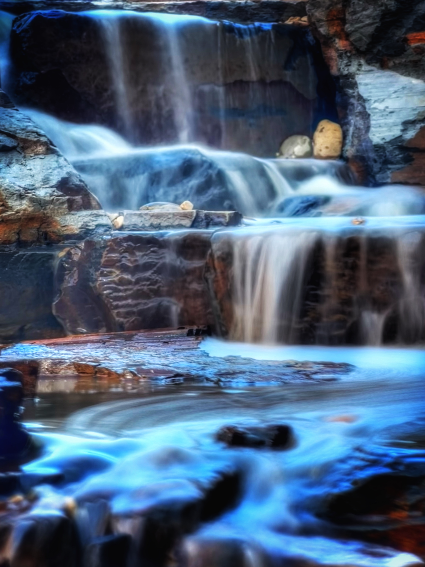
The thrum of a spring stream, flush with rain, moves over rocks, through roots and around boulders as it races along a course set by countless droplets before it.
It takes the path of least resistance.
It glides effortlessly into the tranquil waters of a misty mountain lake at sunrise.
It seeks its own level.
These are the rules of water.
I was just in my 20s when I first heard those rules from a gentleman pond builder named Scotty Hammond.
“Water runs downhill, it takes the path of least resistance, and it seeks its own level. If you can master those three rules, you can build anything,” he would say in his Western twang, shaking his head in what seemed like awe every time he said it.
Here are some basic tips and tricks—recipes, you might say—I’ve picked up for building waterfalls. Some are from people wiser than me, and others are from woodland explorations around our blue planet.
Types of Waterfalls
There are essentially two types of waterfalls. Sheet Falls are created when water shears off a sharp surface while Boulder Falls are created by water flowing along and around smoother, rounded surfaces.
Objects, artifacts and sculptures can also follow these same principles. For example, water falling off the tailgate of a truck is a sheet fall. Water following the curves of a sculpture resembles a boulder fall.
Basic Construction of Sheet Falls
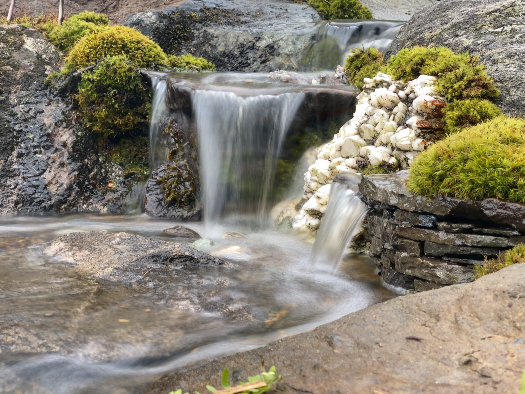
In order to create Sheet Falls, use a flat rock or object with a sharp edge, set perfectly level from left to right. Tilt the stone slightly (up to 1/4 bubble on a level) from front to back to encourage clean sheeting. You’ll need between 1,000 and 3,000 gallons per hour per foot, depending on viewing distance. Sheet falls create a high-pitched, rain-like sound.
Glass Falls: These are precision sheet falls. The stone or object must be perfectly flat and level to create a “glass-like” window of water. Use 1,000 gallons per hour per foot, however if height increase you will need more to preserve clarity. Glass falls are excellent for showcasing plants or sculptures behind the water curtain.
Country Falls: These are a natural variation of the sheet fall. In this type of fall, less perfect stones are used, allowing for more water flow (3,000+ gallons per hour per foot). Level the stone left to right and tilt it slight from front to back. Sound range varies but generally falls in the mid-to-low pitch, depending on water volume, stone size, and the design of the cave or pooling area below.

waterfall.
Horseshoe Falls: These use a concave shape, either crafted from multiple stones or found naturally. The achieve a glassy look with less water, while larger volumes allow for powerful Niagara-like effects. Build using either Glass or Country Fall principles, depending on the desired aesthetic.
Dripping Moss Falls: Level a stone and cover its front and sides with moss to create a dripping moss fall. At a gentle flow rate (around 100 gallons per hour per foot), water will bead and drip. Alternatively, create a custom version using drilled pipe with small holes covered in moss and waterfall foam. A ball valve allows you to fine-tune the flow for that perfect mossy effect.
“Water runs downhill, it takes the path of least resistance and it seeks its own level. If you can master those three rules, you can build anything.”
Basic Construction of Boulder Falls

granite boulder create a masterpiece at sunset.
Boulder falls are formed by arranging boulders or objects to shape shoulders and a weir. Water clings to smooth, round surfaces and falls away from sharper edges. These falls tend to have a deeper, bass-heavy sound—like a bass drum compared to a snare. Larger rocks, deep caves, and pooling areas help amplify the sound. Use 2,000 gallons per hour per foot or more.
Shoot Falls: Create a channel between two boulders by angling them to create a low point. This forms a focused shoot of water. Finish tightly to avoid losing water between stones. Use cobbles or riprap to style the exit. Should you choose cobbles, you will get a braided look. Choose riprap for a whitewater aesthetic.
Slide Falls: When it comes to slide falls, the direction of flow is determined by the angle of the rocks, which should be placed slightly off-level toward the desired direction. Slide waterfalls work beautifully in a series or in areas with minimal height variation.
Horsetail Falls: Inspired by natural falls that are formed from low spaces in cliffs, pond builders can mimic this look by placing two rocks close together with a small cobble in between in which the water flows. The narrow, vertical stream contrasts beautifully with wider waterfalls.
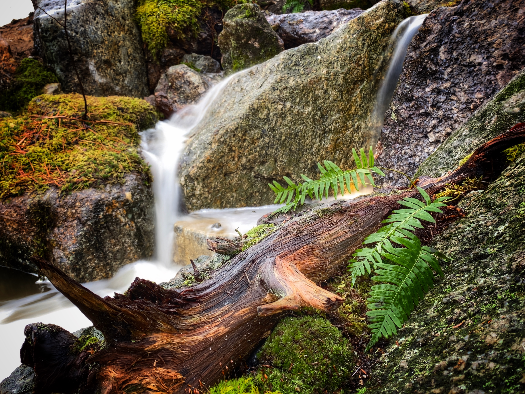
Log Falls: Logs or stumps are used as water features. Measure the low point of the lowith a level to find your weir. Ensure a minimum 3-inch difference from high to low ends for proper flow and freeboard. Combine with stones for a natural, post-flood look.
Use durable hardwoods like cedar, locust or teak for longevity. The contrast between wood and stone is visually dynamic and naturally compelling.
Craigle Falls: This style mimics rocks tumbled down a slope and lodged between larger boulders at a choke point. Set shoulder rocks securely and seal them well. Place sharp-edged stones vertically to cut and redirect water. Each rock should be sealed at the base before foaming in place. Though time-consuming, this technique results in a waterfall that appears forged by nature.


Finishing Tips
To finish a waterfall consider the following finishing tips:
- Fill any gaps behind waterfall boulders with gravel, stopping 4 inches below the water surface.
- Compact the gravel carefully. (We use the back of an ax handle to get into tight spots.)
- Insert a drop liner, a small piece of liner used in addition to your main liner, to seal spaces behind waterfall weirs.
- Foam the edges of the drop liner in a 4-inch band on each side. Foam along the rock edge first, then 4 inches into the gravel, then connect those two lines to form a complete seal.
Before building, I try to study natural waterfalls and streams. Observing how water moves in the wild helps me avoid simply replicating another artist’s work.
Instead, I strive to imitate the true artist—Mother Nature herself. There are endless possibilities and inspiration waiting in the woods, if we just take time to explore our surroundings.

for extra action in a waterfall.
About the Author: April Dugan with American Waterscapes, has been privileged for the last 20 years to build alongside some of the greatest pond builders of our time. She was the first female finalist in the 2021 Water Artisans of the Year contest.
April has worked on four continents and in 18 states building ponds, waterfalls and rainwater-harvesting systems for private residences. The greatest joy of her life was building RainXchange drinking water systems for villages in third world countries with the Aquascape Foundation. To date, the organization has provided drinking water for some 70,000 people.
Find more articles from April Dugan.