
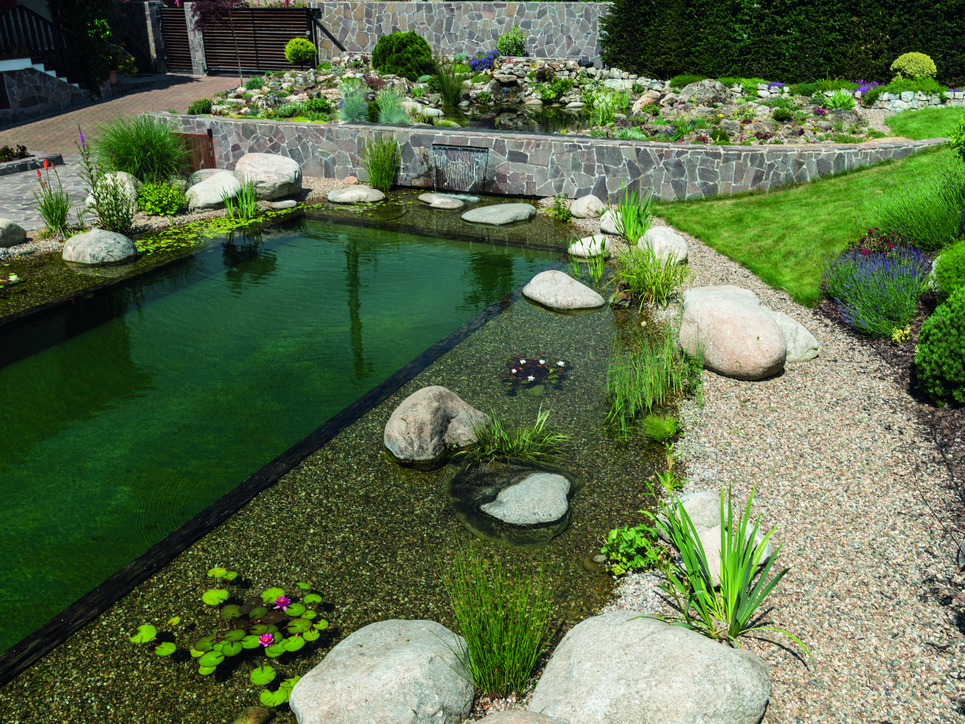
There’s been an explosion of interest in natural swimming ponds over the last couple of years, fueled by concerns about the health risks of chemical disinfectants. Monitoring of chemical-free ponds over the last 50-plus years, particularly in Europe, shows Natural Swimming Ponds typically meet recreational water standards without needing chlorine or other disinfectants when systems are properly designed, operated and maintained.

On the other hand, exactly how they suppress disease-causing organisms (pathogens) like E. coli and enterococci is more nuanced. For pond builders, it may help to first take a look at how Natural Swimming Pond filtration systems work, and how they keep natural swimming ponds safe. Then, we’ll be better able to assess and specify filtration systems designed for natural swimming ponds.
It’s easy to say that natural swimming ponds avoid contamination by pathogenic bacteria using ecological design and biological processes. I’m reminded of a cartoon graphic I saw years ago. A line of “good” bacteria, dressed as police with batons and helmets, was facing down mean-looking “bad” bacteria — and that was all the explanation. As little as that did to explain what’s actually going on, the key point is valid. Competition with beneficial organisms in an optimal environment under ideal conditions will suppress pathogens.
Why Oxygen Matters
Oxygen plays an important role in the healthy pond environment. Aerobic, oxygen-loving bacteria play the crucial role of digesting wastes and urea in the water, creating nitrates. On the other hand, many human pathogens are anaerobic, thriving in environments where little oxygen is present, like deep wounds or abscesses. Others evolved to take advantage of the low-oxygen, nutrient-rich human gut. Still others produce toxins to damage tissue and create further anaerobic conditions, promoting their own growth.
The Role of Regeneration Zones
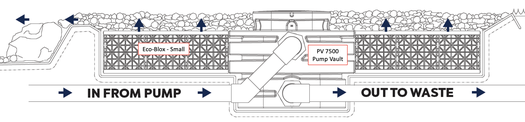
water pumped into the regeneration zone has to overflow up through a shallow planted gravel bed. Run a drain line with a valve out to daylight to flush out settled solids as needed.
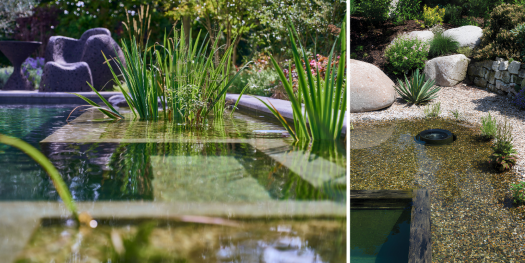
Shallow graveled areas (called “regeneration zones” for their beneficial effect on both water quality and clarity) create conditions less favorable to many human pathogens. Plants and aerobic bacterial communities in the regeneration zones, along with dense microbial colonies in biological filters, outcompete pathogens for nutrients and space. Protozoa, insect larvae and other microscopic predators living in these nutrient-rich, aerated spaces consume bacteria and other microbes.
These work best when well lit sunlight not only keeps planted areas actively growing and removing nutrients, but also exposes shallow gravel beds to natural ultraviolet radiation, which kills many pathogens. But keep bathers at a distance. The active animal, plant and microbial ecosystem of planted areas should be separated from the swimming zone so bathers aren’t in direct contact with the biofilm.
The high oxygen levels and temperature ranges of well-designed Natural Swimming Ponds favor beneficial bacteria, reduce growth of certain pathogens and enhance competition by other organisms. (See Diagram 1)
Filtration: The First Line of Defense
Key to providing the ideal conditions for an optimal environment is a well-designed, well-aerated filtration system. As simplistic as it may sound, removing as much as possible from the water column will eliminate pathogens as well. Particles down to 60 microns (millionths of a meter), and any microbes on them, can be intercepted and removed by the screens or foams of mechanical filtration.
Beneficial bacteria in the biological components of the filters will use oxygen to turn wastes like urea or skin cells into nitrates. Planted regeneration zones will remove nitrates and, if the water flows through slowly enough, settle out particles down to the limit of visibility, 40 microns or smaller. Properly designed, the pathogens and sediment that these planted zones trap can be easily flushed from the system during regular maintenance.
For even finer filtration, sticky biofilms produced by aerobic bacteria in regeneration zones and growing on floating beds of well-aerated filter media can trap and consume microbes and algae down to 3-4 microns, the size of an individual bacterium.
Designing an Effective NSP Filtration System
How, then, should these filtration systems be designed and specified? What components are optimal? How can we balance the nitrogen output of mechanical filtration with the uptake of planted sediment traps? What turnover rate will ensure effective filtration and circulation?
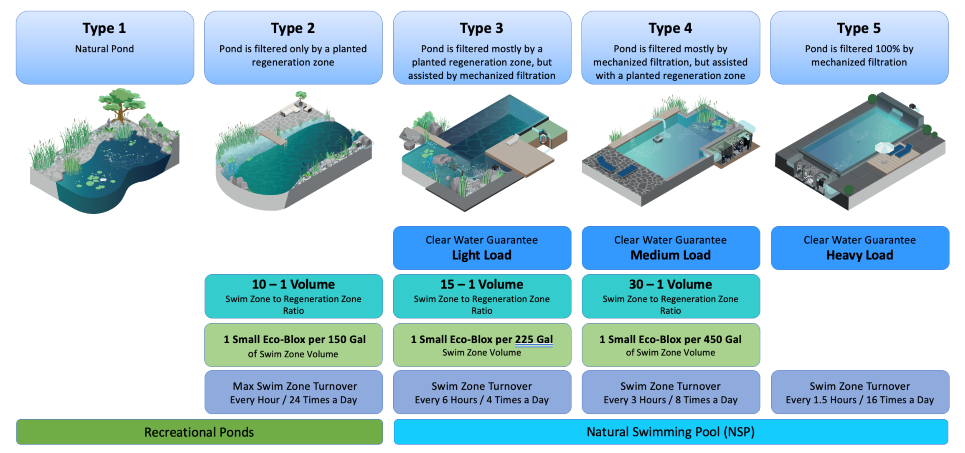
Here is a guide to answering these questions. It starts with defining five types of recreational water features and ends with specifying the exact equipment you’ll need for your Natural Swimming Pond, with Clear Water Guaranteed. (See Diagram 2 on p. 22)
Choosing the Right Type of Natural Swimming Pond
The Atlantic-Oase approach to Natural Swim Pond filtration begins with choosing one of five types of water feature based on the proportion of mechanical/biological filtration to planted regeneration zone, from a hole in the ground with no filtration at all, to a Natural Swimming Pond with only powered filtration and no regeneration zone.
You’ll want to consider your available real estate when deciding. Light filtration with a large regeneration zone could almost double your pond area. If you have a modest amount of room, a natural swimming pondswith medium or heavy filtration will take up less total space.
Figure out what size swimming area you want and multiply by 7.5 for gallons. The number of gallons in the swim zone will determine both the size of the regeneration zone and the equipment needed. Divide the gallons by the number of Eco-Blox for the type of pond you’ve chosen to find the size of the regeneration zone. Then take that volume to the Filtration Chart. (See Diagram 2 on p.22) Find the equipment needed under the Light, Medium or Heavy filtration columns.
You can always round up or increase filtration, but don’t go smaller. Doing less than recommended will not give you guaranteed clear water.
Types of Natural Swimming Ponds
Type 1: No Eco-Blox, No Filtration
If an old-fashioned swimming hole, with no powered circulation or filtration beyond what’s naturally occurring, whatever’s in there is just fine by you, then you want a Type 1. With no circulation or filtration, Type 1 ponds often have algae, weed or stagnation issues.
If au naturel is your vibe, have at it — I’m not dipping.
Type 2: Regeneration Zone Only
(1 Eco-Blox per 150 gallons; 10:1 swim zone to regeneration zone)
A Type 2 is often called a “recreational pond.” It has only a pump (hopefully NOT a submersible) pushing water through a planted regeneration zone to drop out particles suspended in the water and remove nitrates.
The most effective way to build the regeneration zone is to create a water matrix block reservoir above pond water level with a thin layer of planted gravel on top. This allows settled solids to be easily flushed out to grade when cleaning.
This style has the largest regeneration zone by volume. It also has the slowest flow through it, as there is no mechanical filtration.
Type 3 Light Filtration Load
(1 Eco-Blox per 225 gallons; 15:1 swim zone to regeneration zone)
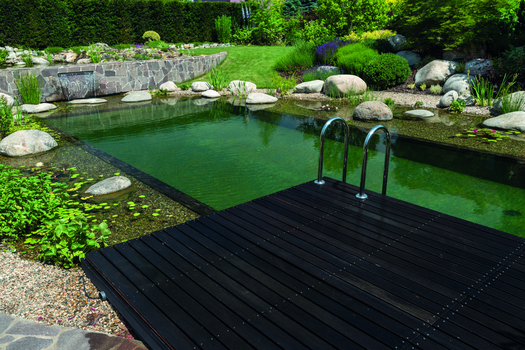
A Type 3 is a Natural Swimming Pond with a small mechanical/biological filter added to the planted regeneration zone. Trapping the majority of suspended particles in the pond water is the job of the proportionately large regeneration zone. The Light filtration helps to polish the water.
- Water flow needs to move through the zone slowly because it has to clear the water and remove nitrates, including those produced by the mechanical/biological filter.
- Most filtration takes place in the regeneration zone, assisted by mechanical filtration.
- 15:1 swim zone to regeneration zone volume ratio.
Filtration may be gravity- or pump-fed. It is often automated, cleaning itself, monitoring and sharing performance and environmental data, while connected to the cloud via Wi-Fi.
Type 4: Medium Filtration Load
(1 Eco-Blox per 450 gallons; 30:1 swim zone to regeneration zone)
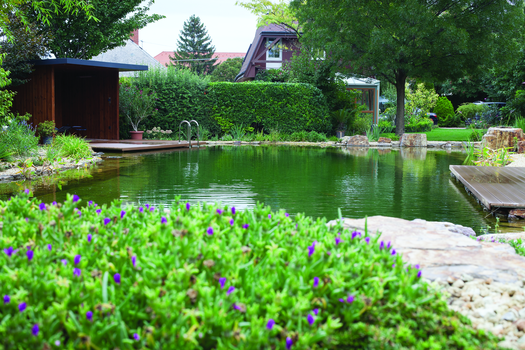
Type 4 reverses the balance between planted area and mechanical/biological filtration. The filter handles most of the particulate removal, so the regeneration zone is small and flow increases.
The function of the planted area has shifted mainly to the removal of the nitrates produced from waste matter by the filter’s beneficial bacteria.
- The pond filtration occurs mostly by mechanized filtration, assisted by regeneration zone.
- 30:1 swim zone to regeneration zone volume ratio.
- Since mechanized filtration takes up much less space than a regeneration zone, a Type 4 natural swim pond can be built into smaller spaces.
Type 5: Heavy Filtration Load
(No regeneration zone)
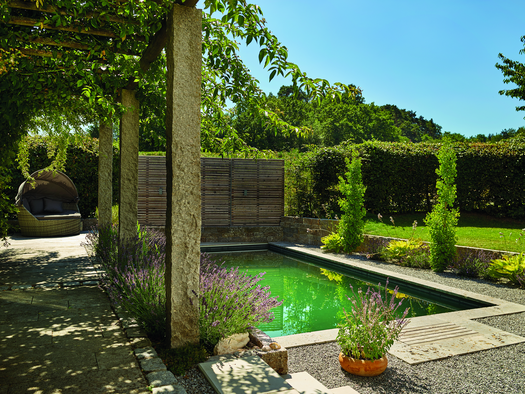
The Type 5 Natural Swimming Pond is 100% filtered by mechanized filtration; there is no regeneration zone. In this type of Natural Swim Pond, it is important to remove organic waste as quickly as possible. There is no process for nitrate removal.
- Multiple inlets, bottom drains and skimmers.
- Large-capacity drum filtration.
- Biological filtration via foams or moving media beds.
- High-output UVC clarification.
- Fully automated operation options.
Natural Swim Pond Specification
Step 1: Choose Type of swim pond. Note level of filtration and gallons per Eco-Blox.
Step 2: Determine Volume of swim zone Length x Width x Depth x 7.5 =Gallons.
Step 3: Divide Volume of swim zone by gallons per Eco-Blox for total number of Eco-Blox.
- Type 1: No regeneration zone / no filtration
- Type 2: 1 Eco-Blox per 150 gallons – Regeneration zone only
- Type 3: 1 Eco-Blox per 225 gallons – Light filtration
- Type 4: 1 Eco-Blox per 450 gallons – Medium filtration
- Type 5: No regeneration zone – Heavy filtration load
Step 4: Choose equipment based on Medium filtration on Chart.
Step-by-Step Example
Let’s say we want a Type 4 Natural Swimming Pond, with a swim zone of 15’ x 30’, 5’ deep. Volume will be 15x30x5x7.5 ≈ 16,000 gallons. Divide Volume by the number of gallons per block 16000 ÷ 450 = 35.5 Eco-Blox. The Volume in the Medium filtration column gives us:
Regeneration Zone:
- 35 Eco-Blox
- PV7500 Pump Vault
- AquaMax Eco Premium 2500 pump
Filtration:
- ProfiClear Compact L Gravity-fed with Drum and Individual (Pump) Module
- Bitron Premium 60W UVC
- ProfiSkim Skimmer
- AquaMax Eco Premium 5500 pump
Equipment Notes
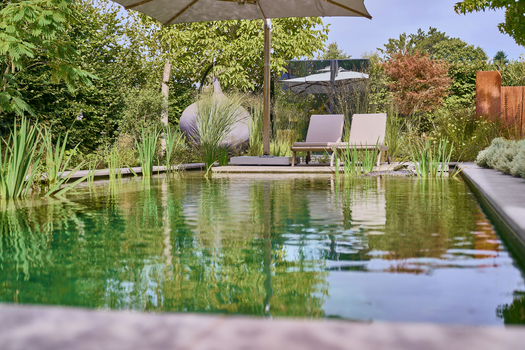
The Eco-Blox number is approximate. Use the closest number necessary to create an appropriate rectangle including the Pump Vault, in this case, a 2×18 rectangle.
Oase UVC units deliver at least 13 microwatts/cc/sec. That’s the dose of UV-C required to inactivate E. coli and render algae cells sterile.
The Individual Module specified will be attached to the ProfiClear Rotating Drum Module and used to house the AquaMax pump and UVC.
Clear Water, By Design
Remember:, use of the specified combination of products confers the Oase Clear Water Guarantee.
About the Author
Demi Fortuna is Director of Product Information for industry leader Atlantic-Oase. He travels and works with contractors and distributors alike in developing targeted Atlantic sales support materials. Fortuna has over 35 years of experience in all aspects of water garden design and construction. He has spent the last ten years in product research, development, sales and product training.