
Let’s focus on hocus pocus.
In recent years, even those who possess no magical powers have become familiar with some aspect of the wizarding world. Muggles everywhere recognize the name Potter. Some are even well acquainted with wizarding schools such as Hogwarts and the curriculum they offer. While courses such as “Spells and Charms” and “Defense Against the Dark Arts” are popular, lesser-known areas of study explore how magic is used to interpret and influence our natural outdoor spaces.
Students pursuing a degree in Water Feature Wizardry will become proficient in those staples of the study program, such as “Enchanted Forestry” and “Levitation-Based Landscaping.” In their junior year, after building a solid foundation, they can focus their studies on the residential sector.
Recently, the chance came my way to guide a group of inquisitive pupils through one of these focused elective courses. “Sorcery in the Secret Garden (WIZ 301)” focuses on residential garden construction through the implementation of magical components.
Defining Magic

So what is magic anyway? It probably makes sense for us to start there.
Members of the non-magical world might define it as the use of rituals, spells or charms to influence events, people or natural forces. Members of the wizarding world know it’s a little more complicated than that. We know that magic cannot be possessed, only guided. Even the weakest witch or warlock can harness powerful magic if their intention is clear.
The objective of the course is to reveal and reinforce the connection with magical potential in the garden space. We do this by focusing efforts toward manipulating the imagination of the observer. Stage-based magicians like Penn and Teller use sleight of hand to provide the illusion of magic. Students in this course will use sleight of mind to aid the observer in providing their own sense of enchantment.
Readers will find a summary of the semester’s study. This includes the students who participated, the syllabus modules included and their magical relevance. Conclusions drawn from completion of the thesis project will follow the general summary.
Participants
Darby Vedder, Cardinal Pond Design and Landscape LLC: Darby is pursuing a graduate degree in Water Feature Wizardry with a minor in Telekinetic Fountainscaping. In the real world, Darby is a Certified Aquascape Contractor servicing Charleston, SC, and the surrounding areas.
Cesar Rodriguez and the Alvina Hardscapes team: Cesar is an accomplished Masonry Mage, 6th level. He and members of his team are auditing this course in conjunction with “Intro to Water Feature Wizardry” (WIZ 101).
Joanna Barryman, of Botany Bay Landscaping: Joanna is a graduate of the Houdini School for Herbology and is pursuing a second degree in Botanical Bewitchery. She is using this course to serve as her work study in Apparitional Aquatics.
Course Overview: Sorcery in the Secret Garden (WIZ 301)
“Sorcery in the Secret Garden (WIZ 301)” centers on the application of the “4 Pillars of Prestidigitation.” This is a framework for designing immersive, story-driven garden spaces. Students explore how principles such as movement, transformation, animation and the passage of time can be integrated into water feature design to influence perception and create a sense of wonder. Each pillar serves as a guide for blending technical craftsmanship with creative storytelling. The result is a magical landscape that engages visitors on both a visual and emotional level.
Pillar 1: Portal Management
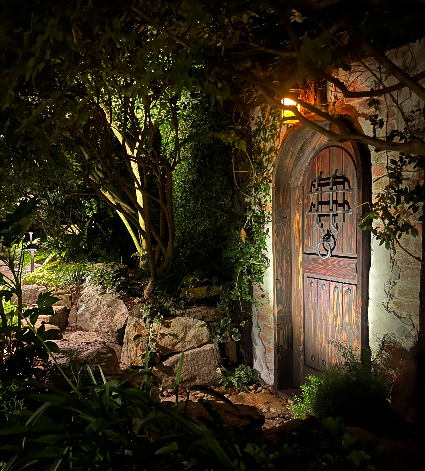
Magical doorways (portals) are essential to any enchanted garden space. Balancing entrance and exit portals keeps magical energy moving through the space. This garden features an entrance portal in the form of a moon gate tucked quietly into a hedge of camellia. The Mojave stone walkway leads across the garden, where the mystery of an aging wooden door entices visitors to explore further. Without realizing it, visitors soon cross the threshold of the entrance portal. From there they begin their transport into the bewitching space beyond.
The aging wooden door sits below grade, and where it goes is unclear at first. Stimulating the imagination to speculate what might lie beyond these walls, this old, beat-up door serves as our exit portal. Rarely used, but useful nonetheless. Unlike the entrance portal, where it leads will be different for each traveler. Willingly participating in the storyline is the first sign that the spells and incantations are taking effect on our visitors.
Pillar 2: Transfiguration
Like a lock of hair on a voodoo doll, normal, everyday items can have intense magical powers when used in the right context. Using an item with a significant personal history can greatly increase the strength of any magical undertaking.
With each visitor focused on the space beyond that wooden door, they are drawn onto the garden patio. There they must make make a decision. Will they continue through the garden and skip the attractions along the way, or will they be led astray? Knowing that the longer a visitor is entertained, the longer they will remain, we present two distractions. Each is an example of transfiguration.
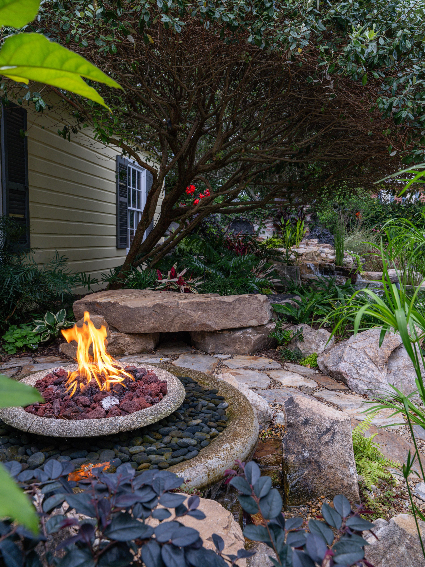
Several years prior, during a collaboration with Cardinal Ponds, we removed a decaying three-tiered fountain to make room for a brand-new fountainscape. This old fountain found its way to Darby’s backyard. There it sat, seemingly never to be used again. Little did we know it was gathering magic all along. Resurrecting this fountain into two different features for our current project, we used the principles of transfiguration to create two separate sources of distraction.
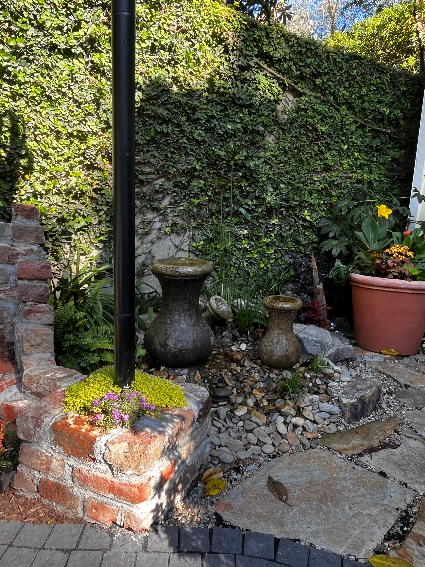
The bowls to the left that form the “tiers” transforn into a fire bowl levitating within an overflowing fountain bowl. To the right, tucked away in the far corner, the gently gurgling sound of water beckons you to stray beyond the crumbling brick wall. Rewarded on your arrival, you’ll see three bubbling urns. By harnessing the powers of such a relevant relic, we ensure that the transfiguration spell will keep our visitors from realizing that the bubbling urns used to be the pedestals for that very same three-tiered fountain.
Pillar 3: Spells of Animation
Demonstrating aptitude in the three categories of animation spells (animation, de-animation and re-animation) is a prerequisite for advanced garden incantations. Bringing things to life that shouldn’t be alive (animation), and pausing life for those things that should be busy living (de-animation), shows flexibility in imagination and proper charm control. Re-animation, on the other hand, is a formidable incantation that, when utilized, has the power to magnify effects of any other magic used within the space.
As our visitor is deciding which way to proceed, they notice a waterfall spilling into a depression in the patio. Suddenly the surface of the patio comes to life with the patterns of waves. The force of these waves has washed away the stone walkway our visitors have been following. As these waves crash against a virtual headland, represented by an organic outcropping of stairs, the animation charm is complete.
After recovering from the purposeful distractions, our visitor will notice that the old stone walkway actually continues beyond the waterfall. They will find it leads to the remnants of a decaying brick structure whose original use is still unknown. Here they will make acquaintances with Dick and Jane, a woeful couple frozen in time amidst an urban waterfall landscape. Casual observers would call them statues, but visitors well versed in de-animation charm will know that the real truth is much more intriguing.
As conversation with Dick and Jane grows tiresome, our visitor will notice that our pathway ultimately leads to what appears to be a formal pool. Only those brave enough to shed their shoes and wade in its waters will know this is the source of re-animation — a proverbial fountain of youth. Sitting in the lobes of the pool, with the natural waterfall rumbling beside you, your old life force is overflowing the whitewashed cement walls. A new energy of wonder and imagination is replacing it. The powerful wizard who acts as warden and protector of this garden knows these secrets all too well. Still he lets all the muggles believe it’s just a great way to beat the summer heat in Charleston.
Pillar 4: Time Travel
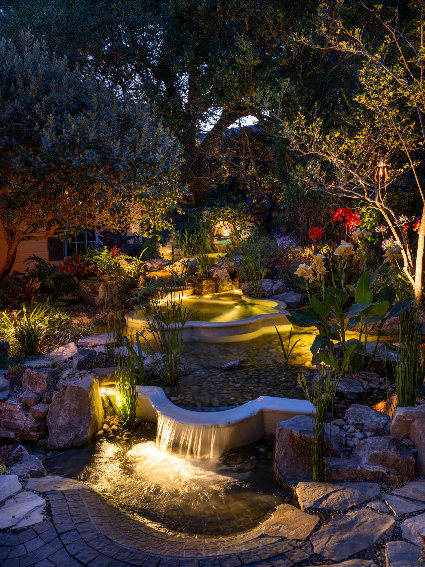
All enchanted gardens must possess the three core directions of movement: movement through space, movement through emotion and movement through time. Moving our subjects through the manipulation of time is an essential tool for transporting visitors into the magical realm. Use of layers to create a timeline of events within the space allows visitors to access their own imaginations. Any wizard worth their wand will assure you that imagination is the very lifeblood of magic.
Layers of brickwork have gone into the creation of this space. Some walls are part brick and part rock. These have their origins deep in time. Later, walls of solid brick have been erected atop these ancient foundations. Time passes on. Inevitably wanting for repair, the structures are patched and coated over with plaster. Eventually, as do all things, these structures too bow to the relentless punishment of time as they crumble in place. Opportunistic plants take hold in any nook available and hold on for dear life. Some thrive and others struggle. Old plants appear along with some newly sprouted. The only story they tell is that one day all of these so-called permanent structures left by the hands of men will be consumed by the sea of greenery and the insatiable hunger of time.
Conclusion: How to Create Magic in the Landscape
Whether our visitor believes in magic or not, we have a duty as witches and wizards of water, dirt and stone. Our duty is to transport the willing — and especially the unwilling — to a place of imagination. It is not enough to wow them with colors and shapes. We must lead them to interact with our landscape on an emotional level and come away with a heightened sense of curiosity.
The truth is: magic is very real. Anytime someone spends more time creating something than anyone could reasonably expect, magic can happen. Some label it passion; others might call it soul. We wizards see fit to call it by its real name: magic.

About the Author
Mr. Underhill is a nomadic student of the aquatic arts. A waterfall wizard 4th class he is likely plying his trade in a village near you. He had the pleasure of serving as adjunct professor during the Winter session of 2024/2025 when this project was conceived and is ever grateful for that opportunity.
About the Contractor
Darby Vedder of Cardinal Pond Design and Landscapes practices his craft in the Charleston SC Area.
Working with a group of magical and non magical beings he and his team are ready in a spell to help you make
magic happen in your space wherever you call home.