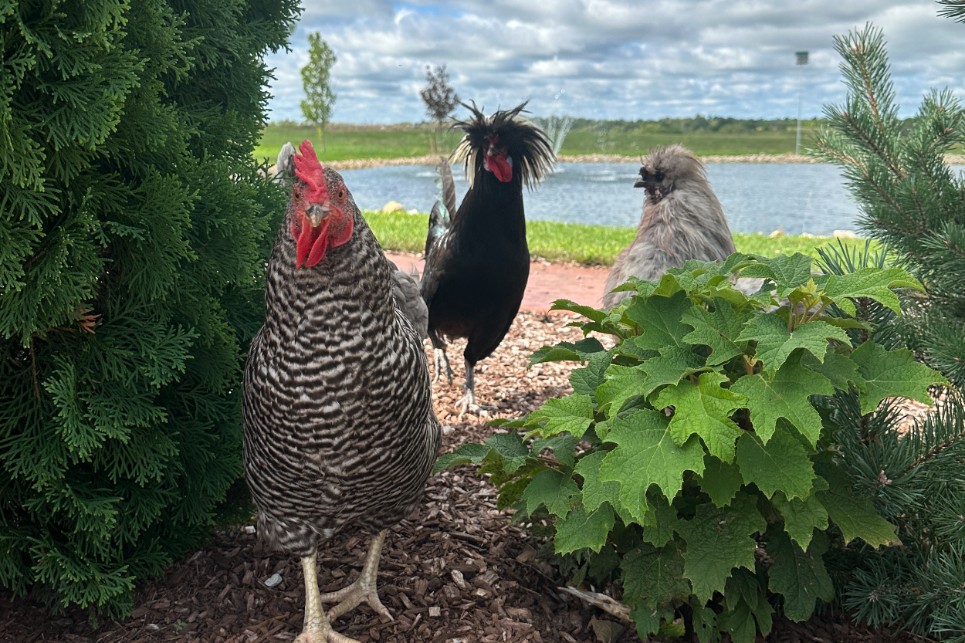
Do you hear that rustling and cackling sound over there, beyond the pond?
If you’re visiting a koi farm for the first time, you might expect the soundtrack to be rippling water, the hum of filtration, the occasional splash of a curious koi or a quiet conversation about water quality.

But on our koi farm, there’s another chorus happening just out of view—feathers fluffing, hens negotiating breakfast and one particularly dramatic rooster who believes he’s in charge of, well, everything.
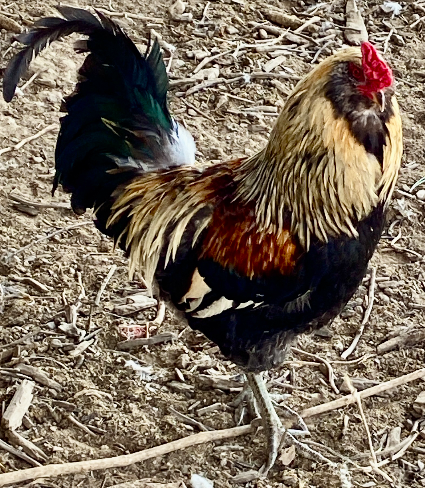
His name is Avant-Garde. And yes, he lives up to it.
He’s flamboyant, proud and just a little too cocky for his own good, strutting around like he owns the place, which, in his mind, he absolutely does.
And he’s not alone.
We also have Chicken Little, Chicken Noodle, Chicken Alfredo, Putsie, Dreads and Sweat-Pants—a rooster whose fluffy gray legs look exactly like he’s wearing a comfortable pair of gray sweatpants, especially when he bends forward to peck the ground!
Welcome to the chicken situation.
Not a Chicken Operation (Just a Chicken Situation)
We are not running a commercial egg operation. We have about 17 hens. This is not a system. This is… a chicken situation.
Like a lot of things on a farm, the chickens started somewhere between intention and “this seemed like a good idea at the time.” Somehow along the way, they became part of daily life.
They’re not just for eggs. They’re what I like to call pets with benefits.
They each have personalities, opinions and very strong feelings about where they should lay their eggs. More often than not, that means several hens bickering over the exact same nesting box, as if there aren’t plenty of other perfectly good options available.
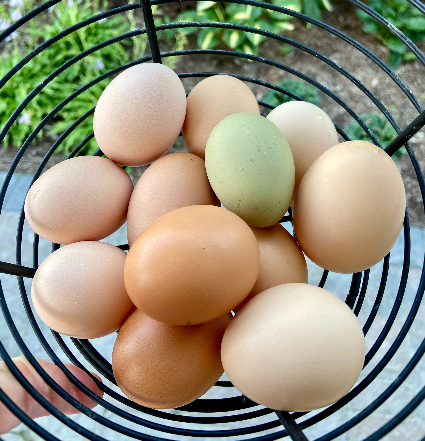
We gather eggs, yes, but we also laugh at them, chase them (occasionally) and talk about them more than we probably should. I was elated the first time we got a blue egg—I showed it to everyone.
And no, we can’t possibly eat all the eggs. So they are shared with family, friends, even the mailman, and that’s honestly the best part of having backyard chickens.
And just to round out the humor of it all, one Christmas I received not one, but two chicken cookbooks as gifts. Everyone thought it was hilarious. Me, not so much.
The Great Chick Chase
Due to recent bird flu outbreaks, a chick shortage became very real. And since chickens don’t exactly have the longest life expectancy, I found myself down to just a few “old gals.”
That wasn’t going to cut it. I needed more chickens.
Spring in the Midwest means chick days at local farm stores—shipments from reputable producers, limited windows and high demand.
And on a family farm, everyone gets involved. Our granddaughter was right there alongside me, checking schedules, riding along and helping in the hunt. We had more fun with it than we probably should have.
I became a full-blown chick tracker, calling stores, checking arrivals and chasing varieties.
If they had what I wanted, I was in the truck and on the road. The Chick Chase was on.
With the shortage, chicks sold out in less than an hour. You had to move fast.
I was thrilled to find some of the varieties I wanted, especially the blue egg layers, Americana types that had been on my list.
And it reinforced something we believe strongly: quality starts at the source. Whether it’s chicks or koi, where they come from matters.
Eggs Are Eggs… Until They’re Not
At a glance, an egg is an egg, right? But on a farm that raises both koi and chickens, that comparison only goes so far.
Chicken eggs are familiar, tangible, something you collect in a basket and crack into a pan.
Koi eggs are something else entirely—tiny, nearly invisible at first glance, and they represent years of selective breeding, planning and intention.
Some eggs we eat. Some eggs we protect like treasure and build an entire future around.
Chickens come in countless breeds—different feather patterns, egg colors, temperaments and quirks. Koi are no different—endless varieties, each with unique color patterns and characteristics that make them one of a kind.
And just like Lay’s potato chips, you can’t have just one.
Backyard Chaos vs. Farm Precision
If you’ve ever had koi in a backyard pond, you may have experienced the ultimate pond chaos: a natural spawn.
You walk outside in the morning and immediately know something is different.
Before you even see it, you smell it.
It’s not subtle.
The water looks off—foamy, cloudy, a little questionable—and the smell hits you. Strong. Unmistakable. Not exactly what you’d call “fresh pond air.”
And then it clicks. They spawned.
Fish are thrashing. Water is churning. Plants are getting beat up. It’s chaotic. It’s messy. And it happens whether you planned for it or not.
For a backyard pond owner, it’s equal parts fascinating and alarming. And once you’ve experienced it, you don’t forget it.
That’s not how we do it on the koi farm.
Here, spawning is controlled, intentional and carefully managed from start to finish. We select the parent fish. We hand strip both the female and male Oyagoi (Japanese parent koi).
The eggs are fertilized and incubated indoors in strictly controlled systems, where we manage water quality, oxygen, temperature and egg health every step of the way.
They hatch under watchful eyes, not in a pond full of chaos. A completely different approach.
Volume vs. Value
A hen gives you an egg a day. Reliable. Predictable.
Koi are a different story entirely.
When koi spawn, they produce thousands, sometimes tens of thousands, of eggs at a time.
One fills a basket. The other fills entire systems.
But more eggs doesn’t just mean more. It means more responsibility.
Not every fish will develop the way you want. It takes experience and a trained eye to recognize potential.
It’s not about producing more. It’s about producing better.
More Than “Just Farming”
From the outside, it’s easy to picture a quiet farm.
But in reality, phones are ringing, orders are moving, marketing and production decisions are being made, and systems are constantly being monitored.
And somewhere in the middle of it all, someone is still chasing a chicken.
Every day involves decisions—what to feed, how much, what to adjust, what to watch.
You learn to notice the small things—behavior, water clarity, koi activity and subtle changes.
Because producing a healthy, hardy koi doesn’t happen by accident.
It takes experience, consistency and a deep understanding of water, biology and environment.
Kloubec Koi Farm operates on a Century Farm that has been in the family for over 100 years, and we’ve been in business since 1981. This isn’t a start-up. It’s decades of experience.
We’re not just raising fish. We’re managing ecosystems.
What Chickens Teach Us
Even though the scale and purpose are completely different, chickens still manage to teach us a few things that apply directly to raising koi.
Consistency matters. Environment matters. Daily rituals matter.
The principle stays the same: take care of the environment, and the animals respond. You get out what you put into it.
Get it right, and things thrive. Get it wrong—and you’ll know pretty quickly.
Farm Life Has a Sense of Humor (Sometimes Dark)
One Christmas morning, everything was exactly what you’d picture—coffee in hand, looking out over a fresh dusting of snow. Calm. Quiet. Peaceful.
And then someone asked, “Where’s Ivy?”
Ivy, our Springer Spaniel. Our very enthusiastic bird dog.
Well, she had found the young pullets. And she was in their pen, playing.
What followed was a full sprint across the snow, in pajamas and boots, trying to rescue chickens and reprimand the dog at the same time.
It was chaos. And not the good kind.
Some of the young chickens didn’t survive. Several were injured. One, who lived on with a limp, earned the name Gimpy.
Around here, we refer to that morning (somewhat grimly) as the Christmas Day Massacre. It wasn’t funny at the time, and this wasn’t the only incident involving dog and chickens.
So, when it came to correcting Ivy’s enthusiasm, let’s just say her training program may have been an old-school method, which could have involved the dog, her collar and her prey for a very specific period of time.
Nothing harmful, just deeply humbling.
And no, you probably won’t find this method in today’s dog training manuals.
But on a farm, sometimes lessons are learned a little differently.
And it worked. Ivy was completely reformed. Chickens simply did not exist in her world any longer. She wouldn’t even look at them.
The Egg Perspective
If you step back and really look at it, both koi eggs and chicken eggs represent potential.
One becomes breakfast. Maybe a shared carton, never quite the same twice, with browns, beiges and the occasional blue or green egg.
The other becomes living art, a fish that will grow, develop and one day be the highlight of someone’s pond; a real show-stopper they’ll be proud of.
Same starting point—an egg.
But what happens next is entirely different.
One is immediate. One is long-term.
One feeds a morning. The other becomes something people enjoy for years.
And yet both are valuable in their own way.
That’s farm life. It’s not always pretty. It’s not always polished. But it’s always real.
More Than Just Fish
Raising koi is what we do. But farm life is everything that happens around it—the chickens, the mud, the routines, the long days and the unexpected chaos.
It’s easy to look at the koi farm and see only the finished product—beautiful koi fish, mirror-surfaced ponds and the entire operation. But behind it all is a real place, with real people—a hardworking family and, yes, a handful of chickens that were never meant to be anything more than a footnote, a small part of our story.
It’s the unexpected experiences that don’t make it into the business plans but make up the story behind the numbers and between the lines. They’re the special times you never planned, but will never forget.
At the end of the day, this isn’t just about fish or chickens. It’s about raising something from the very beginning and seeing it through.
Sometimes the best farm stories aren’t the ones you plan. They’re the ones you survive.
And that’s just a peek at Kloubec Koi Farm… Beyond the Pond.