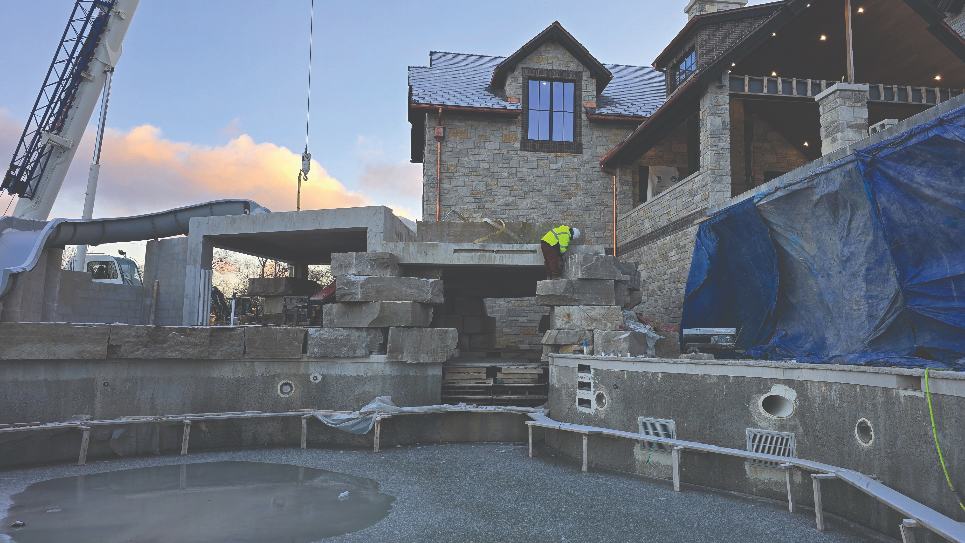
Last year at this time, we were beginning construction on a massive grotto, waterfall and rain curtain in Palos Park, Illinois. While the winter started out mild, we work in the Chicago area. We knew what was coming.

Some might shake their heads at starting such an ambitious build late in the season but at Reflections Water Gardens, we don’t shy away from a challenge.
Platinum Pool, a leading builder in Wheeling, Illinois, invited us to join their team. Their job was to install an Olympic-size swimming pool with amenities, including a 30-foot elbow slide and three hot tubs.
The project ran parallel with the construction of the client’s home—a lodge-style estate situated on an existing horse farm. Beginning late in the season meant the family could enjoy the water features as soon as the weather turned warm.
Our role was to build a 30-foot-high, 25-foot-wide grotto using an elevated deck as its framework. Our list included creating a towering waterfall on one end and a rain curtain shielding a sunken pool on the other.
More than an add-on, the grotto was to be the pool’s focal point. The water feature had to feel massive and natural, yet blend seamlessly with the pool, landscape and the home’s architecture.
According to the design, the spiral staircase was to provide access to the elevated deck and slide. The towering waterfall was to drop from the top of the grotto on the hot tub side. The sunken pool with the rain curtain on the grotto’s opposite side.
From the outset, I knew this build would test our creativity, endurance and ability to adapt—and the challenges were extreme. The constraints of working in ice, sleet and snow were demanding, as were the challenges of curing concrete and keeping pipes, equipment and materials from freezing.
Adding to the complexity, the deck’s concrete framework had been poured before our involvement, meaning we had to cut every rock to fit around it rather than setting stone first and leaving voids for concrete after. The slide was already in place when we arrived, so every stone had to be cut and set without damaging the fiberglass structure.
Navigating Tight Quarters
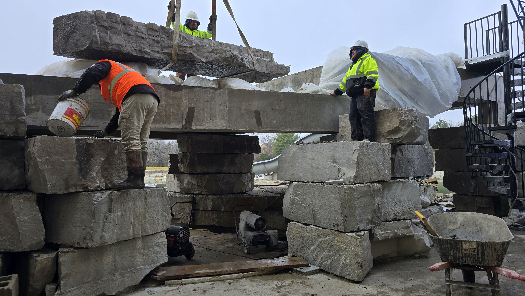
In our business, planning demands creative problem solving. Issues around access can make or break progress, and this was one of those moments.
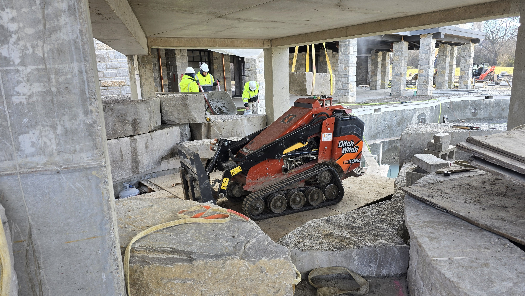
Access to the job site was restricted by the spiral staircase. Concrete pillars framed the deck and the pool’s linear footprint along the back of the house. With no way to bring in full-sized machines, we relied on a crane to position heavy stone and a mini skid steer to transport materials. Meanwhile, contractors installed bluestone patios, so staging and sequencing became coordination with construction.
To move efficiently around the space, we placed pallets inside the sunken pool and created a temporary drivable surface for the skid steer. That adjustment allowed us to waterproof the shell and safely set the rain curtain framework.
We worked with Wisconsin Lannon Stone for this project. During the selection process, each stone was evaluated for stability, load-bearing capacity and ability to strengthen the grotto’s framework, as well as for its rugged texture and warm tones.
This stone choice was critical for structural integrity, water flow, sound and weatherization. Wisconsin Lannon Stone, a dolomite limestone, is valued for its durability and resistance to erosion. It has consistent density that makes it reliable under load, while its color and texture bring dimension to the build.
The design required every stone to be cut and set with precision. During what became a winter with below-average temperatures, each stone had to be handled in freezing conditions. Even a slight misplacement could disrupt the water’s flow and undermine the natural effect of the waterfall.
Adapting to Winter Realities
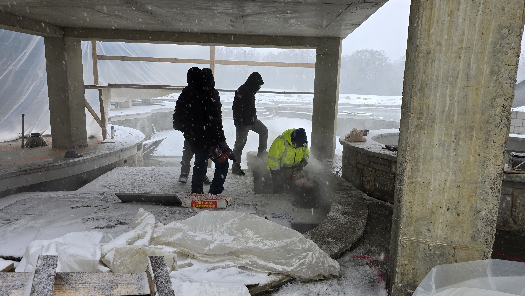
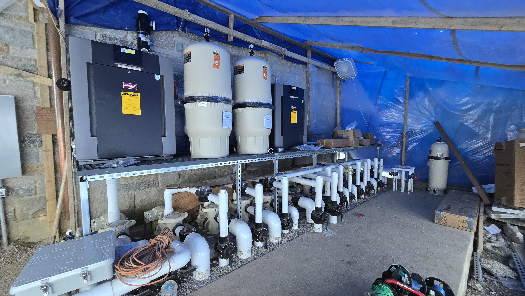
We set up a heated storage facility on-site to protect our hoses and tools. That small shelter was essential for keeping the project moving. Without it, every cold snap could have stalled us for days. Mechanicals were similarly protected, including with tarp to provide shelter from winds and freezing rain.
There’s always a rhythm to stonework: cut, place, step back and assess. Winter has a different rhythm. Water freezes. Equipment fails. Fingers go numb after a few minutes without gloves. At one point, the main grotto stone fractured after being placed, forcing us to remove and source a replacement—no small task in frozen ground.
Working in winter tested our patience and resilience. The rhythm of our work was disrupted by frozen ground, icy surfaces and constant safety checks. Through it all, our team learned to work with the cold instead of against it and that mindset made all the difference.
Instead of resenting the conditions, we leaned into them, pacing ourselves and celebrating progress one boulder at a time. This was not about rushing, but about precision. Each week brought visible change.
Building a Backyard Escape
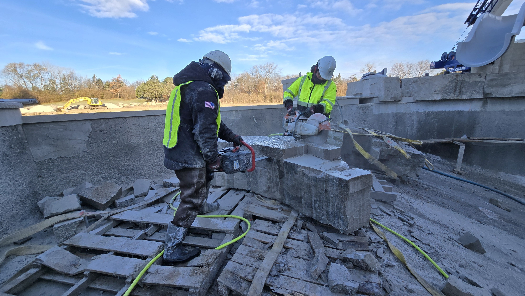
As the grotto took shape, the backyard escape came into focus. The Olympic-size swimming pool stretched out in front. The spiral staircase wound its way to the slide and elevated deck. Three hot tubs provided distinct experiences.
From the pool, the grotto and waterfall offered ambient sound and a dramatic view. From inside the sunken pool, the space became a serene retreat veiled by the rain curtain.
The project was on a fast track for completion, and that pressure shaped everything we did. If we hadn’t worked through winter, we would not have finished on the client’s deadline. By March, the final boulders were nearly in place. The structure was sound and the waterfall’s framework was ready. All that remained was finishing work and fine-tuning the water elements.
Building a grotto is one thing. Making it feel natural is another. Water does not lie. It reveals every imperfection in grade, slope and placement. Our goal was to create a flow that looked effortless and timeless, as though the grotto had always been there.
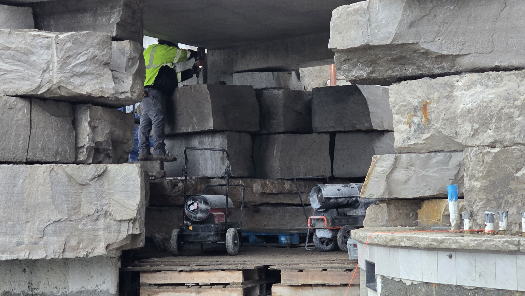
In the early spring, rocks needed adjustment to perfect water flow, so we cut, shifted and reset stone until water cascaded smoothly. The process was meticulous but rewarding. When it came together, ambient sound and movement created a luxury feel that transformed the space.
Fine-tuning the rain curtain added complexity. Too much flow becomes a torrent. Too little, and the effect disappears. We calibrated carefully until the rain curtain created privacy and mystery without overwhelming the sunken pool.
Even then, we couldn’t test the full system until the pool was plastered, filled and running. By the time water flowed, landscaping crews had begun closing off access, which meant we couldn’t use our crane or other large equipment. Adjustments had to be made by hand in tight quarters.
Working side by side with our partners at Platinum Pool, we ensured our features blended seamlessly with theirs and within the site’s landscape. Collaboration is what makes projects like this possible—and fun. Even in winter.
The Finished Escape
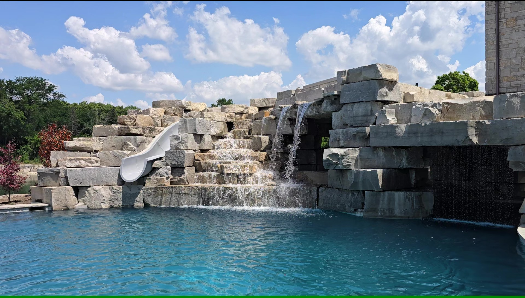
By mid-spring, the grotto was finished, framed in stone that mirrored the home and felt natural in the surrounding landscape. Every vantage point delivered something new—drama, luxury, intimacy and playfulness—the essence of a backyard escape.
For the clients, the grotto was a vision that started months earlier. For our team, it was proof of what can be achieved when determination meets collaboration. We created more than a backyard water feature. We created an environment, an experience and a lasting memory.
Projects like this affirm why I do what I do. Water transforms space. It turns a backyard into an escape, stone into a sculpture and challenge into an accomplishment. When the client walked the site and smiled, every cold morning and frozen late night felt worth it.
Lessons from Winter
As pond professionals, we often face conditions that test our limits. Whether working in heat, cold, rain or logistical puzzles, we adapt. In adapting, we grow. This project reminded me that some of the best outcomes come not in spite of challenges but because of them.
Building in winter is not for everyone, and it’s not always advisable. But when conditions require it and the team is prepared, it can be done—and done well. The keys are preparation, protection and perspective.
Preparation means planning every step, from equipment and storage to materials and staging. Protection means safeguarding tools, hoses and people from the cold. Perspective means embracing the conditions instead of fighting them.
Winter work also highlights the importance of teamwork, especially in tight spaces. You discover rhythms and efficiencies that might otherwise go unnoticed. Without collaboration, the dedication of our crew and the patience of our client, this project would not have come to fruition.
Now that the build is behind us, I often look back on those long winter days with a mix of relief and pride. Relief that we persevered and pride in the final product. The Palos Park grotto is more than stone and water. It’s a testament to resilience, artistry and the belief that beauty can be built in any season.