Why shallow water plants matter
When you picture a beautiful pond, what do you think of? Water lilies in bloom. A bubbling stream. Reflections of blue skies and green trees. Bright fish moving below the waterline.
Behind that picture-perfect scene, something else is happening—quietly, at the water’s edge.
The Overlooked Zone That Does the Heavy Lifting
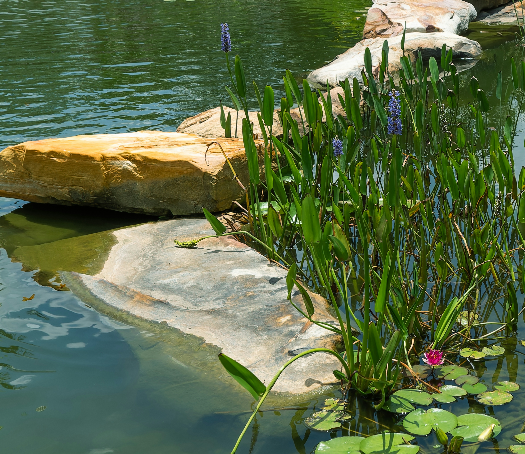
Shallow water plants, also called marginal plants, occupy that narrow but critical zone where land meets water. They grow with their roots submerged and their foliage above the surface, forming a living transition between two environments. They’re often treated as decorative accents. In reality, they’re doing some of the most important work in the pond.
The plants I’m talking about include pickerelweed (Pontederia cordata), cattail (Typha spp.), water iris (Iris spp.), arrowhead (Sagittaria spp.), rush (Juncus spp.), sweetflag (Acorus spp.)—many think of them as finishing touches. They’re actually infrastructure.
These plants act as natural filters, stabilizers and food sources for the pond (and the people around it—more on that later). They influence water clarity, protect pond structure and expand what a water garden can offer beyond aesthetics. In many ways, they are the difference between a pond that looks great for a season and one that stays balanced for years.
Understanding how shallow water plants function is one of the most important steps in building a successful pond. Let’s dive in.
Nutrient Control Starts at the Edge
From the moment you fill a pond, nutrients start building up.
Decomposing plant material, fish waste and runoff all introduce nitrogen and phosphorus into the water. Those nutrients feed algae, which is fast, opportunistic and very good at getting there first.
Shallow water plants compete for those same nutrients. Their roots pull nitrogen and phosphorus directly out of the water and sediment, storing them in their roots and leaves before algae can take over.
The effect is real and measurable. In constructed wetland research, cattail (Typha spp.) has shown ammonia-nitrogen removal rates above 90 percent in some systems. That’s a significant number.
There’s a fish connection here, too. When water quality drops, fish feel it. Research shows that when nitrogen builds up, fish feed less, stress more and become more vulnerable. A planted marginal zone and healthy fish aren’t competing priorities—they’re connected ones.
One thing worth knowing: when marginals die back and decompose in place, those nutrients return to the water. Cut them back before fall and remove the material. The plants did the work all season—you don’t want to put it back.
Holding the Line: Erosion Control That Works
Erosion doesn’t typically announce itself.
It happens gradually, a little soil at the waterline, a bank that slowly softens, an edge that wasn’t quite where it used to be.
The shoreline is where wave action, changing water levels and runoff all converge. Without the right plants holding it together, that edge quietly loses ground season after season.
Pond edge plants hold it together. Iris, pickerelweed, cattail and rush produce dense, interlocking root networks that weave through soil particles and bind them together. They function like a living fabric through the soil.
Above ground, the stems and leaves absorb wave energy before it reaches exposed soil. Every wave that breaks against a stand of pickerelweed instead of bare soil is a small erosion event that didn’t happen. Multiply that across a season and the difference is substantial.
And the roots don’t take a season off. The above-ground portion dies back in winter, but the root network stays intact. The protection continues year-round.
Build the Edge, and Life Shows Up
Plant the edge and the wildlife will follow.
The shallow water zone creates the conditions wildlife is looking for: places to land, shelter for juvenile fish, egg-laying sites for amphibians and food for pollinators.
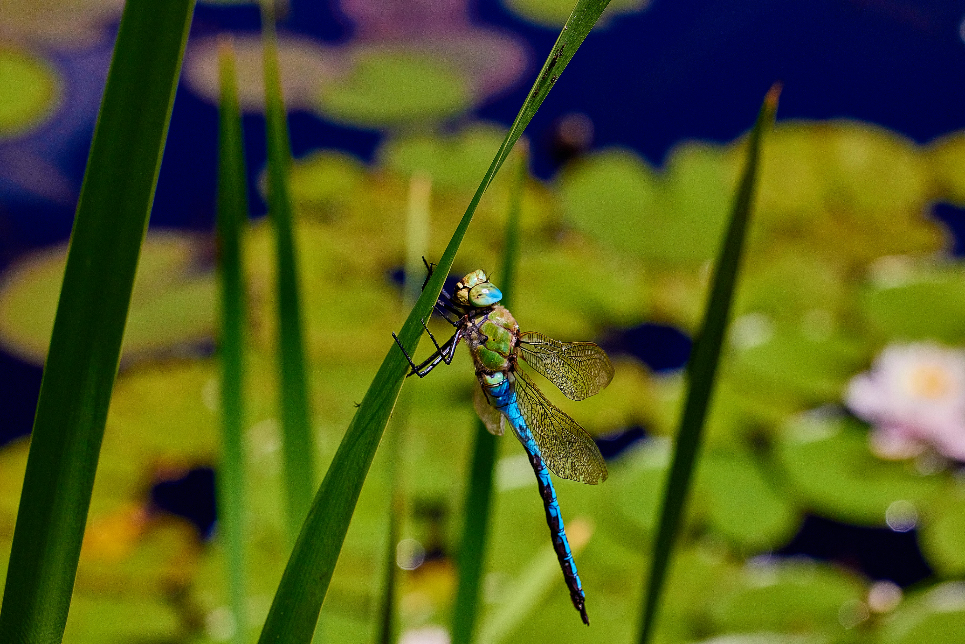
Did you know dragonflies are aquatic insects? They spend most of their lives, sometimes years, as larvae underwater, living among plants and in the silt of the shallow zone. The adult you see gliding over the pond surface spent years in the habitat you planted.
Frogs and toads carry a similar message. A toad’s skin absorbs chemicals, pesticides and pollutants from its environment, making an abundant toad population a strong sign your pond is in good shape.
Structure matters as much as water quality. Gentle, sloping margins give amphibians easy entry and exit. Emergent stems provide egg-laying sites. The root systems of marginal plants create cover for invertebrates and small fish, the base of the pond’s food chain. A 2025 study across more than 150 ponds in Europe found that shallow ponds with better water quality and planted margins supported significantly greater amphibian species richness. Better structure at the edge means more life in and around the pond.
Pollinators find it, too. Pickerelweed draws native bees consistently through its long bloom season. Blue flag iris brings early-season visitors. And two natives worth knowing well: lizard’s tail (Saururus cernuus) and white water hibiscus (Hibiscus lasiocarpos).
Lizard’s tail is a North American perennial that thrives in shallow water and shadier spots where many marginals struggle. Its white, fragrant flowers and lush heart-shaped foliage make it a favorite, and its habit of forming large colonies over time means it does serious work as a planted margin.
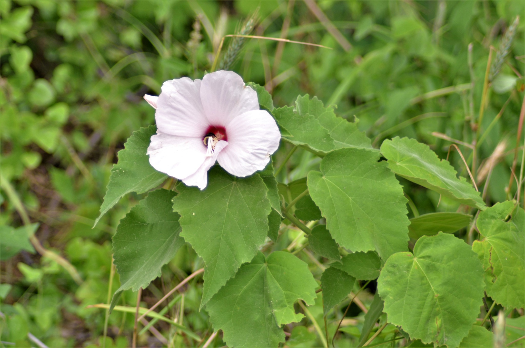
White water hibiscus is one of the showiest native plants you can put at a pond edge. Blooming July through September with flowers up to 6 inches across, it serves as a nectar source for butterflies and a critical pollen source for native bees, continuing the relationship between flower and bee that has been going on for generations.
Plants That Feed the Pond—and You
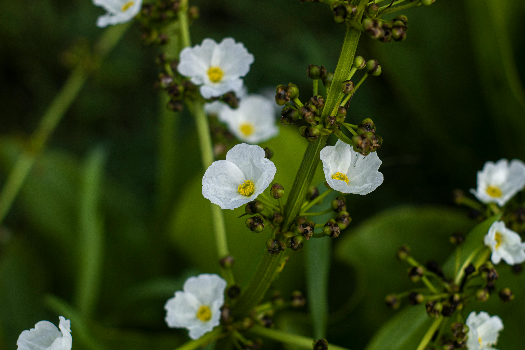
Some of the hardest-working pond plants can also feed you.
Several of the best shallow water plants for water quality and erosion control are also edible.
Arrowhead, also called duck potato (Sagittaria latifolia), produces starchy tubers, often compared to small potatoes when cooked or water chestnuts when raw. An important food source for many Native American peoples, it’s also a reliable marginal plant, thriving in shallow water while stabilizing soil and supporting overall pond health.
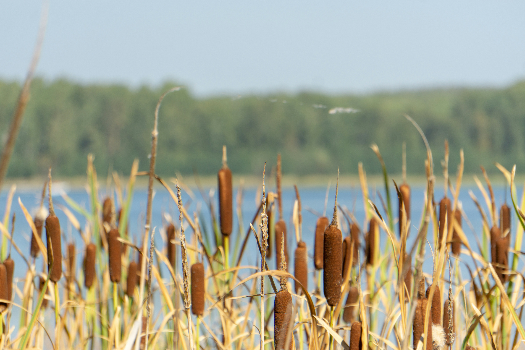
In spring, the young cattail (Typha spp.) shoots can be harvested and eaten fresh or cooked. They have a mild, cucumber-like flavor. The immature flower spikes can be prepared similarly to corn, and later in the season, the pollen can be collected and used as a flour supplement. At the same time, cattail is actively pulling nutrients from the water, anchoring soil and supporting wildlife. Few plants do more in one place.
Taro (Colocasia spp.) belongs in this conversation, too. Grown in shallow, standing or slow-moving water, it produces edible corms and large leaves often used in cooking. In traditional Hawaiian systems, taro was grown in flooded terraces called lo’i kalo, not just for food production but as part of a managed water system that filtered water and supported surrounding ecosystems.
It’s hard to find another group of plants that does this much in one place.
One important note before you start harvesting aquatic crops: aquatic plants are bioaccumulators. Their ability to clean water means they also absorb what’s in it. Harvest only from ponds with known water quality, and always positively identify plants before eating.
Designing the Edge for Long-Term Success
What makes the edge possible?
A newly filled pond can look clean and finished, but without planting at the edge, nutrients begin to build and algae often gets there first. Nothing is in place to compete with it yet.
That’s where that shallow zone comes in.
Creating a shelf or ledge around the perimeter gives these plants a place to live. Without that space, they don’t really have anywhere to establish.
When that zone is planted, the whole system responds. Plants begin intercepting nutrients right away. The water settles in faster. The edges hold together.
From there, it’s less about adding more and more plants and more about how they’re arranged.
A planted edge works best when it carries around the pond and has some variation to it. Mixing heights and textures—upright plants, broader leaves and finer foliage—creates a more natural transition from land to water and gives different types of growth a place to establish.
A single plant repeated everywhere can function, but a mix tends to feel more complete, look more natural and support a wider range of life at the edge.
That’s really what this comes down to. The edge works when you make space for it.
Don’t Overlook the Edge
It’s where plants take hold. Where nutrients are put to work. Where the bank holds together instead of washing away. And where insects, amphibians and pollinators find what they need.
Give those plants a place to grow, and the whole system works better.
The long-term success of a pond is built at the edges.
About the Author
Joe Summers is a horticulturist and the founder of Chalily, a garden center specializing in retail and online sales of water
lilies, lotus, and shallow water plants and more. With decades of hands-on experience, he focuses on helping customers build healthier, more balanced ponds through thoughtful planting.


Thank you for such an informative article. I love that the plants are so pretty and but also so effective at removing the nutrients that feed algae.