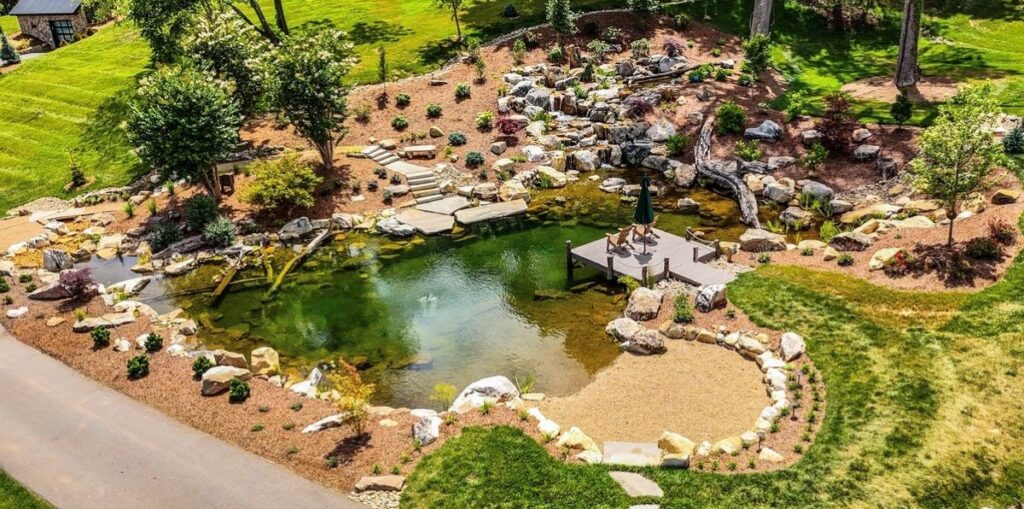
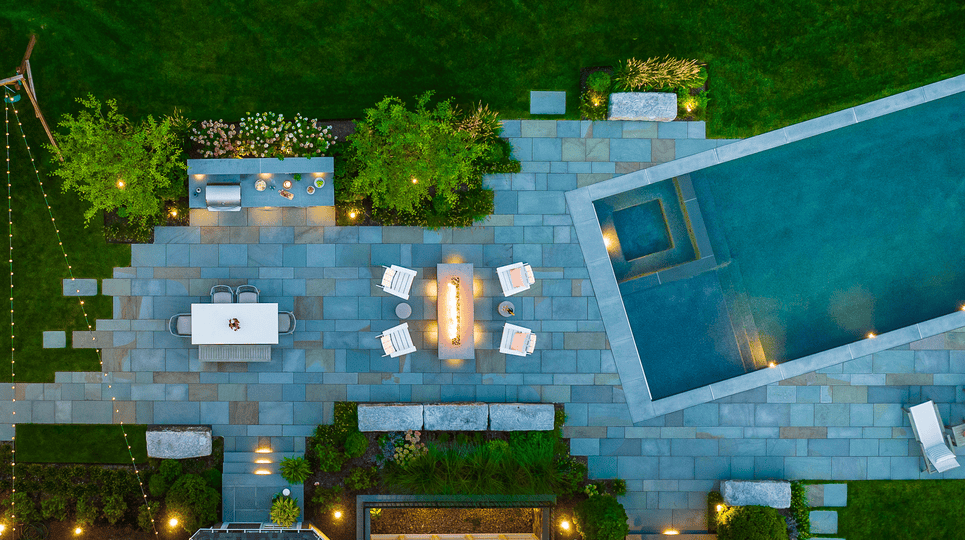
design that offers an entirely different perspective from the ground.
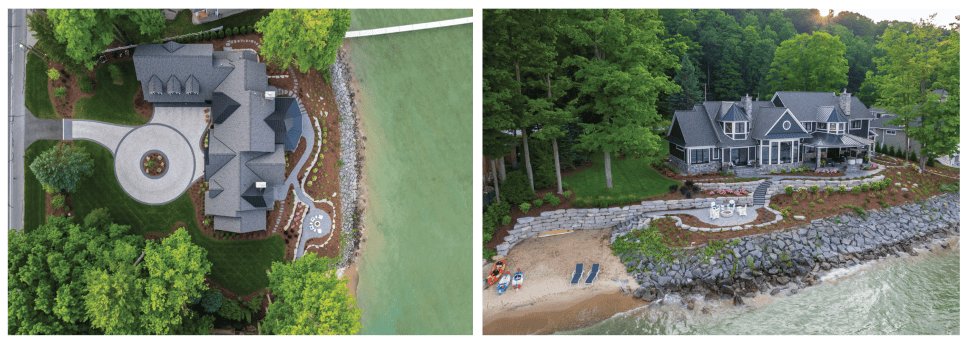
Capturing a water feature project looks great from a lot of angles, but especially from the sky. An elevated view highlights the scope of the work and gives a perspective that’s just as interesting as ground level, sometimes more. There’s a real opportunity here to get great footage and images of the water feature you built. There are also a few hidden pitfalls worth considering before you casually send the drone up.

The first part of this is about getting the shot right. The second part is about something a lot of contractors haven’t thought through: whether the person flying that drone is legally allowed to be doing it for money.
Part One: Getting the Shot, Especially Over Water
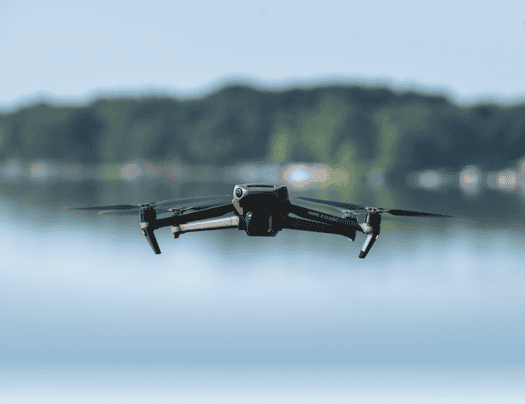
Don’t overthink this part. Some of the best water feature shots come from just getting the drone up and paying attention to a few basics, not from treating every flight like a film shoot.
Time of day is worth thinking about, mainly because of glare and reflection. Water acts like a mirror, and depending on the angle of the sun, that mirror either works for you or against you. Midday sun tends to bounce straight back into the lens. Earlier or later in the day, the light sits at an angle that gives the water color and depth instead of just glare. It’s not something to stress over, just something to keep in mind when you’re picking a time to fly.
A polarizer or ND filter helps here too, and it’s worth having one in the case. It cuts glare off the water’s surface and can pull out reflection and color you’d otherwise lose. Every setup behaves a little differently depending on the light and the water itself, so it’s worth experimenting rather than assuming one filter setting will work every time.
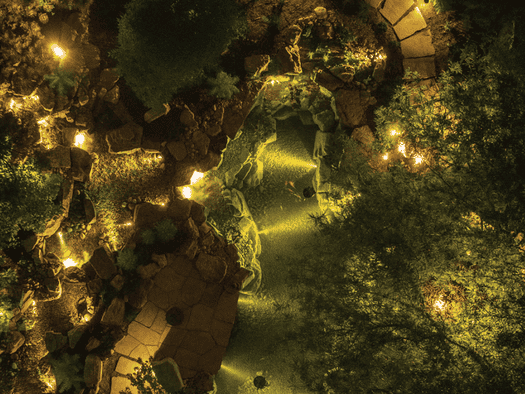
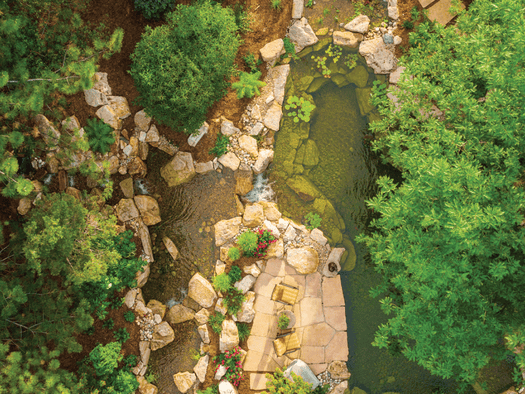
On altitude, grab your wide establishing shot from up high, but don’t stop there. Some of the strongest footage comes from getting closer than people expect, whether that’s dropping altitude or using a tighter zoom if your drone has one. The careful nuance of a waterfall or stream bed built by hand loses its detail from 100 feet or higher. Getting in close enough to show the stonework and the water movement together tells a different story than the high-altitude overhead view, and it might be the shot that actually sells the craftsmanship.
Movement matters, and the key to great video is keeping it slow throughout the flight, not just when you’re closing in on the feature. A slow, steady move from a wide shot of the property into a closer pass over the water reads as intentional. Using something already on the property — a mature tree, a pergola, the corner of the house — to build the reveal makes it even better. Try orbiting slowly around a tree while gradually rotating the camera down toward the water feature. Hiding the payoff behind something for a beat creates tension, and revealing it creates release, which is a far more interesting shot than just flying straight at the feature. Quick or jerky movement could read as amateur no matter how nice the project might be.
As for instability, in my experience the drone can handle almost anything reasonable, so shaky footage from wind usually isn’t the real problem. The real problem is that windy or unpredictable conditions raise the odds of something going wrong, a lost signal, a miscalculated distance, a crash. And that’s where this stops being a conversation about getting a good shot and starts being a conversation about what happens if it goes bad.
Part Two: The Legal Side Nobody Wants to Talk About
I doubt any landscape company is putting “our guy has a Part 107” on their website or Instagram bio. That’s not really the issue. The issue is more common than that. More than likely, someone on staff owns a drone and when the company needs footage, that person gets handed the controls. It seems harmless. It’s often genuinely helpful in the moment. But it means the company is now exposing itself, and that employee, to liability neither of them may realize they’re carrying.
The FAA’s rule is that if a drone flight serves your business in any way, even if nobody paid you directly for that specific flight, it counts as commercial operation. A promotional video for your own company counts. A photo for your own website counts. Legally flying for that purpose requires a Part 107 Remote Pilot Certificate.
For a long time, enforcement was inconsistent enough that a lot of people treated this as a formality. That’s shifting. The FAA has strengthened its enforcement approach to unsafe or unauthorized drone operations. I won’t bury this in a wall of numbers, but it’s worth knowing that violations can result in significant civil penalties. And because a single flight can involve multiple violations, the consequences can add up quickly.
The important takeaway is that not having a Part 107 certificate doesn’t shield you from any of this. It just means that if something goes wrong, the company has no credential to point to and no proof that whoever was flying actually knew the airspace rules, the restrictions or what they were doing up there.
I think about it the same way I think about a CDL. You don’t need one to drive a truck around your own job sites, until you do. Most days, nothing happens and nobody checks. But if you get pulled into a situation where it matters and you don’t have it, that’s a real headache (and then some) for the driver and the company both. Flying a drone commercially works the same way. The requirement isn’t the government overreaching into a hobby. It’s there because the skies need to stay safe for everyone using them, and because a business is better protected when the person flying for them has actual training behind them instead of a few YouTube videos watched the night before.
Common Pitfalls, Licensed or Not
Even trained pilots get complacent. A few mistakes come up again and again in FAA enforcement cases and general drone incidents:
- Flying without checking for temporary flight restrictions or other airspace restrictions
- Flying into restricted airspace, most often near airports, without proper authorization
- Flying in adverse weather conditions, high wind, low visibility or storms rolling in
- Flying over people without understanding and following the applicable FAA requirements
- Ignoring Remote ID requirements
None of these require bad intentions. Most of them come down to not checking something that takes two minutes to look up before a flight. That’s exactly the kind of knowledge a Part 107 course drills into you, and exactly the kind of thing an untrained pilot has little reason to know to check.
What to Look For if You Hire It Out
If getting someone on staff certified isn’t realistic right now, hiring a licensed pilot is your option, but not every drone operator with a website is actually qualified to work on a job site that needs to feature your landscape work.
Start by asking to see the Part 107 certificate itself, not just a mention of it. It’s a simple ask and any legitimate pilot will have it ready. Beyond that, ask about insurance. A pilot carrying liability coverage specific to drone operations is protecting your business as much as their own if something goes wrong on your property.
Experience with the specific kind of site matters too. Flying over an open field is a different job than flying near power lines, close to a home or around a crew that’s actively working. Ask whether they’ve shot job sites like yours before, and ask how they handle safety around people and structures while flying. A pilot who takes that question seriously and has a real answer, not just “I’m careful,” is usually the one worth hiring.
Last thing worth checking: whether they know the airspace restrictions in your area. Some job sites sit closer to airports or controlled airspace than people realize, and a pilot who can speak to that without hesitation has actually done this work before.
What to Look For if You Want to Get Licensed Yourself
Getting a Part 107 certificate takes real study, but it doesn’t require flight hours or a pilot’s license to start. It comes down to passing the FAA’s Aeronautical Knowledge Test, a 60-question exam that covers a lot of the same ground as manned aircraft training, including reading sectional charts, airspace classifications, weather patterns and aviation terminology most people have never had a reason to learn. It’s not a rubber stamp. You’re being tested on some of the same material a plane pilot needs to know.
Most people study on their own using an online prep course, and a solid one will run somewhere in the range of a hundred to a few hundred dollars, plus a testing fee to sit for the exam at an approved center. Plan on a few weeks of focused study, longer if you’re fitting it around a full workload. It’s a real exam, not a formality, but it’s also built to be passable by someone without an aviation background if they put in the study time.
Once you pass, the certificate does not expire, but pilots must complete periodic recurrent training through the FAA to maintain currency rather than sitting for the full exam again. For a company that plans to keep shooting its own aerial footage long term, it’s a one-time investment that pays for itself the first time it keeps you out of a prickly conversation with the FAA.
Marketing your work with drone photography
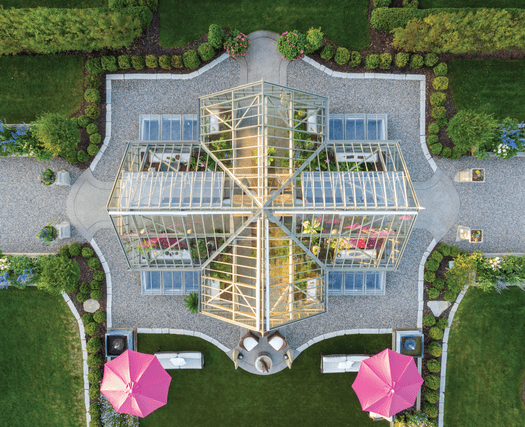

Commissioned by U.K.-based Alitex Glasshouses, these aerial images showcase a custom glass greenhouse set within an expansive estate. The overhead perspective highlights the structure’s design and its relationship to the surrounding landscape.
If drone footage is part of how you market your work, especially something as visually striking as a water feature, the unique perspective is worth chasing. As a business owner, you really have two paths: get someone on your team certified, or hire it out to someone who already is. The upside of good aerial footage is real. So is the exposure if you skip the part that keeps you legal while getting it.
With that all said, take to the skies safely and capture some beautiful watershape images.
A quick note: this isn’t legal advice, just what I’ve learned holding a Part 107 myself. If you’re unsure where you stand, the FAA’s website and a conversation with an attorney are worth the time.
About the Author
Chris Major is a photographer and brand strategist who works with pond builders and water artisans to help them present their work with clarity and purpose. Drawing from a background in the landscape industry and award-winning photography, he focuses on visual storytelling that highlights craftsmanship, builds credibility, and attracts the right clients.