
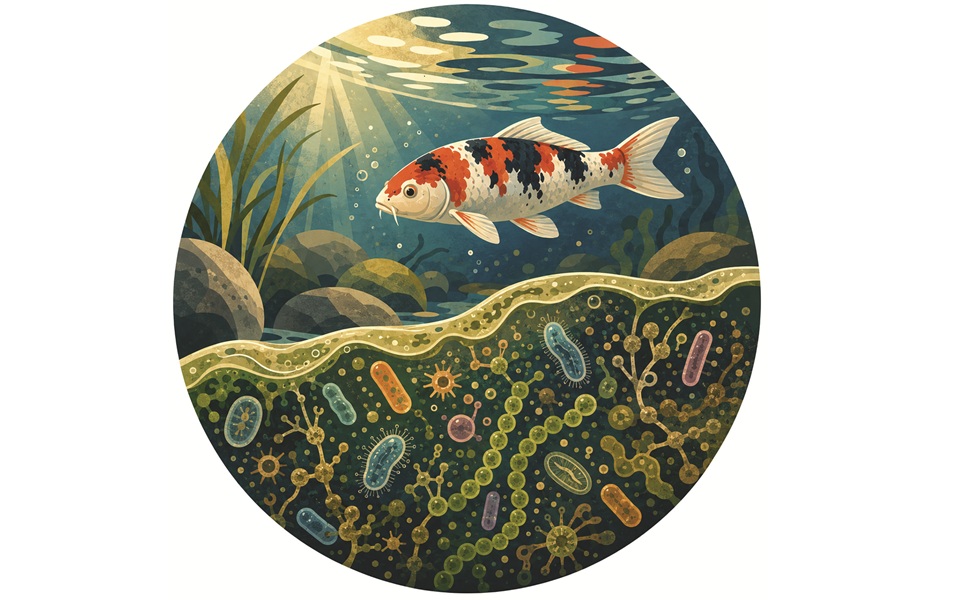
Pond biofilms are complex communities of microorganisms (primarily bacteria, but also containing algae, fungi, protozoa and other microbes) embedded in a protective extracellular polymeric substance matrix, often appearing as slimy films, scums or mats on surfaces in and around ponds. One of the benefits is the water clarifiers, rotifers and nematodes take residence among the algae in the biofilm, along with heterotrophic and nitrifying bacteria.
They form on submerged substrates (rocks, plants and sediments; known as periphyton or benthic biofilms), at the air-water interface and even on artificial structures. While surface scum-type “biofilms” in managed ponds are often a nuisance (accumulations of dead organic matter, pollen, lipids and bacteria when decomposition lags behind die-off), true microbial biofilms play vital ecological roles in natural aquatic systems.
Key Ecological Importance of Pond Biofilms
1. Nutrient Cycling and Water Purification
Biofilms are powerhouse decomposers. Bacteria and other microbes break down organic matter (leaves, dead plants/animals and pollutants), recycling nutrients like nitrogen and phosphorus. They drive processes such as denitrification (conversion of excess nitrogen to gas) and help mitigate eutrophication. In balanced systems, they act as a “microbial skin” that buffers nutrients, preventing harmful algal blooms by competing for resources and producing allelochemicals that inhibit cyanobacteria.
2. Primary Production and Food Web Foundation
Photosynthetic components (i.e., diatoms, green algae and cyanobacteria) in periphyton biofilms contribute significantly to primary production, especially in shallow or clear ponds, which is the primary desire of every pond owner. They form the base of the food web, grazed by invertebrates, tadpoles, fish and other organisms. In nutrient-poor (oligotrophic) systems, they can be the dominant energy source.
3. Bioremediation and Pollutant Removal
Biofilms adsorb and biodegrade toxins, heavy metals, pesticides and organic pollutants. They help remove excess nutrients from runoff, improving overall water quality. This makes them useful in natural treatment systems, floating wetlands or constructed ponds.
4. Sediment Stabilization and Habitat Provision
They bind sediments, reducing erosion, and create microhabitats for diverse microbes and small invertebrates. This supports biodiversity and ecosystem resilience.
5. Resilience and Indicators of Ecosystem Health
Biofilms respond quickly to environmental changes (nutrients, pH, toxins and oxygen levels) due to short generation times, making them excellent bioindicators for monitoring pond/lake health. Healthy biofilms promote stability; imbalances (i.e., excess nutrients or stagnation) can shift them toward problematic states.
Context in Managed Ponds Versus Natural Systems

In natural or well-balanced ponds, biofilms are beneficial and normal (i.e., the slippery coating on rocks in swimming ponds aids in the nitrogen cycle and serves as a food source).
Surface “biofilm scums” (often whitish, grayish, iridescent or brownish films) in ornamental or recreational ponds are typically a symptom of imbalance: excess organic loading, poor circulation, low oxygen, high temperatures (less than 76 F/24 C) or low pH leading to incomplete decomposition. These are not usually directly harmful but can reduce aesthetics, block light, clog filters and signal broader water-quality issues.
Positive applications: Pond managers harness biofilms on substrates as “biofilm reactors” to combat green water and eutrophication by boosting beneficial microbial activity.
Management Implications
To support beneficial biofilms while minimizing nuisance surface films:
- Enhance aeration and circulation — boosts oxygen for aerobic decomposition.
- Reduce organic inputs — limit leaves, excess feed and runoff entering the pond.
- Use beneficial bacteria/enzymes — accelerates breakdown.
- Monitor pH and nutrients — adjustments and water changes can help.
- Physical removal or clarifying agents — i.e., alum, algaecide, flocculent, pH adjuster, KH booster or defoamer — for severe cases.
Overall, pond biofilms underscore the importance of microbial life in aquatic ecosystems. They are essential for healthy nutrient dynamics and biodiversity but require balance to avoid becoming unsightly or indicative of problems. For specific pond issues, water testing is recommended to address root causes.
In the context of pond biofilms, beneficial bacteria help prevent problematic surface scums by accelerating decomposition of dead matter before it floats and accumulates. They promote healthy substrate biofilms (periphyton) that aid nutrient cycling and natural filtration.
They are not a “quick fix” for severe imbalances (test water for ammonia, nitrites, nitrates, phosphorus, pH, KH and oxygen). Overreliance without addressing root causes (i.e., overstocking fish or poor circulation) may yield limited results.*
For large ponds/lakes, professional-grade or higher-volume treatments may be needed. Consult local pond suppliers or extension services for region-specific advice.
Using beneficial bacteria is an eco-friendly way to maintain a healthy, low-maintenance pond ecosystem! If you have details about your pond size, issues (i.e., algae, muck or biofilms) or setup, you can get more tailored suggestions. Ponds naturally develop these communities in time, but adding targeted beneficial bacteria helps establish or reinforce them, especially in new ponds, after cleanouts or during high-load seasons.
If You Call Someone for Help, You Need to Tell Them:
- If the pond is new (less than 1 year old).
- How many fish and what size. Have any died recently? Spawned recently?
- If you added any new fish recently. Added new plants recently?
- How often you do partial water changes. *Topping off to compensate for evaporation is not a water change.
- Water temperature, KH and the other parameters.
- What you have used in the pond so far.
- And, send pictures. A picture is worth 1,000 words.
- Have you scrubbed the sides of your pond? If so, you may have removed the very important denitrifying biofilm.
Managing Ponds Over the Long Haul
When designing and building a new pond for your customer, the first thought is the design, but the second should be, “How is this going to work for them in the long haul?”
An elderly couple or busy newlyweds holding down two to three jobs each want a koi pond. They have a new home, spacious land and a clean slate to work with. Yes, they have dreams and plans. They would appreciate a pond that doesn’t require a lot of water changes. They also are into the Green Movement, so they don’t believe in waste. You are called because you are the expert; you are the best in the business!
Wastewater plants solved the problem of removing organic pollutants and ammonia cost-effectively using biological processes, leading the way to bigger and better technologies. The next thing they targeted was nutrients, primarily nitrates, for their propensity to encourage unwanted algal growth, which had the capacity to impede the pumps and produce noxious odors.
To accomplish this, the next step they employed was denitrification — another biological process where, under anoxic conditions, certain bacteria will utilize the oxygen tied up in oxygen-bearing inorganic compounds (such as nitrate) and chemically reduce them. In the case of nitrates, they are reduced to nitrogen gas. The nitrogen gas is then released harmlessly into the atmosphere, which is naturally comprised of 78% nitrogen gas.
Nitrate Reduction
Nitrates were once considered harmless in ponds, but now we realize there is a big impact on aquatic life. It impacts a fish’s immune response, reproduction and reduces metabolic processes. Eventually, it can result in death.
For too long, we have relied on the addition of plants, sometimes crowding the fish out of their pond in order to balance the nutrient levels, or doing constant water changes. Nitrate buildup is one of the main reasons for doing these water changes.
Many pond builders are already taking advantage of the various types of anoxic filtration to reduce nitrates as a means of saving water and labor for their customers. Doing this allows the pond owner to reduce the frequency of water changes while still maintaining water in their ponds that is healthy and aesthetically pleasing.
In discussing the technology behind this nitrate reduction, it is important to clarify between anoxic and anaerobic conditions, since there are other factors affecting your customer’s ponds … and the success or failure of their filtration systems.
Anoxic conditions exist when there is no elemental oxygen, usually in the form of dissolved oxygen, but there is oxygen in the form of oxygen-bearing inorganic compounds, like nitrates (NO-) or sulfates (SO4-). Rather than support fish life, this oxygen can be used in the oxidation of organics in the pond. As in most oxidation-reduction reactions, when one species is oxidized, another has to be reduced. Kind of a zero-sum game.
Addressing the Oxygen Transfer Rate and Oxygen Utilization Rate (OUR).
In order to establish an anoxic or anaerobic environment, there are two factors that have to be addressed — oxygen transfer rate and oxygen utilization rate (OUR). This is true whether you are looking to achieve the anoxic condition in a liquid medium or a biofilm. Oxygen can be transferred passively through the air-water interface, or actively through the use of aerators, waterfalls, fountains, etc.
The oxygen consumption rate will be related to the organic load:
- How many fish will this pond hold and how many can the bio-exchange really support?
- How much work will the new owner have to do to maintain the pond?
- How easily cleaned is this system?
- Will the mechanical filter remove sufficient waste to allow the bio-reaction to occur naturally?
The organic load creates oxygen demand and the bacteria convert it to carbon dioxide, water and (additional) bacterial cells.
In most cases, in a pond filter it is most desirable to have anoxic rather than true anaerobic activity. The reason for this is that many anaerobic metabolites are malodorous and, in some extreme cases, can be toxic. Even becoming “too anoxic,” as measured by something called oxidation-reduction potential (ORP), can become an issue when sulfates are reduced chemically to hydrogen sulfide, giving that rotten egg smell. If this occurs in the pond in high enough concentrations, it could be harmful to the fish.
Fortunately, it is relatively easy to get into the “sweet spot” where you are anoxic enough to reduce nitrates, and not so anoxic that you get hydrogen sulfide generation, or true anaerobic metabolism where a lot of foul-smelling, possibly toxic byproducts like butyric acid can be produced.
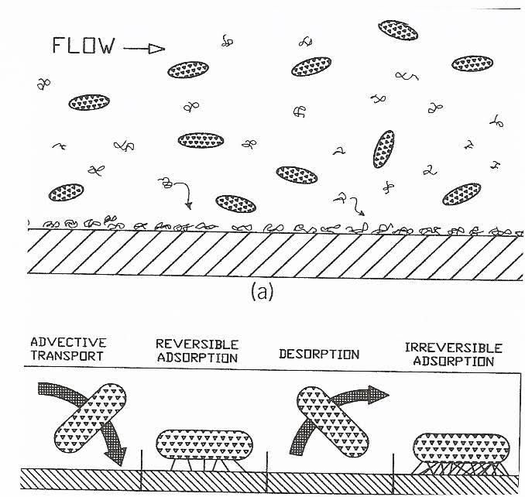
For most anaerobic biofilters for ponds, the biomass grows on a fixed film on the media in the filter. While this biofilm may seem just like a slimy layer on the media, even a thin biofilm contains millions of bacteria per square inch, many layers deep.
Misunderstood Pond Biofilm

The biofilm is an often misunderstood or a vaguely accepted terminology in pond lore.
In a biofilm (see Diagram 1), you will generally have a thin film of water that clings to the outside of the biofilm due to the adhesive and cohesive properties of water. It is these same properties of water that provide for capillary action in plants and help water get to the top of the tallest of trees.
Soluble organics, and some inorganics, like ammonia, diffuse into the biofilm through this layer of water. In the first layer of the biofilm, there is an aerobic zone. What determines the depth of the aerobic zone is the strength of the water in terms of oxygen demand and loading per unit area of the media, and the dissolved oxygen content in the water.
As the oxygen is consumed as it diffuses through the biofilm, and organic and inorganic compounds are still present, an anoxic section develops.
Diagram 1 — Process dynamics of diffusion and biological activity in a biofilm
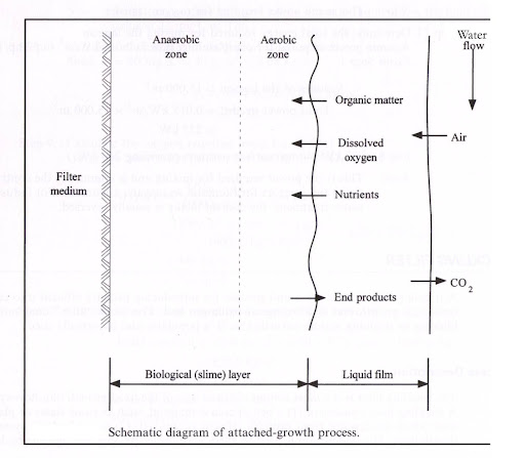
In this section, any oxygen-bearing compounds will be utilized as what is called “electron acceptors,” providing a means to oxidize the organic compounds to carbon dioxide, while reducing the oxygen-bearing inorganic compounds to nitrogen gas (from nitrates) and hydrogen sulfide (from sulfates). Fortunately, the utilization of nitrate is preferred over the utilization of sulfate, and most pond water will have more nitrate than sulfate.
The key to getting the correct dynamics in the anaerobic or anoxic filter is proper sizing of the filter with respect to loading:
If a filter is oversized, and the loading is too light per unit area of surface area, there will not be enough oxygen demand to create an anoxic zone. However, if the loading per unit of surface area is too great, the film may grow too thick and have a true anaerobic zone, which can lead to undesirable results.
So, the filter being oversized as well as undersized may give less than the desired results. In our experience, more people err on the side of the filter being undersized to try to save money.
Monitoring Nitrate Levels

It is fairly easy to track the efficiency of your ponds’ anaerobic filters simply by monitoring the nitrate levels.
A well-functioning anaerobic filter should keep your nitrate levels below 20 mg/L nitrate. If you find that the nitrate levels are not going down, or even going up if you have installed an anoxic filter, it may be helpful to add a bacterial product that contains effective denitrifiers to quickly establish the population.
We have had customers report going from 160 mg/L of nitrate to less than 20 mg/L nitrate after applying a bacterial denitrifying product.
While anoxic/anaerobic filtration is relatively new in the U.S. market, it has been popular in Europe for over 30 years. One of the main reasons for this is that it is generally much more expensive to do water changes in Europe. It is even costly in some parts of the U.S. And large-area ponds rarely, if ever, do water exchanges, simply because it is too much water to replace.
One thing to keep in mind is that in addition to doing water changes to lower nitrates, there are other criteria for doing water changes as well. These include phosphate levels and total dissolved solids (TDS) levels, as both can affect water quality and the health of aquatic life.
There are limits to how much phosphate can be removed biologically. The same applies to TDS levels, which at some concentration can affect the osmoregulatory systems of the aquatic life in your pond.
Phosphate can also be lowered by phosphate-binding water treatments, as well as vegetation, and through water changes. Lowering TDS levels requires either water changes to dilute out the dissolved solids, usually salts, or more sophisticated treatment technologies like reverse osmosis (RO) or ultrafiltration.
You are the specialist that will know the right size filter for your customer’s size pond, recirculation rate and fish load, for a clear water and healthy pond. Now, you have more information to give you the optimal outcome every time!
About the Author
Carolyn Weise is the customer relations manager for Ecological Laboratories, Inc. She studied ornamental horticulture at the State University of New York at Farmingdale. In 2006 she moved to Florida to work at the Cape Coral campus of Ecological Laboratories.