Following the waterlilies through history, art and imagination
By Rip Sokol, Fourth Generation Nursery
Winning a silent auction at the 2024 International Waterlily & Water Garden Symposium turned into one of the most memorable horticultural journeys of my career.
The prize was a five-night stay at the guest house at Latour-Marliac in Le Temple-sur-Lot in southern France, a place with deep roots in the history of modern water gardening. A year later, my wife, Ginger, and I boarded a flight to Paris and began a trip that would connect decades of my own work with the history of water lilies, Claude Monet and the development of the water garden as we know it today.

For a little perspective, I was born into a family florist, greenhouse and nursery business in New Haven, Connecticut. I saw my first pool at age 5, a brick-and-mortar display pond inside a greenhouse planted with tropical water lilies and Cyperus from Tricker’s in New Jersey. At age 11, under my father’s direction, I built my first pond.
College and a horticultural career eventually took me through six states, one province and six decades. For the past 37 years, my focus has been aquatic plant production, teaching and distributing pond equipment and supplies throughout the Northeast. I’ve been fortunate to make a living doing what I love, and maybe with another 60 years I’ll finally get the hang of it.
But back to France.
From the Symposium to France
The story really began in the United Kingdom in 2024, when Ginger and I attended the International Waterlily & Water Garden Symposium in Reading, England.
I’ve attended roughly 25 symposiums since 1992, and every one of them has expanded my knowledge of water lilies, Nymphaea, water gardens, water features and landscape design.
One of the traditions of the symposium is a silent auction of donated items, with proceeds helping support the organization. Most of us donate something, bid generously or, in many cases, do both.
Among the items that caught my attention that year was a five-night stay at Latour-Marliac. Bidding usually stretches over several days, inching upward until the final flurry of good-natured competition. I started with about a week’s pay.
Nobody outbid me.
And just like that, a year of planning began.
Thanks to our dependable crew, especially our managers Emily and Eve, Ginger and I flew to Paris on July 21, 2025. After an overnight flight from Boston, we arrived at Charles de Gaulle Airport late in the morning, collected our luggage and rental car and were out of Paris by midafternoon.
Our hotel was in the small town of Saint-Cyr-l’École, between Giverny and Versailles. We settled in, enjoyed some French cuisine and wine and slept like logs.
The next morning, we headed for Giverny.
Monet’s Garden

Walking into Claude Monet’s garden was, in a word, astounding.
We explored the village, the Museum of Impressionism, the cafes and cobblestone streets before entering Monet’s property. Within the first few minutes, it became obvious that Monet was not simply a painter who happened to own a garden. He was an accomplished garden designer and plantsman.
The 2.5-acre Clos Normand surrounding his home made that clear. Then we reached the adjacent water garden and lily pond, developed in the early 1890s, and that sealed the deal.
Most people have seen Monet’s paintings of his gardens and water lilies, but standing in the place that inspired them creates an entirely different appreciation. His series of water lily paintings, created over decades, helped turn the pond into something more than a garden feature. It became an artistic subject in its own right.
If you’ve never taken the time to study Monet’s garden paintings closely, do it. Spend a couple of days with a book or two about his gardens and artwork. For anyone who designs landscapes or water features, it can be a valuable way to reset your eye and refresh your artistic instincts.
What struck me most during the visit, however, was not simply Monet’s painting ability. It was his influence.
A century before the internet gave us the word “influencer,” Monet was already one.
He loved his gardens, and that love is obvious in his paintings. As people saw those paintings, they fell in love with the gardens, the ponds and, especially, the water lilies.
When Water Gardens Changed

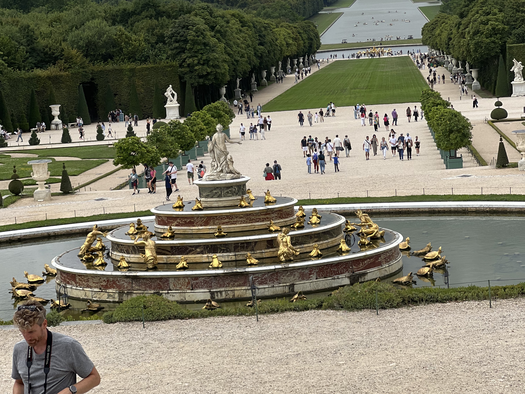
Water in the garden was not a new idea in Monet’s time. Formal fountain pools and reflecting pools had long been common throughout Europe. We saw plenty of them at Versailles.
They were grand, symmetrical and appropriate for royalty.
Monet’s pond was different.
It was naturalistic, heavily planted and designed as a place where people could connect with nature and find a sense of tranquility. Instead of presenting water as architecture, it presented water as a living landscape.
And then there were the lilies.
The colors were unlike what much of the gardening public had previously seen.
In 1854, French botanist Charles Lemaire asked whether it might someday be possible to create a new race of water lilies by crossing hardy white forms with blue- or red-flowered Nymphaea.
At the time, explorers had already collected and identified several hardy species, including white and pale pink forms, along with tropical species in yellow, red, vivid pink and blue-violet.
But hybridization had its limitations. Species within compatible groups could be crossed, while crosses between hardy and tropical groups were not possible using the methods available at the time. For generations of hybridizers, the dream of a blue hardy water lily became something of a horticultural Holy Grail.
That challenge captured the attention of Joseph Bory Latour-Marliac.
Coming from an agricultural and botanical family, Latour-Marliac began experimenting with aquatic plants and eventually opened a specialty nursery in 1875 focused on water lilies, other aquatic plants and bamboo.
His timing could not have been better.
By 1889, Latour-Marliac was exhibiting colorful new water lily hybrids at the Paris Exposition. Monet’s Japanese-inspired water garden followed soon afterward, and many of Latour-Marliac’s hybrids eventually found their way into Monet’s pond.
The connection between the two men helped change horticulture.
Monet was, in modern terms, an early adopter. His famous paintings of the water lily pond helped establish the lily pond as a desirable element in garden design. Bright reds, deep pinks, vivid yellows, oranges and tropical blues appeared in his later paintings, accelerating public interest in water lilies and water gardens.
Other influential horticulturists and designers were part of the same broader movement. Gertrude Jekyll, William Robinson, William Tricker and Frederick Law Olmsted were all connected, directly or indirectly, to the horticultural exhibitions and design ideas circulating during this period.
Water gardens began to gain popularity rapidly from the 1890s into the early decades of the 20th century.
They were beautiful, but they were not necessarily accessible.
Creating one required expertise, specialized construction, mail-order plant purchases and, in many cases, a sizable budget.
That would change decades later.
Back to Latour-Marliac

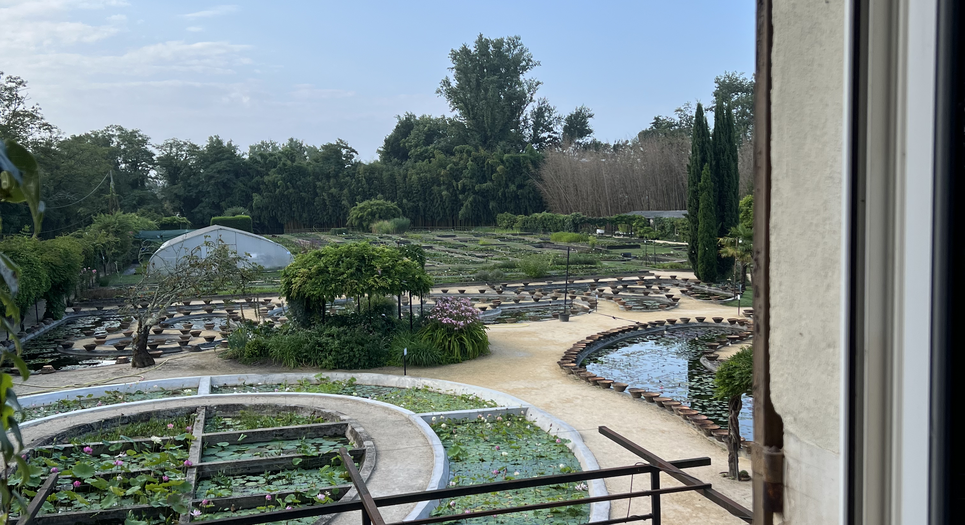
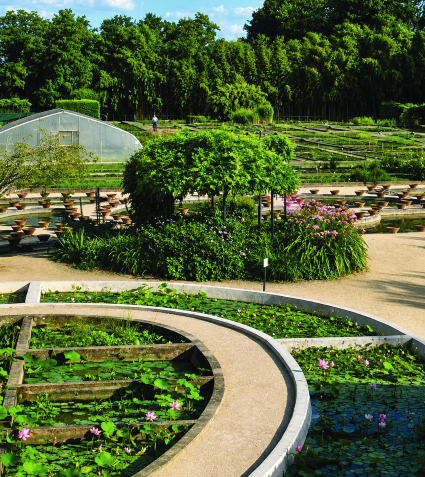
Walking through the gate of the guest house at Latour-Marliac and looking out across the roughly 4-acre nursery felt like stepping back 140 years.
Dozens of concrete-lined pools were filled with hundreds of cultivars and multiple species of hardy Nymphaea. Only a small number of pools contained tropical water lilies, lotus or other emergent aquatic plants.
During the day, we watched visitors, customers and staff wander among the pools.
Many were mesmerized by the flowers and foliage. Birds, pollinators and amphibians moved casually through the same landscape.
Some visitors carried cameras. Others had pencil and paper in hand as they planned gardens or placed orders.
Staff members cut, wrapped and prepared plants for customers to take home to new garden ponds, much as workers might have done generations earlier.
That was one of the things I found so compelling about the nursery.
It is not simply a historical site. It is still functioning.
The plants are still being grown, selected and sold. Customers are still choosing lilies for their own ponds. The same basic passion that drove Monet, Latour-Marliac and generations of water gardeners remains alive.
During the evening, the experience became even more memorable.
Once the visitors had gone, Ginger and I often had the grounds almost entirely to ourselves, aside from the wildlife.
The last flowers would begin closing. We’d walk through the nursery with a glass of wine in hand, surrounded by the quiet of the gardens.
Dinner in France tends to come later than we are accustomed to at home, which gave us plenty of time to enjoy the nursery before heading out for a meal.
Those evenings gave me time to think, not just about the history in front of us, but about the decades I had spent in the water garden industry.
A Lifetime Perspective
After World War II, homeownership grew dramatically in the United States, but residential landscapes were often sparse and simple.
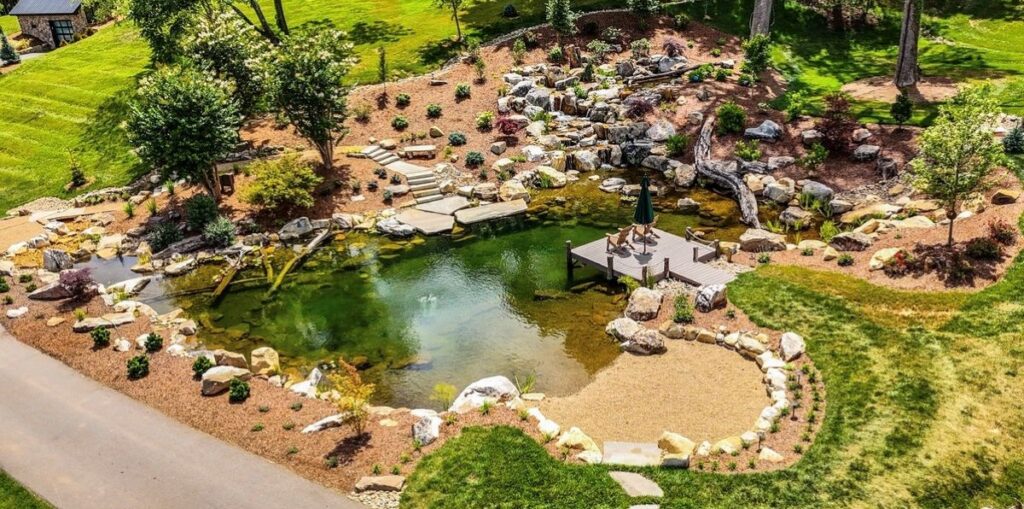
Ponds were generally associated with grand estates, public gardens or wealthy property owners. You might see them at a Rockefeller or DuPont estate or in a well-funded botanical garden, but they were not yet common in the average backyard.
By the late 1980s, that began to change.
Around the same time we started our current business, roughly a century after Latour-Marliac introduced his colorful hybrids, two developments helped transform the pond industry.
The first was the availability of user-friendly, economical pond liners, pumps and related equipment. Pond construction became simpler and more accessible to homeowners.
The second was the growth of regional sources for established aquatic plants.
Together, those changes helped create a rapidly growing community of garden pond hobbyists.
A decade later, after thousands of classes taught by myself and many others in the industry, landscape contractors increasingly joined the movement. They brought with them customers who wanted the experience of a water garden but preferred to have someone else design and build it.
Manufacturers and distributors seemed to pop up faster than dandelions in spring.
And the industry grew.
Don’t Forget What Started It All

That growth has brought tremendous advances in pond construction, filtration, circulation and maintenance.
Those things matter.
I’ve seen hundreds of beautifully crafted waterfalls, streams and ponds created by exceptionally talented artisans, and we should continue to celebrate their work.
But there is something worth remembering.
On my first trips with the International Waterlily & Water Gardening Society to the United Kingdom in the 1990s, we saw water features intertwined with mature plantings that were absolutely stunning.
The plants were not an accessory to the pond.
They were part of the composition.
In our modern industry, construction techniques and equipment can sometimes take center stage. Yet it was the beauty of the water lilies, along with the fish, that first captured people’s imagination and helped launch the water garden movement in the first place.
Monet understood that.
Latour-Marliac understood it.
And the best pond designers today understand it, too.
A waterfall can be beautifully constructed. A pond can be technically perfect. The filtration can perform flawlessly.
But if the finished landscape lacks plants, texture, color and seasonal change, something is missing.

The most memorable water gardens are not simply collections of stone, liner, pumps and plumbing. They are living compositions.
Plants soften rockwork, frame views and change the character of a pond throughout the season. Water lilies add color and movement to the surface. Marginal plants connect the pond visually to the surrounding landscape.
Together, they make the water feature feel established rather than installed.
That is a lesson worth carrying forward from Monet’s garden and from Latour-Marliac.
Give every customer the most beautiful pond you can create.
Artists are remembered for the finished masterpiece, not for how many tubes of paint they used. In much the same way, our customers remember the beauty they experience, not the square footage of liner beneath the water.
Don’t neglect the plants, in the pond or around it.
They complete the composition.
And don’t leave money on the table.
About the Author
Rip Sokol is the owner of Fourth Generation Nursery and a lifelong horticulturist whose career has spanned six decades, with the past 37 years focused on aquatic plants, water gardening and the pond industry. He built his first pond at age 11 and has since dedicated his career to aquatic plant production, education and the distribution of pond equipment and supplies throughout the Northeast.