
Almost every water gardener that I know has raccoons (Procyon lotor) prowling around their water gardens or fish ponds. This includes both rural and urban pond owners. As they say, if you build it, they will come. Coons love water, but chances are they were probably already there, because they are so adaptable and people have created superb habitat for them in so many ways. They love sweet corn, garbage, pet food, compost, bird food, warm chimneys and the list goes on and on.
Raccoons are common over all of North America with the exception of the Rocky Mountains higher elevations and some areas of the arid Southwest. They are more numerous and more widely distributed now than they were in the 1800’s, most likely due to the changes humans have made in the raccoons’ environment.
Recognizing Whether Raccoons Are the Problem
I would like to discuss clues that will help you determine if a client has a problem with raccoons. Since they are nocturnal (active primarily at night), they may not be spotted eating fish or damaging plants, and only the signs left behind will tell you what’s happening. Their footprints (either muddy or still wet in early morning) are sure evidence of raccoons. Of course, the client, or you, must be able to determine if they are coon track. They are distinctive. Please refer to Figure 1.
Raccoons are very destructive when they are foraging for fish. Telltale signs of their activity include tipped over potted plants, or water lily leaves that are torn up and in disarray.

Missing fish could also indicate raccoon predation, but this usually only happens when the pond edge is shallow or sloping or the pond is so small that a raccoon can easily stand in it and catch fish. Remember that a lot of other critters eat fish so this fact alone does not always indicate that raccoons are present.
Preventing Raccoon Damage
The best way to control the damage done by raccoons is to prevent them from getting to your fish. Before even a shovelful of dirt is turned, while the pond is still in the planning stages, is when the best precautions are made. Anybody that has been in this business very long quickly learns that sloping edges on a pond invite wildlife in to explore. Most naturally occurring bodies of water have this type of edge and so wildlife, like raccoons, can easily enter a pond and cause damage. Plan on building the edge of your pond so that it drops immediately to at least one foot in depth. I have seen references say that at least two feet of depth are needed, but I know that one foot will work great. (The one foot depth also is safer for children.) This way, when a coon wants to catch fish in this type of pond, he has to go swimming. I have always said that when a coon is doing a backstroke he cannot catch fish easily.
On many occasions I have seen a properly designed pond with one foot ledges, where a raccoon has entered the pond, swum out through the water lilies about 5 to 7´ and then immediately headed back to shore. It is easy to see the trail through the displaced water lily leaves. This may only happen one or two times during the season. On all occasions there has never been any fish lost, at least, any that we know of. Believe me, if they were snacking on fish they would be back every night.

Garbage cans and dumpsters need to have lids and covers that coons cannot open. Bird feeders and sweet corn patches will also attract them. My experience tells me that once the coons find a food source, they will continually check it out for months even after it has been removed.
Controlling Raccoon Damage
So, you know that you already have raccoons, now what can be done? There several techniques that will work to keep them from doing any damage. Unfortunately, there is usually some kind of disadvantage to each of these beyond the effort involved to create them. Again, prevention is much easier.
Keeping a large dog that has free access to the landscape where the pond is located, at least during the night time, works very well. Great deterrent, but not all people are able or want to do this.
Installing an electric fence will also be very effective. Most of the time one wire only 6 in. off the ground around the pond will work very well. Sometimes two wires may be necessary. Two wires off the ground 6 in. and 12 in. will keep all coons out. The system can be on a timer so that it is on from dusk till dawn. It is wise to install a disconnect switch on the system in case you want to access your pond at night. Electric fencing works but it can be an eyesore. The obvious disadvantage is the wires going around the pond, but I have seen some very effective systems that did not look all that bad.
I have one client that likes to cover his small water garden with 1 x 1 in. welded wire at night. He does not have any upright marginal plants that will interfere with the wire. This is really only practical for smaller ponds.
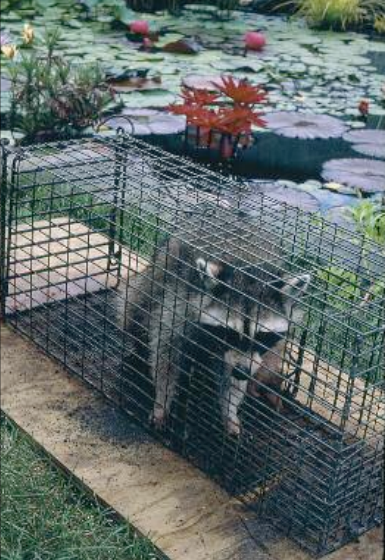
The last resort for taking care of a raccoon that has decided to make your garden his home, is the technique of box trapping the critters. I am not advocating this technique in the spring of the year when sows would have young back in the den. Always check local regulations concerning trapping before you begin. Use a 12 x 10 x 32 in. single door box trap that is well built. Tomahawk box traps are very good as well as the professional grade of Havahart box traps. Some of the cheaper versions will hold a coon for only a few minutes. They are a very strong animal and traps made with light gauge wire will not hold them. Bait the trap with cheap sardines that are packed in oil, not tomato paste.
Think about “what you are going to do with the coon” if you decide to box trap them. I would encourage you to euthanize the animal instead of translocating it and this is why – in some states you legally cannot release animals in an area that is different from where it was trapped. Nobody else wants your problem. Besides, if you move a box trapped animal it is important to move it 20 to 30 miles. Otherwise, the coon could beat you back home. Any shorter distance and you are simply releasing the animal back into its own home range.
Techniques for Controlling Raccoon Damage That May Work for Awhile
A motion activated water sprinkler (Scarecrow), placing capsicum pepper around the pond, playing an all night radio talk show and/or leaving a light on may work. At least until the raccoons get used to them. I can visualize a raccoon, listening to the radio, eating your fish sprinkled with capsicum pepper and being able to easily see you coming because of the light. Then his sprinkler shower would be over.
A technique that I have not tried yet, but want to, is to cover very hot peppers (like habanero) with peanut butter and place them around the water garden. I suspect that these would be avoided in time and they still will dine on your fish.
So What is the Final Answer?
If a pond is designed and built correctly with steep edges that go immediately down to one foot, then raccoons are not a problem. This is where you can serve your clients the best. Plan it right to begin with.
If bird feeders, garbage or pet food attracted coons initially, then the problem can be corrected within a short time frame by removing the attractions and then box trapping the coons. Of course, using electric fencing or a large dog also works, but these are not always the answer.
Whenever I deal with any wildlife species there are always exceptions to the “rule.” They can be frustrating at times, but the above techniques will work the majority of the time.

Good article. Properly built, coons will not be a problem. By properly built, I mean just with the author said, it should be deep enough so that the coon cannot stand in the shallow area and wait for the fish to swim by where he can grab them. The same method will also keep birds from getting into your pond unless they are very large.
Interesting article. Thank you! I have a small pond with Koi, shabunkin, gold fish, comets and they had babies this year! I have had a pond for 22 yrs. I had to cover it with bird netting years ago due to kingfisher and heron stealing my fish! It was tie wrapped to narrow plastic PVC pipe with elbows at ends sitting on LONG heavy nails into the ground. Now, I have a raccoon swimming in my pond (caught him on film), stepping on the netting and walking around on it which makes it go down into the water! He has managed to get at least 1 fish. I am about to make a chicken wire cover, and I hope this works. I have 2 small dogs and 5 cats but keep them all in at night. One of the dogs would probably eat the peppers as he about eats anything! Anyway, wish me luck:)
Having a problem with these vermin for years have left me very frustrated, but I think I have found a solution. I installed a motion sensor light next to my pond and coupled it w/ a radio. As the bright light is triggered an unexpected high volume of radio static or rock n roll music is suddenly manifested scaring the intruders away.
I do like your set-up. I also have seen this work well but in other situations the raccoons became used to the lights/noise and ignored them. I think I saw those coons dancing to the music in the spotlight. 🙂 I am just kidding, of course but if they really want something they will go for it. Jamie
We bought a home with a pond that was covered in chain link like a dog kennel. I removed the fencing (not worth having a pond if it looks like a prison for fish…) and laid green plastic mesh over the water while I decide what to do next. The pond is about 18″ deep and roughly 6×6 in size. The sides drop straight down. I’ve lost dozens of fish, mostly due to the small size of the pond and the fact that the coon can just wade in and stand in the water.
I’m digging a whole new pond, at least 36″ deep with more than a foot straight drop from the edge, and considering an electric fence.
Good idea to dig a deeper pond with the foot straight drop from the edge. I know the electric fence can be always added later. Jamie
I built a pond with straight sides; it’s 2 feet deep, but after years of successfully fending off the coons with a Fido-shock fence, one big one has killed my two oldest and largest koi (about 7 pounds each, so I know it’s a big thief.) The shock fence had only surrounded the most vulnerable sides; now I will extend it.
This particular thief has an M.O.: probably leaning over a rock, and patiently waiting until my ocean-liner specimen swims near the edge; he doesn’t have to lean over very far, as the carp swims near the surface at times. He probably catches it by the tail, and bites its snout. The next day, I find the poor victim on the bank behind the pond, its tail de-fleshed and snout ravaged. Its fat body is still intact.
Using a several-pronged approach, I found some fence spikes, made of polypropylene, which I will glue or nail to the top of the fence surrounding the entire garden. I do not want my dog to one night be attacked, as she runs out her doggy door to see what’s going on.
I will also install a camera, in case those thieves are not deterred.
Hi Jo
Are you sure that it is a raccoon catching your Koi? Normally a coon will eat the entire fish or at least carry it off to its den to finish later — especially a “big” coon.
I would suspect a mink may be the predator. The M.O. fits better. Your camera will tell you but so will wet footprints on the rocks around the pond. Look for them at sunrise before the tracks evaporate.
Keep us posted. Good luck
My 70 gallon pond is a black plastic kidney shape, a foot + edge, a foot wide ledge on either side, and 2 feet deep in the middle. The raccoons come every September extracting all the floating globes, pulling out the pump, sometimes carrying pieces away.They’ve been particularly destructive this year, introducing cups full of dirt, and tearing up everything about a foot from the edge of the pond. It’s OK, except for the dirt is hard to get out, and destroys the plastic parts of the impeller.
I don’t mean them harm, but just trying to guess what they’re looking for. I haven’t had fish in that pond for more than a decade.
Hi Jenelle
It is interesting that raccoons are a very curious critter. They do love water whether there are fish in it or not. All animals need water and while coons are there they will play in it as well. You are a very patient and forgiving ponderer. Most people would be very upset with the circumstances.
An easy solution like I mention in my article is to take a piece of welded wire (1×2 inch or 2×2 inch) that is large enough to cover the pond at night. It should be easy enough to place it over the pond in the evening and then pick it up in the morning. You can get creative with your “cage” like hooping it or whatever. Easy, cheap and will normally take care of the problem. There are always exception to “rules” when it comes to wildlife so I think that this will solve your problem but…
Good luck. Jamie
I have learned by experience by trying various methods that there are just a couple ways to keep raccoons from eating my pond plants and making a mess of everything. It may not be pleasant to many people, but I have found that:
#1 Live trap them and relocate them a far distance from your home. (Not my favorite way)
#2 Live trapping them and then permanently disposing of them.
#3 Just shoot them. There are quiet 22 cal. shells available that work well in residential areas.
Totally unnecessary, disgusting, and cruel. Why would anyone recommend this?
After 75 years I put in a pond this last year. It is 16‘ x 21‘ x 4 1/2‘ deep with straight walls all the way around. I live in the country and we have raccoons but they did not bother me last year. Should I worry about them since there are no ledges for them to stand on, and if so, will netting help?
Hi Pete
Generally speaking, you should not have an issue of raccoons catching your fish with a properly designed pond like yours. When it comes to nature and wildlife there are never any absolutes but in your case, I think you are safe. Problems with coons in your situation would be if you have potted marginal plants that the coons can stand on and then wait for a fish to swim by. The major damage in this situation is to the plant and you may lose an occasional fish.
If netting is used then it needs to be stiff netting (wire maybe or well supported) as the coons can possibly walk on it causing it to sag into the water. I am not a fan of using netting since it destroys the aesthetics of the pond. Simply put, it is ugly in most cases. However, I do not think you need to use netting anyway.
I want to remind you and everybody reading this is to not invite coons to your backyard by feeding pets outside, feeding the birds or throwing table food scrapes on the compost pile. Also make sure you have a good relationship with your neighbors to not be doing these things as well. Once the coons have set up residence it is very tough to discourage them to leave. Yes, ponds are attractive to begin with but if they do not have access to your fish then they become disinterested and normally would leave. Again, with your pond I would surprised if you had much of an issue with these critters but if they become desperate for food especially when they have young then who knows what they will do to your pond.
One last thing since the price of raccoon pelts has declined due to loss of demand by Russia and China for a host of reasons. Because of this hunters and trappers are not pursuing them as they used to, and our coon population is exploding. We will see a higher incidence of diseases in them but the number of conflicts that humans have with them will escalate.
Have fun water gardening. Jamie
I was lucky when I built by little concrete pond. It is 2’x5’x26″ deep with vertical walls. I have not lost any fish in 15 years but the coons are in every other night or so trying. I recently added 2 water lilies and as they have grown to the surface, the coons have chewed them up bad. I think I’d like to try the 1″ wire mesh “cover” method you speak to but need to know if I need to “lock” it in to ground stakes or weight it so the coons cannot lift it high/move it aside enough to get to the water…or is such a size of wire mesh heavy enough? The concrete edge around the pool is 5″ wide of uniform height so a wire cover would lay/snuggly fit pretty well.
I live in SoCal at 2600′ next to a golf course and have 26 fruit trees so have lots of coons. I set 2 live traps last night and caught one coon. It’s now 4:30 am as I wind down in my frustration.