

There is no doubt that we are living in changing times. Some 20 years ago, the modern U.S. pond movement was well underway, escalating in sales and progressive technology. Business empires were built and new manufacturers appeared. Then, about five years ago, the recession took a toll on all businesses, including those in the pond world. About a year ago, the recession began lifting and the pond world began to pick up.
Then, a new challenge began. At first it crept slowly, but it has recently gained momentum that is threatening to unseat the popularity of ponds as part of the outdoor living experience. The challenge is real … and it is known as the Mega Drought.
How bad is this drought? For the first time in American history, over half the United States has declared drought. For the first time in California history, the entire state is under drought and the Governor has declared a historic 25 percent mandatory water reduction. The result? People are now taking shorter showers, irrigating landscapes only one or two days per week and draining water features. Many cities have put residents on notice that, if the drought continues in its persistent ways, all outdoor watering for landscaping purposes will be outlawed. Many fountains have been drained in public places such as malls and government buildings.
Is this drought as serious as it is being portrayed? The top water scientist for NASA stated in February of this year that California has one year left in its water reserves. Yes, it is as bad as people are reading, and this is the tip of the iceberg.
On another front, drought means less water for growing food crops. Did you know that 65 percent of the fresh fruits and veggies grown for the United States come from central California? Drought means significantly higher food prices. Higher water prices, higher food prices … and soon ponds may be villianized like turf grass, where local city governments are paying homeowners to remove their lawns and install native succulents and cactus.

We have heard that the carbon footprint needs to be reduced. We can do this by driving less. One way to help fight carbon emissions is by growing our own food, or at least a portion of our food. Think about it: the average tomato travels about 1,000 miles to go from farm to table. The environmental cost to make this happen is very great. Growing our own is good for the environment and the only way we can be sure we are getting organic, non-GMO, pesticide/herbicide-free food.
Agriculture accounts for about 80 percent of water use in California. So when people ask if there’s a way ponds can help, the answer is a resounding “Yes!” This can be achieved by incorporating aquaponics into our ponds. Aquaponics is the practice of growing food with pond water. Many cultures have done this for centuries. However, modern technology makes it possible to do so with the added benefit of recycling and reusing the same water over and over.
Many people get excited when they think of the practice of using “greywater,” which is washing clothes or taking a shower and then piping the wastewater to the landscape. This results in water being used twice. This is a great idea and is being hailed as a great example of sustainability.
Aquaponics, if done right, will recycle and reuse the same water not twice or three times, but 100 times over. It seems like a dream come true, and that is why I wrote this article — to show that dreams do come true! What might be viewed as a problem is really part of the solution.
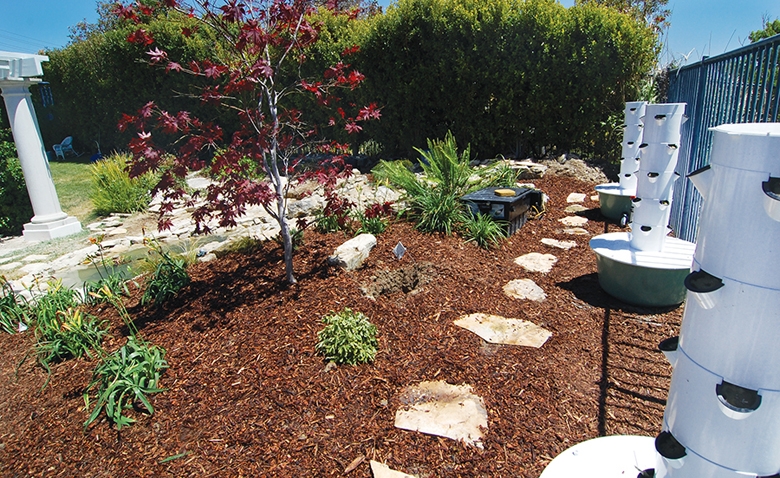
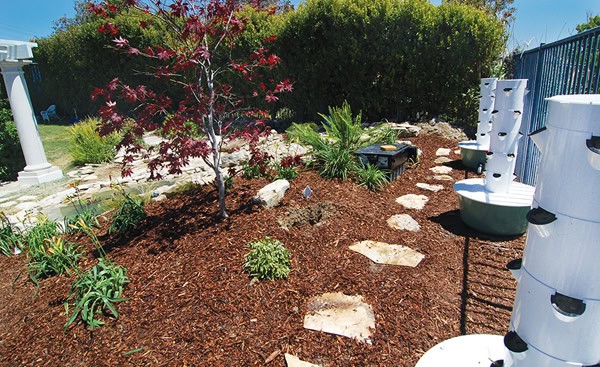
We have been building our water gardens and koi ponds as we always have, but we now add a second small pump by pond boss, which will feed the nutrient-rich pond water to aeroponic systems, which we convert into aquaponic systems.
[box]>> Sidebar | Greywater and the Pond World[/box]
Aeroponics is a lot like aquaponics…however, aeroponics uses tap water and liquid fertilizer. An aquaponic system pumps pond water directly to the veggie roots, then back to the pond. This is a closed-loop system, resulting in about 95 percent water savings over a traditional soil garden!
A head of lettuce is very water-intensive and takes about 100 gallons to grow from seed to salad. But in an aquaponic system, growing the same head of lettuce from seed to salad takes about three gallons.
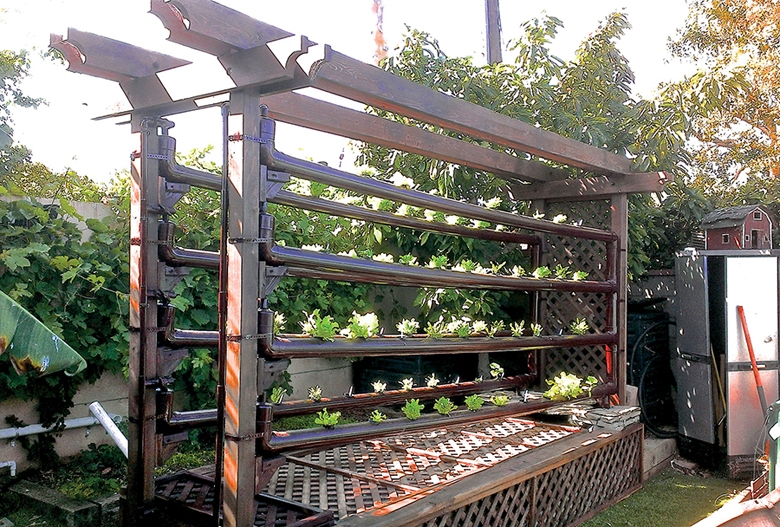
We like vertical systems because growing vertically saves space. Growing vertically also helps keep pests at bay. We put a timer on our vertical gardens, and the magic formula is a running time of 15 minutes on and 15 minutes off, 24/7. Food will grow two to three times faster due to increased oxygen levels. No composting. No weeding. And best of all, the University of Mississippi did a study of this type of growing and found that food grown in these types of systems are more nutrient-dense.
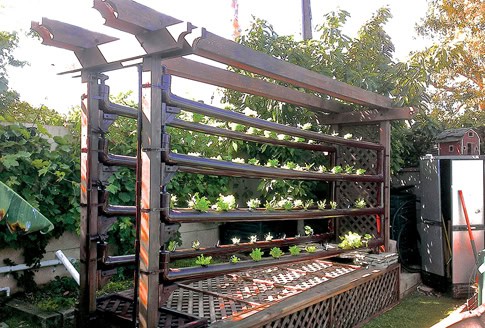
What is the downside? If you don’t harvest, the food will turn to seed! Eating from your garden is never a problem.
If you decide that being a part of the solution is where you want to take your company, build a vertical aquaponic system, then make YouTube videos of the process and post pictures to social media. You will become part of the solution and portray ponds in a good light. Together, we can all make a difference for our customers, our businesses and our health.