In front of a Southern California water company stands a huge concrete fountain that holds about 2,000 gallons of water. On a typical day, this coastal fountain can be heard from quite a distance as the soothing
sound of water colliding with water — with a glimmer of sunshine to light up the display — is quite impressive.
Currently, however, this beautiful work of water art stands empty. Nearby, an explanatory sign reads: “Due to drought, this fountain has been emptied” — as if to imply that water features contribute to the drought and are not a good thing in dry times.
Whether or not one agrees with the sign, here are the facts as presented in a recent series of New York Times articles covering the drought:
- For the first time in history, California farmers can expect no water from the federal government. This is a historic first.
- California is America’s panhandle, and 75 percent of America’s produce comes from central California.
- In 2014, over 800,000 acres (over three quarters of a million acres) will be left unplanted due a lack of life-sustaining water.
- No water = No Crops. Expect food and clothing prices to spike unlike anything we have ever seen.
- Less water means higher water prices way higher, since the law of supply and demand applies here.
- Historically, Los Angeles gets an average of 15 inches of rain per year. The record low, back in 1947, was four inches. Last year, Los Angeles set a record low of three inches of rainfall.
- The cost of pumping water to Southern California consumes about 20 percent of all electrical costs consumed by the state.
- The cost of meat will skyrocket since it takes billions of gallons of water to grow the food needed to keep the animals alive.
While some may question the propriety of installing ponds and waterfalls, one thing is certain: the need for water conservation is here to stay. And what many don’t know is that the same technology that is used to build ponds and waterfalls can actually be used to help out in drought situations. How? By the implementation of Rainwater Harvesting Systems.
Water: An Ancient Need
Rainwater harvesting dates back before
recorded history. As early as 6,000 B.C., civilizations were capturing rainwater and reusing it for irrigation. The Romans built and used cisterns throughout their empire.
The cisterns were fed by a network of aqueducts and were used for drinking water and irrigation. In modern times, we remember rain barrels our parents used to capture rainwater that fell on the roof, only to be used later to water herb or flower gardens. Then the municipal water agencies came along, which supplied inexpensive water for irrigation systems, and the need to harvest rainwater became obsolete … or so we thought!
Modern Rainwater Harvesting
While rain barrels are a good start in saving rainwater for future reuse, modern methodologies from the pond world have improved on the standard above-ground water tank by offering underground solutions.
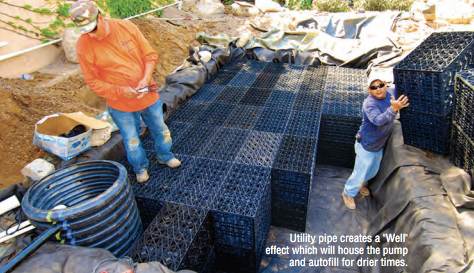
Constructing underground cisterns saves valuable space for planting and hides the typical eyesore rain barrel that needs to be screened! Above-ground rain barrels are limited due to size constraints. The underground cistern is unlimited in its storage capacity due to the use of a recycled plastic tank (cube) that looks like a milk crate. The tanks typically hold a water storage capacity of 30 gallons or more and can be stacked in a Lego fashion. The tanks are designed strong enough to hold traffic-type weight loads when engineered properly. You can install them under your driveway or even under a parking lot!
How much water can you save? On average, a 1,000-square-foot roof will yield about 625 gallons of rainwater for every one inch of rain! At this rate, a 1,000-square-foot
roof in dry Los Angeles would yield close to 10,000 gallons of rainwater in one season.
With the cost of water prices rising, this is beginning to make more sense.
Getting Started
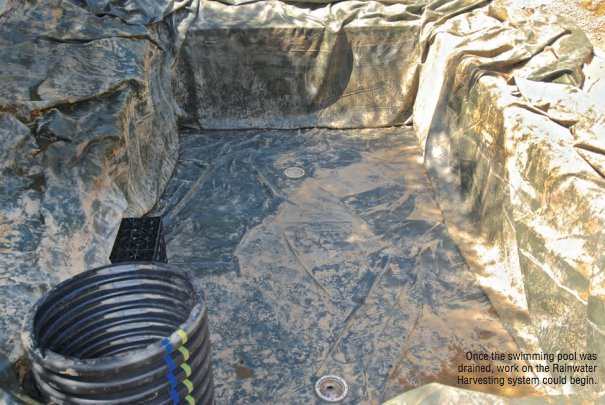
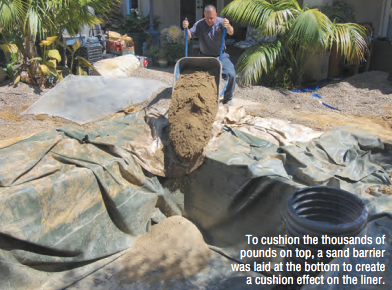
Let’s say you would like to install a 500-gallon underground rainwater harvesting system in your backyard. You would begin by figuring out how many tanks you would need to accomplish your goal. If each tank held 30 gallons of water, you would need about 17 tanks to reach your target. Depending on the size of your tanks, you would need to dig a hole big enough to accommodate the tanks and accessories. You would begin by digging the hole, and once this was finished, you would install a sand base to absorb future land movement. A geotextile fabric would then cover the sand, and then the 45-mm EPDM liner would go over the fabric. As a precaution, we like to add another layer of sand over the liner and another layer of geotextile fabric over the liner as well.
At this point, you are ready to begin installing the tanks. Make sure that the tanks are installed according to manufacturers’ specifications, as installing the wrong way could lead to tank malfunction. A “well” consisting of at least 18 inches pipe can now be installed standing up, and this will house your pump accessories as well as the autofill for dry years. The entire system is wrapped in geotextile fabric to make a “box” look. All is wrapped except for the “well.”

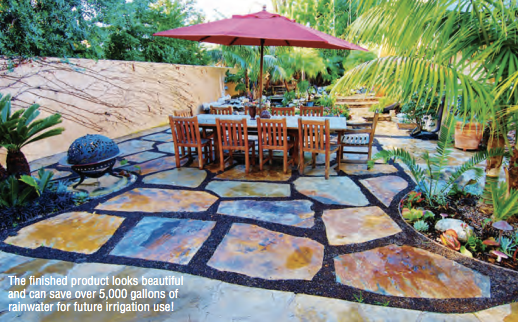
You have many different options as to how to make a final cover for your tanks. Perhaps you would like a patio on top? Or perhaps it makes more sense to locate your system under your driveway. The options are endless.
How is rainwater retrieved? Through the use of an irrigation pump. It makes the most sense if the irrigation pump is used to send water to drip irrigation. This way the most water efficacy is achieved. Rainwater can be used with native or drought-tolerant gardens, and modern technology has given rise to the advent of vegetable gardens that recycle and reuse water!
In times of natural disaster, it may take weeks before first responders can help. You
can live awhile without food, but water is a daily essential! A full rainwater harvesting tank can make the difference in hard times.
There are a couple of other advantages that are sometimes overlooked. First, fire protection in rural areas not serviced by hydrants can, in some areas, require 10,000 gallons. When I talked to the fire chief in my area, which just experienced two devastating fires, the chief pointed out that none of the structures lost had supplemental water available. Conversely, every structure that did have supplemental water was saved.
When the pumper truck shows up, they only have a limited amount of water to fight the fire … and when it’s gone they have to leave. Having the extra water supply could be the difference between losing your property and having something to go home to.
Underground cisterns don’t need engineered pads to hold the tanks and don’t clutter up your view. The other advantage would be that in areas that could lose water service in a disaster, cisterns would be a great resource of potable water using some commercially available purification devices. Earthquakes are a good example of a disaster that could disrupt water mains for quite a while.
Rainwater Harvesting and Your Business
In a very depressed economy or a drought, the first things to be eliminated are the disposable income items, such as ponds and water gardens. The really great thing about installing rain harvest storage systems is that the same tools and manpower are needed to install both kinds of systems. If the economy has resulted in your receiving fewer calls for water feature work, why not consider diversifying and riding the green wave?
Seriously take a look at rain harvest storage system installation. The drought and the economy don’t mean the end is near; to the contrary, you can find opportunity in any dark cloud. Remember, if you want the rainbow, you have to put up with the rain! In our case, the rainbow will come if we capture and use rainwater sensibly.


This is definitely a great idea for anyone living in California!
Who makes the tanks and where can I find them for sale? Cost? Thank you for your help!
Hi Ann
These tanks are a available through Atlantic Water Gardens and you want to look for atlantic water gardens “eco-blox water matrix” which are available @ http://www.pondliner.com
I like your point about potentially storing your water tank under your patio or driveway. My wife and I were thinking about installing a water tank in our home to help water our garden. We might think about storing it underground like this so it doesn’t take up room in the yard.